The Myth of the Truly Isolated Man Is Dangerous, Research Time, 01/08/2014

I’ve been working on a lot of projects since returning from Eclipse Festival last weekend. I’ve gotten back to work at my freelance editing gig, am finishing up the edits to my play script You Were My Friend, preparing for the actual launch of Under the Trees, Eaten, and starting work on a feature film script adapting my old short story about Alice. Also, I’m reading philosophy. Never stopped through the festival, as I would quite often chill by our tent or walk to the chillout stage to read. 

Rousseau was the most liberatory of the
social contract theorists. Even so, he put
people in more chains than he thought.
But Mikhail Bakunin offers more and more philosophical surprises, one of which is a profound denunciation of social contract theory as the central concept of political philosophy. I call it a denunciation because it isn’t exactly an argument in the formal academic sense. Bakunin wrote philosophically dense polemics and speeches, not academic articles or books. His deep thinking and creative concepts animated his writing, but they were always for a different kind of audience and context of delivery than the institutionalized academe of 19th century Europe.

So he doesn’t choose a particular foundational text to analyze per se. Instead, he identifies the main schools of his time’s social contract theory of politics, drops the names of a couple of key authors, and proceeds to target the essential form of the concept, the premises that are invariant across all the different approaches and frameworks a theorist may take while still calling their creation a social contract theory. In a way, it reminds of what Gilles Deleuze does with his philosophical analyses, except with language that is far more direct.

That core premise is that humanity only became social with the foundation of the contract, constituting a proto-state. As a result, the state becomes understood as the primary form of human association. The only means humans have of genuinely keeping order are, therefore, the authoritative arms* of the state like police, schoolteachers, bureaucrats, and the military. Laws, law givers, and the enforcers of law. 

* There are, in English, two key senses to the word ‘authority.’ One is the authority of an expert, and the other is the authority of a political-military power. You obey the former in deference to their knowledge, the latter out of fear for your life. I think I’ll have to incorporate a little Joseph Raz into this dimension of Utopia’s theorizing.

Bakunin denounces this as simply a falsehood: Humans have always lived in social groups, their members cooperating with each other for a common good. We as individuals were born into these groups and raised as members, negotiating our individual identities in dialogue with the social forces such as ethical obligation, pressure toward fairness, and the complex bonds of family, friendship, and community. Contemporary evolutionary and anthropological research has borne out the empirical truth of this notion. Instead of laws dispensed and enforced through authorities and their institutions, we governed ourselves through customs that were always subject to adaptation to changing circumstances or spontaneous transformation through the critical powers of thinkers. This is a conception of politics as immanent to political life itself.

Even in our earliest days, humanity was a social creature.
 It’s fitting that Bakunin initially choose Rousseau’s social contract theory as the primally focal theorist for his conception of social contract theory. He spends much of the relevant section of the essay “Federalism, Socialism, Anti-Theologism” railing against the presumption in most social contract theories that humanity would be inescapably violent to each other without submission to the authority of a state. But this is because of the polemic nature of his style.

Rousseau’s social contract theory is an exception to the principle that a society before the state is necessarily violent. Pre-state people, for Rousseau, are happy and peaceful. And he even describes the social contract as putting humanity in chains. But Bakunin chooses him as the key representative of the theory because, even in their happy pre-state sense, humans are still conceived as isolated. They are naturally individuals. 

Bakunin opposes this, because he understood intuitively, more than a hundred years before scientific confirmation, that we are only complete humans insofar as we are part of vibrant communities of neighbours, colleagues, and friends. This simple fact about the world itself makes every theory of the social contract into false philosophy leading us in directions that are nonsense for human nature itself.

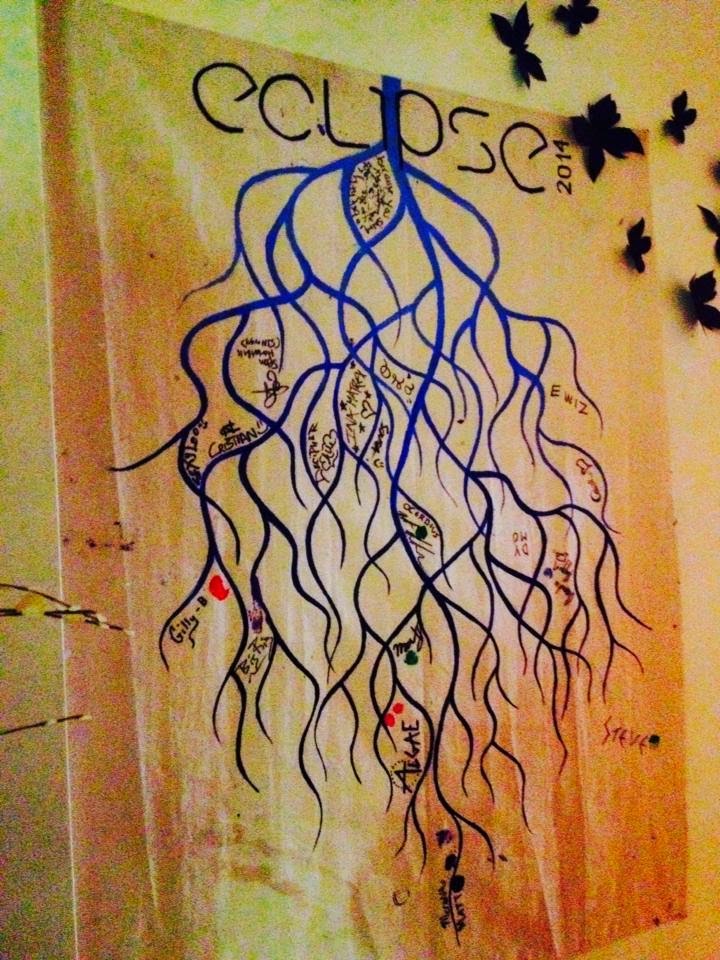
Dreaming of a Better World, Call It a Utopia, or a Music Festival, Jamming, 31/07/2014

A rhizome of memory. Thanks for the image,
Syn.
My girlfriend and I went to our first giant electronic music festival as part of our one year anniversary. Eclipse was quite possibly the largest, most entertaining, utterly epic shit-show that I’ve ever experienced, and I’d love to return to the next one in 2016. But I was also very philosophically stimulated by the entire affair, so while this post won’t discuss the personal aspects of the long weekend (because they’re personal), the political and metaphysical will get their due consideration. 

When the hippie movement began, it was intensely political and deeply politically informed. They were the social revolution in the class of white intelligentsia in North America, a group of young people rejecting their parents’ ideals, at least for a while, large enough that they couldn’t be written off or swept under the rug. Yet the culture was always driven not only by socialist political ideals and opposition to international war, but also drugs. At first, psychedelics were pharmaceutical routes to personal and communal spiritual enlightenment. Now, the rhetoric survives, but psychedelics are now one part of a wider cornucopia of substances that exist mostly just to get you pleasantly fucked up.

I’ve noticed a recent trend in drug use that could actually put people’s health at considerable risk. MAOIs are chemicals that were originally developed as anti-depressants, but which are now pitched as a ‘high enhancer’ for people who are already having a really rather pleasant trip on LSD or mushrooms. But these drugs chemically contraindicate each other, resulting in extreme toxicity (which induces vomiting if you’re lucky) and can raise your blood pressure to disastrously high levels. 

I’ve long had something of an ethical problem with using hallucinogens as party drugs, once again because of their original purpose in hippie culture as pathways, in conjunction with meditation and philosophical and scientific learning, to enlightenment. Under the guidance of a shaman, DMT, the active ingredient in ayahuasca, can bring a person into a trance that displays their entire past existence before them for contemplation and analysis in experience. The goal is to understand one’s entire past narrative as a foundation for ethical progress. That purpose of enlightenment has become largely forgotten as hippie culture has slowly changed its focus to dropping out of society’s rat races and getting pleasantly fucked up.

A reasonable skepticism of government chicanery about such deceptions as the Gulf of Tonkin incident and of hiding the full truth about the Kennedy assassination has developed today into a belief that the September 11 attacks were the work of government conspiracy (including anti-Semitic notions that Jewish businessmen were secretly in league with the CIA to destroy the WTC to foster conflict between the USA and Arab nations), and a healthy distrust of pharmaceutical companies has snowballed into widespread anti-vaxxerism. 

The modern hippie community has no longer dropped out of the mainstream to inspire political revolution. They have dropped out merely for the sake of a misfit existence. Even the community’s political radicalism, where it exists, is misdirected. I overheard one attendee last weekend talking about his desire to move to a commune where everything would be shared. But he said that as soon as anyone attempted to barter or trade, he would leave. He called such behaviour, “economics.” 

That seriously saddened me because it confused the mere act of asking for something in return for a product you worked hard to produce with the large-scale economic exploitations of the modern industrial era. A successful commune returns its residents to a lifestyle where power arises from the community’s own productive labour. It is not a place like a music festival, where the escapism and partying of the many attendees rest on the intense labour of a small technical crew working to the bone. 

As I watched a field full of people dancing wildly on more speed than a fighter pilot usually takes while the enormous bass of hour-long psy-trance mixes blasts them with more powerful forces than a riot control sound cannon, it reminded me of Marinetti’s comments on the mechanization of man. Human industry creates a force so powerful that it dwarfs humanity itself, crushing it under its waves. 

The psy-trance was exploding across the central field of Eclipse Festival for 90 of 96 total hours. Its rhythm constant, its beat continuous, its pulse shattering, its force unrelenting. As the music overtook our entire environment, dominating every aspect of our experience, I felt myself become psy-trance. In a wonderful, adventurous weekend that brought me romantic joy and happy encounters with old friends and new ones, I experienced philosophical disappointments that re-energized me for future creativity. 

I realized that a book like Utopias, with its goal to help resurrect a livable ideal for a better world, is more necessary than ever when the former vanguards and prophets of that world have sunk into ignorance and self-absorption. Perhaps with a little charismatic writing, they can be woken up again. 

Brief Hiatus, So Buy My Book, 25/07/2014

Just a short note to let any regular readers and random happenstance readers know that Adam Writes Everything is going on a bit of a hiatus for a few days, which is a massive gap compared to the actual purpose of the blog.

By the time this post is published, I'll be on my way to Eclipse festival in a campsite in the middle of nowhere in Quebec. With my best girl by my side, my copy of Spinoza's Ethics in my hand (and maybe I'll take some Negri along too; I'm not sure), and our friend Dreamboat driving the rental car up with his compact-size girlfriend L, I'll dance, rave, philosophize, and promote my book with a campsite full of hippies and party people.

I probably won't get back to the internet until the following Tuesday or Wednesday. It'll be a good break, especially after this past week. Until then, here's the link to my publisher's website, where you can buy my book, Under the Trees, Eaten.

The Ideology Must Also Free You, Research Time, 24/07/2014

Some more thoughts on the nature of revolution. Reading through Bakunin’s essays is quite interesting precisely because he never actually developed a systematic philosophy, though his thoughts were shaped by a profound engagement with the philosophy of his time. I’m sure there are plenty of interesting and hideously boring texts comparing the Hegelian influence of both Marx and Bakunin. I’ll ask B about them one day, as his work is must more directly focussed on Hegel. 

George W Bush, unknown prophet of his own end.
One of the recurring ideas in revolutionary political philosophy and the real concerns of activists is that, after a revolutionary government is established, the new rulers will be little better than the previous one. I know what The Who’s “Won’t Get Fooled Again” is about; it’s really quite obvious. One of my favourite Bushisms was his, “Fool me once, shame on me; fool me twice . . . well, we won’t get fooled again.” And not just because The Who is totally fucking awesome. 

In that one moment, he embodied the entire future of failed radical political change that he tried to inculcate in Iraq through his government’s incompetent, abusive, and destructive invasion. The goal of Bush and his advisors from Project for a New American Century* was to turn Iraq into a democracy through military invasion, under their belief that merely the opportunity for a free vote would let the natural light of liberated reason shine upon the people of Iraq and they would elect enlightened leaders, Iraqi equivalents to Jefferson, Franklin, and John Jay. 

* This was a think tank formed in the 1990s that essentially incubated all the international political philosophies of the W government, particularly the notion that a military invasion could introduce democracy into a region, and that Iraq was the best candidate to begin this democratic domino effect. Of course, this domino effect was no more effective for democratic culture than communism. Prominent members of PNAC included Dick Cheney, Paul Wolfowitz, Donald Rumsfeld, and William Kristol.

Seriously. They actually believed this. They did the same in Israel when they brushed aside the concerns of Ehud Olmert and Mahmoud Abbas that Hamas would win the Palestinian national election of 2006 and their brand of radical Islamic fundamentalism would gain a streak of democratic legitimacy.

I think because too many in the West no longer confront
racism on a daily basis, we've lost our ability to accept its
existence and how pervasive such ideologies still are.
The secular left-wing democratic defenders of Hamas** that I have spoken with over the last few weeks since the Gaza offensive kicked into gear have defended that organization’s legitimacy on this ground. This was yet another unfortunate legacy of the Bush Administration and PNAC, in addition to creating the conditions for the incompetent Shi’a despotism of modern Iraq’s Nouri al-Maliki regime.

** I can’t believe I actually wrote that phrase and it refers to an existing set of people.

But there is a deeper reason why many folks on the secular left of Western democracies treat a political organization whose central constitutional goal is to replace the state of Israel with a Muslim fundamentalist state run according to traditional Shari’a principles on the model of the Muslim Brotherhood as an ally and comrade. No one who looks at the disenfranchisement of the ordinary people of the Palestinian Territories can ignore that there are great injustices in their political and social situation. 

There are many factors in this injustice: they include Israeli laws about who can legitimately hold real estate in the Territories, Fatah corruption, a culture that is increasingly tolerant of racist extremism on all sides and intolerant of the conciliatory gestures and friendships forged by idealists working toward an integrated community, the long cultural neglect of their former rulers in Jordan and Egypt who conceived the Territories’ peasantry as no more than political tools. I make no claim that this is a complete list.

Shortly before the current Gaza offensive, legendary Israeli
author Amos Oz spoke out to denounce the price tag wave
of violence: extremist Jews who vandalize and destroy the
property of Arabs, Christians, and Jews who do not support
an ethnically pure and fundamentalist Israel.
In such a situation of injustice, any form of resistance is legitimized because resistance to such an intractable political and social situation is legitimate. But while resistance itself is legitimate, there are many concrete forms of resistance that are ultimately counter-productive. The resistance strategy of Hamas and their Iranian military sponsors is ultimately nihilistic because the practical ideology of Hamas does not itself enable human freedom.

Say Hamas were to succeed in its revolution. While Article 31 of Hamas’ Charter gives lip service to religious pluralism, stating that Muslims, Jews, and Christians are hypothetically capable of living together in an Islamist state, the amount of anti-Jewish hatred Hamas has inculcated among Palestinian people to encourage militant action against Israel has poisoned any cultural possibility of genuine pluralism in a Hamas-governed Palestine that covers the entire modern state of Israel. 

Besides, in all of the surrounding Arab states, children’s television encourages the hatred and murder of Jews, and elementary education still teaches such genocidal slander as the blood libel and the Protocols of the Elders of Zion as basic facts about Jews and Judaism. Add to this, all the standard Islamic fundamentalist political norms of heavy restrictions on freedom of thought, hostility to secularism and science, and the institutionalization of the abuse and commodification of women.

Frantz Fanon, one of the original leaders of the anti-colonialist struggle in the Muslim world, is often cited as one of the thinkers who argued that violent revolution against colonial oppressors was a legitimate and appropriate expression of the people’s work for freedom and emancipation. That’s the textbook version of Fanon that everybody knows and cites. But there’s a lot more in Fanon’s ideas than this, and he provides the clearest rebuke to anyone, especially anyone who was raised in a democratic culture, who would use this concept to justify whatever acts of terror, violence, racism, and murder organizations like Hamas would commit in the name of freedom from oppressors.

Leader of Algeria's liberation, Frantz Fanon.
Fanon doesn’t stop with the legitimacy of resistance. The most unfortunate forms of political resistance are those that, while legitimate in the abstract sense, will only bring further material destruction on their people in eventual victory. If the political and social vision of a revolutionary army does not include the inculcation of a democratic culture, it will only result in further oppression. In The Wretched of the Earth, Fanon wrote of two ways a revolutionary movement can fail in this sense. 1) They become so defined by the struggle against the enemy that, even when in power, their politics remain defined by the hunt for enemies, so they continue a war against their former masters and paranoiacally hunt down any form of dissent in their own culture as if mere refusal to obey were an existential threat. 2) The revolutionary ideology is merely a different kind of oppressive social and political structure. 

Revolutionaries are not simply warriors; they must also be nation builders. They themselves, their actions, and their philosophical thoughts provide the role models and templates for the citizens of their revolutionary new public. The true revolutionaries of the Middle East are the activists and artists who denounce racism in all its forms. Hamas are not true revolutionaries because they are just one more actor in the Middle East who seek to impose their vision on the world through violence. They are no exception to the region’s political order. 

The closest thing to an exception in the Middle East is the democratic culture of Israel, where despite the vehement denunciations that some members of the public fling at those who advocate an end to war, peace demonstrations and criticism of the government is accepted as a natural expression of social and political freedom. The utopian democratic movement of the kibbutzim was an essential element of the original Zionist movement, building alliances among oppressed peoples (Jews from around the world, the Sephardic communities that had lived in the region for thousands of years, in solidarity with local peasant populations who were similarly oppressed through feudalist hierarchy and monarchial despots; today, this population identifies as Palestinian) through communal agricultural production. In a society riven with hatred, fear, and violence, the most truly revolutionary act is to lay down arms and eat together as friends and neighbours in the face of armies.

By Demons Be Driven, Research Time, 23/07/2014

I’ve been reading a little about the history of anarchism lately too, familiarizing myself with the contexts in which Peter Kropotkin and Mikhail Bakunin’s ideas and activism arose. The 19th century was a time of incredible political upheaval, after all. The stereotype of the Victorian era’s stability is often used to gloss over the genuinely radical activities of the period and the popular resistance.

This was a century that began with the Napoleonic Wars, a military movement that lasted two decades, whose ostensible goal was quite literally the conquest of Europe. Globally, the century was dominated by the rise of colonial empires across the world. The colonial possessions of Britain and France (and the other major countries of Europe, but these were the major powers) enabled those states to build their armies and navies to such a degree that they would conquer parts of the world that were never within reach before. 

Because of the incredible ethnocentrism and racism that had developed in European culture, they had no qualms about overwriting the cultures and moralities of the people in their newly colonized lands. Instead of simply exploiting the locals’ labour and extracting their resources, as most colonial empires had done before,* the European empires set about marginalizaing the cultures of the subjugated peoples. Only the horrifying trauma of the First World War could bring this process to a skittering halt. Even then, the true wind-down never occurred until after the Second World War, when the European economies and military had literally been exhausted fighting each other in a conflict that literally spanned the Earth, making the Second World War the only truly unified global war of states. 

* When you look at the investments that state and Communist Party owned corporations have made throughout Africa today, it’s easy to see that this economic colonialism continues today. The Chinese, however, have the good business sense simply to strip these lands of their resources and not rub salt in the wound through further cultural destruction in the name of a false sense of moral and rational superiority.

Bakunin, the revolutionary who never
lost his hope, even after he lost all his
teeth from scurvy developed in a
Russian prison.
The story of anarchist movements in the 19th century is the story of domestic resistance to these powerful state militaries and the institutions that they supported. These movements, of which Mikhail Bakunin was a central leader throughout Europe, sought to dismantle the modern militarized state and restore a new form of governance adapting the model of the communal city-state to the industrial era. We’ll never know precisely how these forms of government would have developed over time, because the political revolutions in 1848 and 1870 that tried to institute such governance models were all stamped out by the state militaries of the time.

Reading through a long biographical essay on the life of Bakunin, I am struck by the ferocity with which he advocated violent revolution, and the equal ferocity with which he denounced violence. One of the more important stories of Bakunin’s life was his brief relationship with a Russian revolutionary named Sergey Nechaev. Nechaev advocated revolution by any means, that whatever violence and despotism was necessary to install and maintain a true communist regime was justified through the justice of its goal. Bakunin could not tolerate this, and eventually broke with Nechaev because of the younger man’s utter amorality. Bakunin himself advocated violence against the state and its agents in the army and the police, but he drew the line at Machiavellian murder.

Nechaev was eventually arrested in Russia. He murdered a former member of his revolutionary cell and attempted to manipulate the murder’s public image to encourage revolt against the Tsarist regime. This plan was an utter failure, and a few years later, he was captured and locked away in the hells of the Russian prison system.

If the story sounds familiar to you, the murder and its motivation is the basic plot of Pyotr Verkhovensky’s story in Fyodor Dostoyevsky’s Demons. Dostoyevsky himself had been a political revolutionary, but abandoned the cause of radical socialism after the trauma of receiving a pardon from the Tsar, timed to arrive literally seconds before his execution by firing squad. After serving his prison sentence, he became a staunch social conservative and Orthodox Christian, and wrote some of the greatest works of literature in human history, including Demons.

Demons is Dostoyevsky’s most explicitly political novel, engaging with the liberal and socialist revolutions that were rocking Russia and Europe at the time. His story offered revolutionaries a powerful challenge in the figures of the Verkhovensky father and son, Stepan and Pyotr. Violent revolution, articulated in the machinations of Pyotr (who was, remember, based on a real communist revolutionary, Nechaev), could only achieve empty violence that inspired no true believers in the cause of liberation from despotism. 

The route of persuasion, meanwhile, led you to the position of Stepan. A writer of moving works of political philosophy, Stepan essentially was a self-parody. A man who spent decades writing to advocate the overthrow of the Tsar and to inspire a democratic culture, he was employed as a teacher and scholar through the support of the very landed gentry he thought at the heart of such intolerable despotism. His figure cuts close to my own anxieties, as I believe in using my books to advocate and inspire social change. 

So if both paths are ultimately impotent, says Dostoyevsky, what choice is left, either for the activist or the writer?

Yellow Wallpaper: Centuries Collide in Joyous Explosions, 22/07/2014

Last week, I wrote a post that was a philosophical analysis of Yellow Wallpaper, an original play that my friend Kristi Boulton adapted from a short story by Charlottle Perkins Gilman. I discussed many of the meta-fictional and feminist aspects of the play in the first post, based on a couple of conversations between Kristi and I. Now I’ve seen the play, and there’s even more roiling within it. The play is still running until July 27, and it's a good idea to go.

Yellow Wallpaper depicts a woman in
a multifaceted prison: a locked room,
a morality that reduces her to an
incubator, politics and economics that
make her entirely servile. Forces from
beyond her walls offer liberation.
“Yellow Wallpaper” the short story is a product of the late Victorian era, an expression of the feminist culture and the female voices that were rebelling against the period’s cultural oppression. And the trappings of the era are well on display. The costumes evoke the physical constraints of the time’s upper-class fashions and stiff pretensions. The characters themselves speak in mannered Victorianisms, which slowly strain and crack under the emotional pressures that the protagonist’s mental illness forces on them. 

This growing pressure constitutes the narrative thrust of the play. As the play begins, the protagonist just looks as though she needs a vacation in the country after a stressful period. Her husband, a Victorian doctor, is concerned for his wife, but confident that he and his brother, a fellow doctor whose Victorian coldness and status-consciousness is played for laughs, can restore her to mental health. Her sister-in-law Rachel is similarly confident and optimistic. The family maid is a non-entity. 

As the lead actress becomes more unhinged and obsessed with her visions and nervousness, her husband becomes similarly uncertain in his abilities and wracked with self-doubt. His collaborating brother becomes openly cruel to her. As Rachel sees the protagonist’s behaviour and statements sensibly questioning the Victorian morality in which the purpose of a woman is to bear and raise children, she snaps and begins losing her temper. The maid begins a scheme of her own to rise in this wealthy family at the expense of the doctor’s marginalized wife.

Yet Yellow Wallpaper is not only a story of oppression, but of liberation.

The first sign of this is in the use of names. The only use of the protagonist’s own name throughout the entire play was at the very end, spoken by the yellow spectres. She has been referred to as a patient, a wife, a mother, a threat, and as darling, but never by her own name.* The spectres call her Charlotte in the only moment where any character acknowledges her humanity. It is to the detriment of the human characters that only the spectres of the house, whose very ontological nature is obscured among many possibilities, accept Charlotte’s singularity.

* Names have a curious power in Boulton’s script.** One subtle assault on the protagonist’s security is an otherwise unremarkable character breaking her place in the social hierarchy when she calls the lead actor John.

** And I’ve just used our common naming convention to accord my friend an extra layer of respect. After all this analysis, it would be improper for me to refer to her by the familiar Kristi, trivializing her contribution to her own production. So here I call her Boulton.

Hanah Itner's masterful performance as
manic intensity itself straining against
its constraints anchors and elevates an
already fascinating play.
Charlotte is not simply mad, not simply unhinged. She is a creative figure, diegetically a nationally famous author of children’s literature, a genre that the play explicitly associates with fantasy and escape from reality. A symptom of the typical Victorian (and generally patriarchal, whether Western, global, past, or present) repression of women, her husband does not allow her to write, to express her creative drives, until she is cured. The doctors frame this cure in terms of self-discipline, self-control. Her presumptive healers see imagination, the creative act itself, as a threat.

The other female characters join with the doctors to supply the content and purpose for this discipline. She will have considered herself cured when she can hold her baby without anxiety, when she is able to be a mother, joyously happy in the care of her infant. Rachel herself articulates this ideology most clearly: she turns from Charlotte’s only apparently sympathetic ear to a dedicated enemy when she hears her express seriously the idea that not all women are cut out to be mothers. 

As a character, there is a psychological reason for this, because Rachel herself is barren. So psychologically, this is a simple expression of jealousy. However, Rachel never appeared in Gilman’s story. She is entirely Boulton’s creation, and Boulton herself plays her well. Her performance goes beyond this petty psychological motivation so that Rachel expresses one of our culture’s most oppressive ideologies: that the only purpose of a woman is as a vehicle for procreation.

It’s fitting that the day before I went to see Boulton’s play, I wrote some light reflections about how one can be happy in life without having children. I framed my own take on this in reaction to Lee Edelman’s notion that a life without children signifies a joyous embrace of death and the annihilation of the self and all others. Edelman’s Lacanian influence leads him to think this way, interpreting Lacan’s concept of jouissance as the annihilation of identity, the joy of becoming thanatos, the death drive.

Boulton told me that the more overtly sexual
elements of Granger's dance came from
collaboration with the Fringe version's lead
actress, Itner, and was absent in the original
McMaster production. A great improvement.
Because I have no loyalty to Lacan, I need not argue against this, only state my opposition, and instead argue that my own ideological perspective offers a better existence. Charlotte, in betraying her husband to the spectre women of her wallpaper, does not embrace death. Much of this is down to the physical interaction of Hanah Itner as Charlotte and Sarah Granger as The Wallpaper Woman. They relate through a sensual dance that is clearly sexual in nature, which supplies Charlotte’s positive identity: as woman, as writer, and as homosexual, a triple threat to the oppressive morality of the Victorian era and so many other oppressive cultural currents that still exist today. Granger’s dancing is explicitly a product of the twentieth century: she is a modern dancer breaking into this militarized Victorian setting. Their dances are the only times in the play when Charlotte’s body language changes from the shaking nerves of constricted energy to the smooth bodily flows of free motion. 

The Yellow Wallpaper charts many attempts to constrain Charlotte, whether through a reproductive futurist morality, the rhetoric of self-control, economic dependence, medical institutions, or anaesthetic drugs. Joining with the Wallpaper Woman is a physical and ontological transformation, setting Charlotte free. She doesn’t trade one morality from another, but articulates an ethical transformation, a complete metamorphosis of who she truly is. A new genuine identity is created, and the regimentation of Victorian identity, ideology, and political morality is impotent before the power of a woman who has finally freed herself.

Editor's note: In case you were wondering, Kristi: Yes, I thought it was good. And I hope you don't mind that I used a couple of photos from your Facebook page.

Institutionalized Sophistry, Jamming, 21/07/2014

I think a reason most ancient Greek sophists could get away
with such cheap rhetorical tricks in their city assemblies is
because democratic political culture of this sort hadn't yet
developed a worldly sense of cynicism in the West. So
people were more easily bamboozled.
In terms of individual page views, this post from last July is still my most popular. I even noticed that, with no help from my own social media feeds, it experienced a sudden surge in page views this May. It’s about a terrible problem that philosophy departments and programs face because they tend to attract a particular type of undergraduate student. If you’ve hung out in a philosophy student society long enough, you’ll see them: they’re combative, arrogant, finding any excuse to argue with people. They are precisely the people that drive a lot of women and generally kind people out of studying philosophy, and most of them will feel good about having done so.

Having spent most of my twenties encountering such people, I became thoroughly tired of them by the time I began my doctorate in philosophy. Whenever I encountered such confrontational and argumentative people in the classes I taught, I quickly shut them down with the two weapons against which they can’t defend, a smile and an open mind. I even encountered the occasional philosophy professor whose confrontational attitudes had survived his (and it was always a man) impetuous youth. 

I mention this dislike of the undergraduate sophist that philosophy departments tend to produce now and then because of a curious comment in Michael Gilbert’s Coalescent Argumentation that demonstrates how correct my old professor David Hitchcock was when he said I’d like that book.

Gilbert describes just the same attitude of argumentative hostility that I just have, but identifies it specifically as arising in critical reasoning classes. These classes are the bread and butter of most philosophy departments in universities that allocate budgets according to course enrolment numbers. They’re relatively simple courses as well, which focus simply on the rules and techniques for examining and analyzing arguments, the composition and relation of premises to conclusions in day-to-day argumentation.

But critical reasoning as it's typically taught tends to forge or reinforce the aggressive argumentative habits that drive more reasonable people away from philosophy classes. One analyzes an argument, in the typical critical reasoning class, to find its flaws and mistakes. You analyze an argument not to see how it functions, what its aims are, and why it's being made when it is, but only to discover what's wrong with it. More than this, such antagonistic argument is sometimes described as being fun. Most people who have spent any time hanging out with enthusiastic young male philosophy undergraduate students will usually have experienced one person who takes unnecessarily aggressive stands in favour of arguments he (and it is always he) doesn't even really believe in, just to be devil's advocate. Gilbert critiques this model insofar as it reduces all critical thinking to a kind of nihilistic cynicism that's more interested in tearing down what someone else has built than building in your own right.

There's another problem that the book diagnoses in critical reasoning. Critical reasoning classes are themselves often perceived as bird courses, which is really a shame because their basic task — identifying the formal structure of arguments in everyday discourse — can be enormously difficult. When I took elementary logic and reasoning courses in my own undergraduate years, I found these tasks most difficult. You had to cut through a lot of extra material — appeals to emotion, social and political context, the particular relationships of the individuals making the argument — to identify each particular formal element in each person’s argument for his case and the logical rules by which the argument transitioned from one such element to the next.

Gilbert’s idea for reform of critical reasoning would have made this procedure easier in one sense and more difficult in others. One of the concerns of Coalescent Argumentation is to reform critical reasoning classes to make them more practically useful. You don’t understand how an argument actually functions in the world when you strip away all those contextual elements to grasp its essence as its skeletal logical structure. So Gilbert brings the resources of argumentation theory and related academic discourses to analyze both the logical skeletons and the operative political, social, and personal flesh of an argument. As he says in the title of chapter three, his focus is just as much on the arguers as the arguments.

This, however, does make critical reasoning analyses more difficult because you now not only have to extract and analyze the framework of that logical skeleton, but understand as well all the functions and relations of the contextual elements that is physically making that argument in the world. 

Well, philosophy is hard, and so is life.