Showing posts with label Fyodor Dostoyevsky. Show all posts

Tainted Left III: Good as a Crystal Ball, Research Time, 21/07/2016

Continued from last post . . . When I was reading Antonio Gramsci’s Prison Notebooks a couple of years ago, I noticed a frequent target of his criticism. It was the idea that history’s development was inevitable. 

A little more detail. History developed according to a logical order: the creation and reconciliation of contradictions. This is the Hegelian vision of history, the necessary development of progress. The marxist reading was that history inevitably progressed to the terminal crisis of capitalism and the emergence of communist institutions and society.

From a march of Italy's many different communist parties,
in solidarity with Greece's Syriza and other resisters to
the European Central Bank's austerity regimes.
Notice, I said ‘marxist,’ without capitalizing, or referring explicitly to Karl Marx. That’s because, as Gramsci repeated and Louis Althusser demonstrated through some intense analysis, Marx himself didn’t think this way about history at all.

Gramsci found many of his fellow Communist Party activists in Italy frustrating because they had essentially become quietists. Not because they had given up on building a new order in society, but because they believed that it would come about through the superstructures of capitalist human society. And not through any direct doings of their own.

Now, it’s not as though any subversive activity at all would do. Fyodor Dostoyevsky could teach us the futility of subversion done in the wrong way, in the wrong place, in the wrong time, or just plain stupidly. That was the story of both his own life and his classic novel Demons

His own anti-Czarist campaigning was at the wrong time. Stepan’s intellectual democracy activism was in the wrong place, under the condescending dotage of the Russian aristocracy. His son Pyotr’s violent revolutionary terrorism was the wrong way, needlessly killing people and burning down neighbourhoods because he believed it would provoke mass unrest. 

And they were all stupid about it, Dostoyevsky implies. I mean, they got so much wrong. 

Where does this historical necessity come from? It’s a false necessity, of course, but it’s still a concept, and so we can ask about its mechanics. There’s no ontological necessity involved in this vision of reality – no clockwork parts here. 

Instead, the ontology of a necessary path for history’s development flows from a philosophical principle – the principle of history’s narrative on the Hegelian account.* Basically, it’s the notion that history has a single dominant narrative at all. That there’s a story of human history and society that is literally THE story.

From the 2014 television adaptation of Dostoyevsky's
Demons, directed by Vladimir Khotinenko.
* At least the bog-standard Hegelian account that most of the Communist Party activists in whose circles Gramsci and Althusser moved believed. It's not Hegel’s own thinking, which is much more complex than a lot of its most enthusiastic inheritors conceived. It’s the Hegelian idea of history’s logic reduced to dogma.

I’m not even sure I should have separated that last footnote, because its central idea works just as well in the main text of this post. When a complicated philosophical concept or idea gets turned into a dogma, it’s reduced to platitudes, too-simple matters of faith, the emptiness of common-sense truths. 

A dogma no longer provokes thought, but simply has to be believed. And that’s kind of what happened to Karl Marx’s very complex engagement with Hegel’s and the Hegelian concept of history’s logic. 

When a complex philosophical concept is barmy and ultimately unworkable – like Hegel’s concept of history’s logic – becomes a dogma, we end up with a movement of people making themselves into idiots. As in the quietist revolutionaries of Gramsci's Italian Communist Party.

In super-short form, the concept of history’s logic runs like this. Hegel developed a structure of logic – simple concepts (like Being and Nothing) contradict each other, but you can resolve that contradiction to create a more advanced concept. This process keeps going until you reach a single concept that includes the entire range of human knowledge and potential, the absolute.

Hegel’s Logic mapped this progression. He wrote it concurrently with The Phenomenology of Spirit, which mapped this progression of concepts onto human history and psychology. He found embodiments of these ideas and movements all over human existence. Of course he did – he was looking for them.

Hegel mapped his Logic onto human existence through abstraction. He reduced a complex and complicated human self-consciousness of a given event, society, or era to the pure abstract of a philosophical diagram. It understood reality along very clean lines, but that understanding no longer had anything to do with real life.

So how are you going to act in the world if your thinking is no longer connected with the messy complexity of real life? Let alone change the world? . . . To be continued

Never Give Up and Never Give In, A History Boy, 08/04/2016


Human politics driven by our ideals puts us at war with the cosmos itself. It means that the ideal of human politics is to demand a better world than the universe is able to give you – if I can’t find it in the world as it is, I’ll build it.

It’s the demand to God herself – I won’t submit to your theodicy; I won’t justify the raw deal of human suffering. My ideal is a world where everyone lives in peace and happiness. Where a single crying child is too much pain to be right, to be justified.

For a Dostoyevsky fan, I've never been that into Crime
and Punishment
, though I do love it. It's a beautiful
book and a fantastically intense character. But I
found the characters themselves tended to become
ciphers for ideas a little too easily. The Wikipedia
page
gives a pretty good sign of how irritatingly
up-front the book is about this breakdown.
Hmmm. Where have I heard that before?

This week’s posts have become a very unexpected series. They aren’t even really a series, as I’ve typically presented these things. Just picking up from the end of one post, moving in a tangent that it suggests, and then repeating the same from another tangent. Today is more of the same. And I hope it’s a little illuminating.

I’ve talked about my love of Fyodor Dostoyevsky’s novels on the blog before, and how much he’s influenced my political thinking. Today, I want to tease out how it makes sense for a strict Russian Orthodox Christian monarchist to have influenced views and ideas like mine.

Begin with the beginning. Dostoyevsky was a radical anti-monarchist revolutionary and atheist. And he got caught. He expected to be executed, because this was 1840s Russia, of course. But the Czar played kind of a cruel trick on him and his co-conspirators. 

Dostoyevsky was led out to a firing squad field, and the execution was proceeding entirely according to protocol. Then as the guns were about to fire, the squad put down their weapons and the drill sergeant announced that their death sentences were commuted by royal decree to several years in Siberia. This isn’t a myth – it was a real event that happened.

That moment of facing the certainty of his own death, seemingly within minutes and seconds, rekindled Dostoyevsky’s faith in God. And he was a dedicated Orthodox Christian and grumpy royalist for the rest of his life. A life he spent tortured by alcoholism and gambling addiction, as well as building one of humanity’s most legendary writing careers. 

Akira Kurosawa made one of the few attempts to adapt
Dostoyevsky's sprawling epic of our interior lives, the
novel of his that first hit my soul, The Idiot.
Because Dostoyevsky didn’t become one of those unfortunate religious converts whose works become an excuse to spout dogma. This isn’t Kirk Cameron we’re talking about here. 

What was most important to Dostoyevsky were the crises themselves – depicting in his art narrative and mental moments of the same terrifying intensity as he experienced up against that wall as a young man. Characters with the singular uniqueness as he felt in that moment when he knew he was going to die – there was never going to be another like him.

The list of Dostoyevsky characters that affected me over the years began with Prince Lev Myshkin in The Idiot, and Parfyon Rogozhin as well. One was the most beautiful vulnerability I had ever seen in a fictional character, and the other was a remarkable, malevolence that would make a heart burn with blackened flame.

After I read The Idiot, I thought that if I could ever create a character in fiction or film with the same intensity and singularity of Myshkin, even if only once, it would be worth all the work to devote at least a part of my life to make art.

I actually read Ivan Karamazov’s monologue about why he’s an atheist before I read the entire book. It was one of the readings from an undergrad course I took on philosophy of religion, presented as a straightforward argument for atheism. 

A poster for the 1969 Russian film
adaptation of The Brothers Karamazov.
It was co-directed by the actors who
played Dmitri and Ivan after the death of
original director Ivan Pyryev, Mikhail
Ulyanov and Kirill Lavrov.
It’s probably the best argument for atheism that exists – it certainly blows away anything Hitchens or Dawkins may have written. It justifies and contributed to my belief that only someone with a deep and complex relationship with the divine can actually explain the deepest philosophical and ethical meaning of atheism.

Essentially, I hold that atheism. It’s an atheism that still believes in God. If you believe that’s contradictory, then you’ve been reading too much Dawkins and you think all you need to do to be a thorough atheist is not go to church and act like scientific knowledge is absolutely perfect.*

* Let’s not get into the contingency of scientific knowledge existing simultaneously with its systematic reliability, or we’ll be here for a whole damn book. And if you want me to write that book, you can subsidize it directly now.

Simply not believing in God because scientific knowledge can’t prove God’s existence is a kind of alienation from the divine. You’re alienated because you may once have expected something to be there that isn’t and never will be.

Ivan Karamazov’s is the atheism that embodies the most robust alienation from God – the ethical. It refuses to accept the legitimacy of the world’s ultimate goodness in the fact of suffering and destruction. 

Theodicy, traditionally speaking, is the moral justification of God’s existence and goodness. Speaking very simply and quickly, it justifies the order and history of the universe as the overall product of God’s plan. All the suffering, cruelty, and destruction of the world is a function of God’s love.

It’s a refusal that the world could be better than it is. The human dedication to political ideals is a profound engagement with reality – a refusal of reality as it exists and an overwhelming desire to rewrite reality. That reality is the reality of God – Reality is the material expression of God. If you have a problem with reality as it is, then you have a problem with God.

Ivan Karamazov is Dostoyevsky the revolutionary. Learning who really murdered his father is Dostoyevsky’s moment in front of the firing squad. The desire to change the world for the better is real. The rage at the world is real. That rage has to build a new world.

Justifying Idealism, Composing, 07/04/2016

A map of the universe where Earth is one planet among many is more complicated than the geocentric spheres. But it’s more accurate, and a more diverse and fascinating universe to explore than a geocentric reality could ever have been.
So it goes for the more complicated political universe with many diverse, intersecting, and conflicting axes of freedom and liberation. It’s much more complex to navigate. If you thought easy answers were tough in the liberal individualist model of politics, then this model with so many different axes of freedom is even harder.
Why would anyone want to do something that’s hard?

Mostly because it’s necessary. The libertarian – the most intense traditional liberals in the world, really – argument that you can still be free in absolute poverty is based on a paltry, one-dimensional conception of freedom. 

This has been another week where each entry returns
to the same ideas just a little differently, trying to find
the best way to express them. Literally composing my
ideas, day by day, thought by thought.
To be free is freedom from the authoritarian control of a sovereign state, and there’s no distinction between the oppression of a secret police service and an income tax agency. You may barely afford to eat, but if you live in a society without a state tax authority, you’re free because no government coerces you.

I call shenanigans. Shenanigans because the deprivation of poverty genuinely ruins lives. Not just the immediate material deprivations of poverty, but the erosion of opportunities to dig yourself out of poverty that living hand-to-mouth creates. The inability to save. The inability to eat healthily. The inability to access housing. The heightened vulnerability to catastrophic results from otherwise minor accidents.

Many people around the world are increasingly sick of an economic regime that facilitates such incredible inequality that more people are stuck in inescapable poverty traps. 

The Copernican Revolution of political thinking is about redefining politics so that political discussions can include these economic issues, first and foremost. To do that, we need an expansive understanding of what a properly political conversation is.

We’ve become too accustomed to thinking of politics as being solely about the interplay of private and public – working out what areas of life are proper to individuals and what are proper to the government.

What is the political? It’s every relationship between people that helps constitute society. Every aspect of human life constitutes our political life. The domain of politics is life itself. You understand this and all that libertarianism just falls away. It’s just inadequate to the problems we face and the solutions we need.

We can forget the most valuable contribution that libertarianism brings to political thinking – how horrifyingly dangerous the state is. But that’s only one aspect of a universe of political importance and power. 

An artist's representation of a startled Copernicus.
The original Copernican Revolution – you know, the one the actual Nicolas Copernicus* started – transformed our image of the cosmos from a home built specifically for humanity into a complex assemblage where humanity lives. That cosmology alienated God from humanity because it implied that God had more complex priorities than human development.

* Or rather, Mikolaj Kopernik, for those of you like me who think Latin is kind of snooty and Slavic languages generally sound extra-badass.

Kant, like all reactionaries who believe themselves progressive, wanted to preserve the material truth of a world more complex than humanity, but restore the moral authority of a God that cares only for humanity.

But the problem with an image of God as a moral authority is that it seems an unjustly one-way relationship. Living in a manifestly unfair world, prayer and piety alone isn’t exactly effective in building a more just society. If we expect justice and fairness to arise naturally, it will never arrive. 

The strong will continue to eat the weak, unless the weak find new ways to make themselves strong. But that strength has to be new kinds of power that undercut the strength of the already-strong. Our ideals have to be about remaking society – changing each of our minds – so that violent coercion is literally not effective anymore.

Human politics driven by our ideals puts us at war with the cosmos itself. It means that the ideal of human politics is to demand a better world than the universe is able to give you – if I can’t find it in the world as it is, I’ll build it.

It’s the demand to God herself – I won’t submit to your theodicy; I won’t justify the raw deal of human suffering. My ideal is a world where everyone lives in peace and happiness. Where a single crying child is too much pain to be right, to be justified.


Adam Writes Everything has launched a Patreon to support continued work on the blog and the creative projects whose (slow, inching, but always present) progress it charts. Whether it’s continued work on Utopias, Sunnyvale Psychochronography, You Were My Friend, Here Is a Man, A Small Man’s Town, or any other project that arises in the future, you can support it and contribute to the work that I do. 

Knowing Knowledge III: Nature Itself Is God's Book, Dialogues, 19/03/2015

The discussion with Steve Fuller and myself about his latest book, Knowledge: The Philosophical Quest in Nature, continues today with a discussion of the ontological and moral aspects of theodicy.
• • •
Dear Steve;

I would call the major theme of this chapter the redemption of theodicy. Why I say redemption will become clear as I go on. 

The language of God is the
functional codes of the universe.
This chapter was entirely an education for me, demonstrating conclusively the inescapable roots of modern science's methods in the priorities and ideas of Christian theodicy. This bedrock is the concept that the mathematical structures and functional molecular codes (like DNA) constitute the word and thoughts of God expressed in reality itself. Humanity, being made in the image of God and therefore sharing in the same divinity, can investigate the world – whether through experiment, theoretical mathematics, empirical observation, or computer simulation – to read and write the word of God.

This is a beautiful model for understanding what science is. And I think it makes for a perfect route to replace the idiotic reductive conception of science that comes out of people like Dawkins today. 

It's also a perfect route to defend science from the attacks that scientific education and institutions face from the people you so tactfully call the Creationist Right Wing. I, however, will excuse myself from all tact regarding the Creationist Right and call them as I see them: bigoted imbeciles who exert powerful influences over major political and media organizations who aim to replace science education of all kinds with Biblical literalist dogma. I like Dan Savage's term for them, the American Taliban.

The Creationist Left, with which you identify, faces an uphill battle so difficult, I don't know that you can fight it directly and even come close to winning. You call creationism the sensible notion that reality can be called creation, that there is an order which unifies the multifaceted complexity of being, and humanity can understand that order. 

As we understand the order of the universe more adequately, we bring ourselves closer to God. I'm glad you've finally been able to explain to me what precisely you mean by creationism, because I've always been confused when the subject has come up at the Reply Collective.

The term 'creationism' in popular culture is owned
entirely by people who consider scientific inquiry a
pack of lies, which leaves thinkers who simply
understand there to be design principles in the
universe as a whole stuck with the worst bedfellows.
However, the American Taliban, with their enormous media power and influence, already owns the word 'creationism.' They have set its meaning in all of popular discourse to refer to their own form of disgusting Biblical literalism that breeds dogmatism and ignorance. They would not consider your nuanced and historically informed philosophy to be a creationism. 

If anything, Ken Ham and his ilk would probably see you as a worse apostate than Dawkins, Stephen Jay Gould, or any actual biologist. An atheist biologist would only deny their God. You envision a God that speaks not in the literal text of the Bible, but in figurative language, in mathematics, and in the planetary history of evolution itself. You profane their God.

To reclaim the language of creationism for the scientific theodicy you describe is, as far as I can tell, practically impossible. Making the battle explicit would bring in the most extreme militants on both sides of the popular conflict of science and religion who would simply trample you under their onslaught.

The only way you could save yourself from this madness is leaving behind the label of creationism and the associated debates, and regenerating the core concepts of theodicy in new ways. I'm particularly excited about how you discuss what you call the Petrine-Pauline conflict in how to express our relationships with God.

My sympathies lie with the Pauline tradition: engagement with the divine in nature without the mediation of institutions, that we can achieve scientific knowledge without depending on a particular path or authority. You understand this rebellion against authority in knowledge as the foundation of modern secularism. 

The now-demolished Mount Cashel Boys Home in
St. John's, Newfoundland, my hometown. This
orphanage is where the most respected Catholic
clergymen in the province regularly raped the
children in their care, with the knowledge and
protection of higher Church authorities. The
reason for my rather extreme anti-clericalism.
But last week, you also wondered why "God is unfairly subject to a much higher standard of proof than we normally require of big theoretical ideas" like complex scientific concepts that are much more tenuous and strange than God. I have an answer to that which lies in how people who become secular or atheist engage with the Petrine tradition where the content of belief in God depends on authority.

Resting the concept of the divine in an authority uses the concept of God for social conformity and to enrich a human institution that, to pick an example close to my biography and homeland of Newfoundland, protects child molesters and gives them control of orphanages full of defenceless young boys to rape. It's an intense example, but it's at the root of why I, at least, am such an anti-clerical guy. 

Human suffering in all its forms is the heart of the most powerful weakness of theodicy, particularly the ethical dimensions of the order of the universe. The optimism of theodicy is also its cruelty. Suffering and pain has its place in the overall fabric of the universe such that it is justified in the ultimate outcome. 

You build a solid account of how deontology and utilitarianism are products of theodicy, philosophical edifices which justify scenarios and circumstances that are unpalatable to our intuitive distaste and disgust for pain.

I will not go to Voltaire's Candide for my refutation, as Dr. Pangloss is too cartoonish an enemy, and simplifies the problem. It's not a matter of disproving the truth of theodicy's mission and conception of being. I instead think of Ivan Karamazov, who does not deny the truth of God's existence, and does not deny the validity of theodicy. He accepts that there is a plan in creation that justifies its suffering, including the institutionalized abuse of millions over the centuries in the name of God and faith.

He simply refuses to sign on to the ethical aspects of theodicy. The notion that there is an order to the universe for which humans are uniquely suited to understanding, and that we investigate this order through our own designed knowledge tools; this is fine, and enlightening to me.

But I cannot accept the ethics. Don't ask me to sign on. Don't ask me to contribute anything to the ethical and political aspects of theodicy but my rage.
• • • 
Dear Adam;

I’m glad you’ve gotten so engaged with the theology, despite whatever disagreements we might have! Chapter two explains the mind-set in which I agreed to be an expert witness for the intelligent design defenders at the Dover trial. To be honest, it was only by agreeing to serve in the trial that I was forced to come clean on a lot of my own views, which up to that point had existed in a semi-self-censored state. 

A lot of other things started to fall into place after that point, including a stronger affinity for existentialism as an ethic of risk-taking designed to reveal one’s true being. I will stop on this point here to deal more directly with your challenges.

I clearly have a more relaxed attitude to the Creationist Right than you do. Part of this reflects the fact that the more scientifically minded people in this camp (so-called ‘Young Earth Creationists’) are trying to mount a methodological critique of the means by which we assign dates to fossils and even light beams from distant parts of the universe. 

Of course, there is no guarantee of success but I don’t see why they shouldn’t try. It’s certainly conceivable that all the physical facts remain as they are but the time-frame locating them is significantly compressed. In other words, the time it took to produce them could be condensed from 6 billion to 6000 years. 

Again, I don’t expect that this particular hypothesis will turn out to be true, but any significant compression in the time-frame for natural history (say, from billions to millions of years) hits the strict Darwinists hard, since natural selection’s plausibility requires a very long time for its blind trial-and-error processes to work their magic to produce something that looks like – but isn’t – a designed universe.
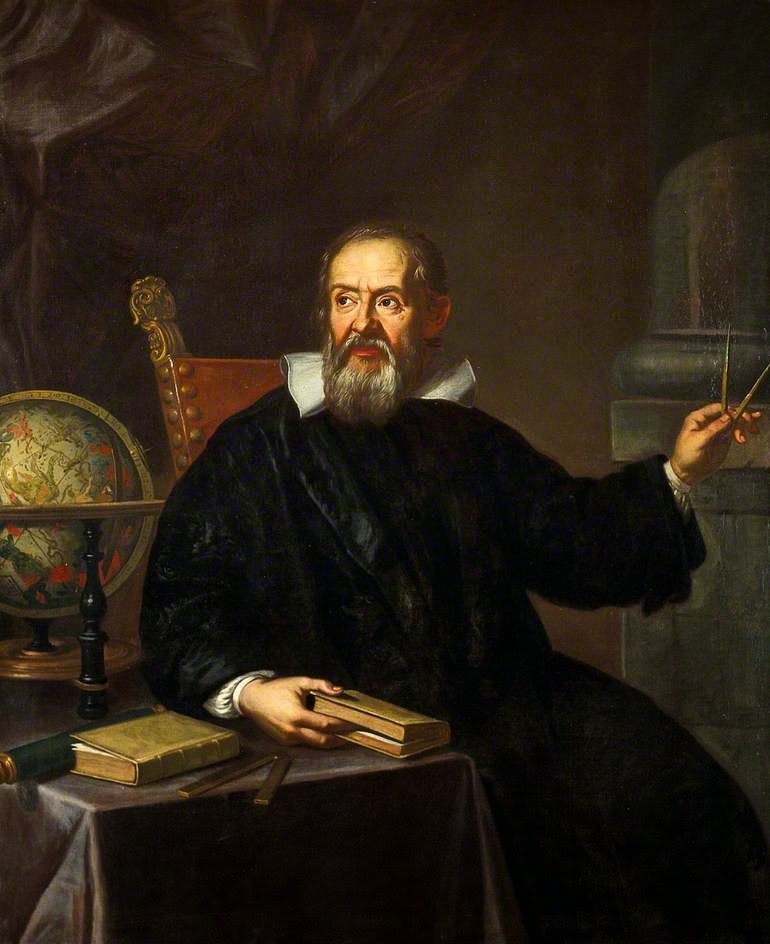
Galileo was both a pious Christian and the
persecuted man who became many children's
first boyhood hero of science.
This raises the issue of ‘Biblical literalism,’ with which I am also comfortable. The literal/figurative distinction is not helpful because it is really a euphemism for stupid/smart readings of the Bible, as drawn by the people who think they’re ‘smart.’ I have no doubt that the Scientific Revolutionaries understood that they were created ‘in the image and likeness of God’ literally -- and acted accordingly. 

When Galileo and Bacon said that God issued two books, the Bible and Nature, they were both meant to be read literally. If the mathematically formulated regularities observed in nature are literally true, so too are the words in the Bible. The question then is finding the right semantics for making sense of both of them.

To be sure, there is plenty of room for disagreement and we may get things wrong, but to speak of ‘figurative’ readings is simply to de-legitimate the entire enterprise. The basic point about literalism is that the text – be it a sentence or a formula – provides the anchor for whatever interpretations follow. It is not simply a touchstone for an interpretation that could have been arrived independently of the text. 

In an earlier book, Science: The Art of Living, I mentioned the lawyer John Calvin as instrumental in raising this awareness – as this is a very legalistic way of thinking about language, the precedent for which had been set by the Talmudic tradition of Judaism but before Calvin had only been intermittently endorsed by Christian intellectuals, notably followers of John Duns Scotus like John Wycliffe, who got the Bible translated into English.

No, none of this justifies Ken Ham’s Creationist theme parks. But my attitude towards Creationists is very much case by case, depending on what they wish to present as science in their textbooks, etc. Only someone ignorant of the history of science could think that creationism is intrinsically antagonistic to science, even as a world-view that might inform scientific practice today. 

After all, if humans had not aspired to godlike powers, we would not be on the threshold of synthesizing life, intelligence, etc. And if the Creationist Right wishes to castigate such people, then they have only their own Abrahamic religious trajectory to blame, because I doubt that any other religious tradition would have ever gotten us to this point.* Like or not, in practice, most scientists are Creationist Leftists – and bully for them! Contrary to appearances, the Mormons have a good grasp of this point, based on their rather adventurous track record in biomedical research, including eugenics.

Dostoyevsky's characters articulated
some of the best critiques of moral
theodicy in the Western tradition of
thought.
* Maybe the problem here is that the Creationist Right do not take their Biblical literalism sufficiently literally! 

Finally, theodicy – and yes, this is a source of serious disagreement between us. ‘God’s sense of justice’ (the literal meaning of ‘theodicy’) has always fascinated me, largely because it seems to be the ideal perspective from which understand human rationality as something fallible yet aspirational. We can understand the bad things that happen to us as episodes in learning to get somewhere better. 

But this logic is compelling for an individual only if in some sense you are still around after the bad thing has passed. And of course, people often die or are irreversibly damaged as a result of the bad things that happen to them, whether or not they are responsible for them (i.e. what the theologians call ‘moral evil’ and ‘natural evil’). 

In that case, people need to think of their individual lives as moments in a larger project, so that, say, my death enables others who identify with me (and I with them) to improve our collectively owned position. So, when Jesus said he died for all of humanity’s sins, the task ahead was to make good on his message without necessarily suffering his fate. Those who interpret Jesus’ life in this way – as an experiment in living – are ‘Christians’.

In a sense, this is all about ‘the end justifies the means’ and ‘the greatest good for the greatest number.’** And it is familiar enough from secular military contexts, in which soldiers sacrifice themselves for countries, whose citizens are expected to provide due support and even derive inspiration. 

** Utilitarianism is basically secularized theodicy, whereby the sovereign legislator replaces the deity.

I would like to see this sentiment extended to participation in scientific research, which people may be allowed to perform in fulfilment of ‘national service’ in lieu of military training. But that’s a proposal I pursue in The Proactionary Imperative, rather than this book. 

What Fuller says about Mill reminds me a lot of
what Nietzsche said about the requirement of
pain for progress, which makes me think that
pretty much the entire history of Western
philosophy since Mill has severely
misinterpreted him.
The point I would stress in all this is that identifying with the lives of those who come after oneself need not be something imposed from the outside (even by God) but can – and should – be something that is voluntarily assumed on one’s own part. In that respect, God may choose the time that you go, but you are already mentally prepared to go willingly. Clearly, then, Ivan Karamazov uses his free will to opposite effect – namely, to opt out of the divine justice system altogether. But where does that leave you? Is nihilism a viable position?

Darwin himself – faced with the harsh sense of divine justice espoused by Reverend Malthus’s population theory – simply concluded that no deity worthy of belief could be behind it, and so ‘natural selection’ in Darwin’s original rendering is radically blind to all purpose, let alone human interest. Of course, not all evolutionists drew such atheistic conclusions. 

Moreover, those inclined to embrace a utilitarian world-view came up with more finessed positions that aimed to incorporate the apparent trump card of ‘needless suffering’ into some global optimum of goodness. This is the context in which to understand John Stuart Mill’s oft-quoted maxim, ‘Better to be Socrates dissatisfied than a pig satisfied’. What he meant was that Socratic suffering and death teaches us more than the life of an untroubled pig. Socrates’ life was not good in itself but good for us. 

Notwithstanding his politically incorrect speciesism, Mill is basically thinking about matters the right way. Unlike classical Epicureanism, Utilitarianism does not aim to minimize pain per se but to arrive at the optimal pleasure-to-pain ratio – and that may mean sustaining considerable pain, at least locally and in the short term. ​In short, no pain, no gain!

What Are These Words For? A History Boy, 06/09/2014

Another one of those memes about the books most influential in your life has been going around my Facebook friends, and I thought I’d spell out the list more clearly on the blog, because I think it would be interesting. It’s also a good way for me to get a sense of my own influences as my own writing career finally picks up a little. But the reason these books were each influential on me kind of overlaps. So I thought I’d make several sub-lists of factors and group the books under them.

The Whole List, in chronological order of my discovering them
- Herman Melville, Moby-Dick
- Kurt Vonnegut, Cat's Cradle 
- Fyodor Dostoyevsky, The Idiot 
- Isaac Asimov, The Foundation Series
- James Joyce, Ulysses 
- Immanuel Kant, The Critique of Pure Reason 
- Gao Xingjian, Soul Mountain 
- Friedrich Nietzsche, Beyond Good and Evil
- Graham Greene, The Quiet American 
- Roberto Bolaño, The Savage Detectives
- Gilles Deleuze and Félix Guattari, What Is Philosophy?
- Philip K Dick, Ubik
- Benedict Spinoza, Ethics
- Kojo Laing, Search Sweet Country
- Alan Moore, Swamp Thing Vols. 1 & 2

Amazing Worlds
• Cat’s Cradle, Foundation, Ulysses, The Savage Detectives, Ubik, Search Sweet Country, Swamp Thing

The many are modifications of the one, but are no less
individual for that. Swamp Thing is something of a Spinozist.
These books opened my mind to the possibility of worlds that were very different from my own, threading narratives of a few particular people through a setting that was so complex to be an actual ecology. Foundation saw this enormously complicated galactic human civilization that was so much more than a simple metaphor applying to a single story, which too much science-fiction in the Golden Age was like. It also helped that I was maybe 13 years old. 

Ubik did the same thing, but escaped the epic register of which Asimov was so fond, and rooted a strange story in a humanity very much like our own, with shysters, criminals, nagging bosses, and loveable schlubs. The film version of Ubik in my head will always feature Seth Rogen as the protagonist Joe Chip. It was the first Philip K Dick I’d ever read.

Cat’s Cradle and Swamp Thing found strange corners within our own world to build their fantastic settings. Ulysses made the ordinary fantastic, and once again, brought the epic to the scale of ordinary folks and their personal and political struggles. Bolaño and Laing brought foreign lands that I’d never visited before to my own mind, and made them feel so familiar, it was almost as if they had physically taken me there.

Yearning for Justice
• The Idiot, Soul Mountain, The Quiet American, Swamp Thing

I felt in these stories a powerful force straining against and overcoming political and social oppression. Alan Moore used fantasy and horror to explore the struggles of humanity with the ecology where we developed, and the paradoxes that our fear of nature’s power and yearning to protect ourselves from its wrath may destroy us.

The Idiot is a profound story of one person whose basic kindness struggles against the more heartless perspectives of the people around him; the tragedy is that his virtue ultimately lacks the strength to combat the worst that humanity can offer. Soul Mountain is the story of one such person who succeeded, despite the violence and backwardness around him and in his own heart.

Graham Greene taught me never to trust the conclusions of anyone who looks at the world and says, “I know exactly what’s going on. It’s quite simple!” Ruin and death lie in these words.

New Ways to Think
• Cat’s Cradle, The Critique of Pure Reason, Soul Mountain, Beyond Good and Evil, What Is Philosophy?, Ethics

Philosophy isn’t just a matter of searching for the truth, and it isn’t just a matter of criticizing the ideas of others. It’s also about developing new ways to understand the world. Studying Kant first taught me how to explore a system so complex that it’s literally like rewiring your mind as you understand it. After my old philosophical mentor, Jim Bradley, walked me through the Critique of Pure Reason, I felt like I understood not just how to read philosophy, but how to philosophize.

When he was young, Vonnegut could still
laugh without crying.
Nietzsche, Deleuze, and Spinoza ended up doing the same thing for me, and taking me to places where I wanted to go anyway. I’ve read other philosophers than these three, but concepts at the forefront of their works are the biggest concrete influences on how I do philosophy myself. Beyond Good and Evil introduced me to the strongest critiques of morality, and I never took another moral philosopher or preacher (even an atheist one) as an authority again. Deleuze introduced me to an entire new paradigm of doing philosophy, geological or ecological philosophy, and What Is Philosophy? was the first of his large books I’d read. Spinoza was the ethicist of immanence that started it all, and was the first to make explicit the inter-relation of all the domains of philosophy, which common academic practice keeps separate.

Gao wrote a literal exploration of the multiplicity inside each of us as individuals. Vonnegut developed a playfulness to his own voice that was so utterly unique that the world is richer for its existence. And Cat's Cradle, his first book that I read, came early enough in his life that it had not grown too cynical to inspire.

Excitement for Writing
• Moby-Dick, Ulysses, Soul Mountain, The Savage Detectives, Search Sweet Country, Ethics

Moby-Dick was one of the first novels I ever remember reading. I first had an illustrated copy for children when I was maybe eight years old, and it fascinated me. I don’t know how many times I read it. I ended up having to buy multiple copies. That illustrated edition I left in a box in my grandmother’s house when I moved out and it was destroyed in a fire over a decade later. Then I bought an old second-hand copy, but that was too badly water damaged after loaning it to a friend. Then I found a cheap edition at a Coles in Hamilton and have had that on my shelf ever since.

Ulysses, Soul Mountain, and The Ethics were three books I read that redefined for me the limits of what language was capable of. I’m now leaning toward a definition of those limits as limitless. Bolaño taught me a way to express a character that was wholly new to me. Most importantly, reading The Savage Detectives inspired me to start writing fiction seriously myself. And reading Search Sweet Country two years ago nearly made me stop because I don’t think I’ll ever be able to write such beautiful, poetic sentences as Kojo Laing.

Singularity in Art
• Cat’s Cradle, The Idiot, Ulysses, Soul Mountain, The Savage Detectives, What Is Philosophy?, Ubik, Search Sweet Country

Gao spent many years in rural China, on
the run from the oppression of the Deng
government and the Communist Party. So
did I, you, and she, as well as he.
They used to teach me in high school literature class that a good character is consistent. What a load of shit. A character that’s true to what a person is will be paradoxical, self-contradictory, and utterly inexplicable. This isn’t the same as randomness, which is genuine sloppiness. A character truly adequate to human nature will contain genuine multitudes, and there will always be new complexities to discover. No one explanation for their behaviour will ever suffice to complete them. A person is impossible to complete. 

Characters who genuinely embody this impossibility of completion are Prince Myshkin and Rogozhin (and Stepan Verkhovensky, and Nikolai Stavrogin, and the Karamazov brothers), the narrator(s) of Soul Mountain, and Joe Chip. Vonnegut’s very narrative voice embodies this singularity. Laing did this for the entire city of Accra, as did Joyce for Dublin and our culture's most popular Greek epic.

The Savage Detectives showed me something different: the impossibility of, no matter the depth of your research and how many different angles you find to view a person, ever truly understanding them to the depths of their souls. After 54 narrators, we understand so much about Ulises Lima and Arturo Belano, but in all that multiplicity, there is no essence. Of course, that’s the point.

Deleuze and Guattari’s work did this for the authors themselves, channelling their ideas and styles of expression and argument through so many different prisms and contexts the philosophy seemed adequate to the world if only because it approached a similar complexity (not in the dismissive sense of a reader’s confusion, but in the ecological sense of new details emerging from every new examination). The freaky thing is, Guattari wasn't even involved in writing the book; he was too sick with depression and heart failure. Deleuze writes as if he’s channelling his old friend, and when you read it, it seems that he’s really there. All of him. All of them.

One Legacy of Bakunin, Part II: A Nation’s Dreams, Research Time, 21/08/2014

Continued from previous . . . And even at the end of his life, Bakunin didn’t have any answers. All there was, was the resignation of a dying man that he would never see the social revolution of which he dreamed. His massive network of labour organizations, the International Workingmen’s Association, was split and torn apart by the internal rifts between his own factions and those of Marx and his authoritarian followers. Meanwhile, monarchist Germany consolidated its position as Europe’s new leading economic and military power, and nationalist movements continued to sweep the continent.

Gavrilo Princip, the nationalist
revolutionary whose terrorist attack
would start the First World War.
Nationalism would come to define the politics of the following century and beyond throughout the world. Today, we often understand nationalism as an entirely negative, destructive politics. In most of its articulations, that’s true.

Mikhail Bakunin interacted with many nationalist movements throughout his political life, and his reflections on the subject at the end of his days shows his usual clarity. When I read Bakunin, his words have a directness that is rare in most philosophical writing, which is usually very detail-oriented, more often to its detriment than otherwise. Reading secondary material about Bakunin’s work, I find snide remarks from the academics who write about him, even admirably, regarding his up-front style. Kolakowski’s giant book of Marxism is a noteworthy example of this subtle derision.

But Bakunin’s direct language crafts some clear assessments and condemnations of the nationalist movements that were growing in Europe at the time. Pan-Slavism is the central object of his criticism, being a major focus of his only long-form work, the career-capping Statism and Anarchy that still remained unfinished. At the time, few Slavic peoples had nations of their own. They were almost all dominated by one of two imperial states: either the Hapsburg monarchy of the Austro-Hungarian Empire, or the Ottoman Empire.

Pan-Slavism, in its most popular form, reached for what Bakunin rightly considered the worst form of liberation from these two empires: the expansion of Czarist Russian rule over the Slavic territories of the Ottomans and Austria-Hungary. This would simply trade one oppressive regime for another, replacing an Austrian or Ottoman monarch with a Russian one. The kind of Slavic nationalism that embraced domination by the Russian monarch was a notion defined by paternalism. 

As well as Bakunin, Fyodor Dostoyevsky diagnoses this as the pervasive corruption of the Russian character: the tyrannical authority of a father figure weighs over all people at virtually all contexts of self-understanding, individual, familial, communal, bureaucratic and national. This cultural paternalism was the villainous force underlying Dostoyevsky’s most utopian novel, The Brothers Karamazov.

Slobodan Milosevic, an heir to the petty,
exclusionary nationalism that Bakunin
decried in the 1870s. We've come so far,
haven't we?
The only form of nationalism with any genuine potential to liberate is the version that recognizes the singularity of a local culture as it has developed throughout history. In this sense, a culture or a nation has a similar kind of character as an individual person, Bakunin says, and its constituent people should be free of oppressive measures to run its own affairs according to their own logic, dynamic traditions, and decisions. But this kind of nationalism can similarly (and often, or perhaps I should say usually) go horribly wrong when the people in question understand their national character in an exclusive sense. 

This is the petty kind of nationalism that defines itself by its physical and social borders, the ability to reject those who do not conform to its narrow self-definitions. We are all familiar with this brand of insular nationalism, because we’ve all grown up watching the violence and warfare it generates when such a movement takes control of a state apparatus, or even just enough guns to cause trouble. We’ve seen petty nationalisms do violence to minorities in the name of cultural purity, the exclusive definition of community. It’s in the suffering of the Jews, Roma, Albanians, Muslims, African immigrants. The topical term for it is ethnic cleansing.

The petty, superficial definitions of what it means to be of a particular nationality take precedence over what should be a person’s most important expressions of nationhood. The nationalism of brotherhood, of expressing one cultural history as a singular voice in a diverse world of equally unique and therefore valuable social characters, is the nationalism of friendly pride that motivates peace and freedom. Its rarity is another way Bakunin would remain a disappointed man. What could be done? To be continued. . . 

By Demons Be Driven, Research Time, 23/07/2014

I’ve been reading a little about the history of anarchism lately too, familiarizing myself with the contexts in which Peter Kropotkin and Mikhail Bakunin’s ideas and activism arose. The 19th century was a time of incredible political upheaval, after all. The stereotype of the Victorian era’s stability is often used to gloss over the genuinely radical activities of the period and the popular resistance.

This was a century that began with the Napoleonic Wars, a military movement that lasted two decades, whose ostensible goal was quite literally the conquest of Europe. Globally, the century was dominated by the rise of colonial empires across the world. The colonial possessions of Britain and France (and the other major countries of Europe, but these were the major powers) enabled those states to build their armies and navies to such a degree that they would conquer parts of the world that were never within reach before. 

Because of the incredible ethnocentrism and racism that had developed in European culture, they had no qualms about overwriting the cultures and moralities of the people in their newly colonized lands. Instead of simply exploiting the locals’ labour and extracting their resources, as most colonial empires had done before,* the European empires set about marginalizaing the cultures of the subjugated peoples. Only the horrifying trauma of the First World War could bring this process to a skittering halt. Even then, the true wind-down never occurred until after the Second World War, when the European economies and military had literally been exhausted fighting each other in a conflict that literally spanned the Earth, making the Second World War the only truly unified global war of states. 

* When you look at the investments that state and Communist Party owned corporations have made throughout Africa today, it’s easy to see that this economic colonialism continues today. The Chinese, however, have the good business sense simply to strip these lands of their resources and not rub salt in the wound through further cultural destruction in the name of a false sense of moral and rational superiority.

Bakunin, the revolutionary who never
lost his hope, even after he lost all his
teeth from scurvy developed in a
Russian prison.
The story of anarchist movements in the 19th century is the story of domestic resistance to these powerful state militaries and the institutions that they supported. These movements, of which Mikhail Bakunin was a central leader throughout Europe, sought to dismantle the modern militarized state and restore a new form of governance adapting the model of the communal city-state to the industrial era. We’ll never know precisely how these forms of government would have developed over time, because the political revolutions in 1848 and 1870 that tried to institute such governance models were all stamped out by the state militaries of the time.

Reading through a long biographical essay on the life of Bakunin, I am struck by the ferocity with which he advocated violent revolution, and the equal ferocity with which he denounced violence. One of the more important stories of Bakunin’s life was his brief relationship with a Russian revolutionary named Sergey Nechaev. Nechaev advocated revolution by any means, that whatever violence and despotism was necessary to install and maintain a true communist regime was justified through the justice of its goal. Bakunin could not tolerate this, and eventually broke with Nechaev because of the younger man’s utter amorality. Bakunin himself advocated violence against the state and its agents in the army and the police, but he drew the line at Machiavellian murder.

Nechaev was eventually arrested in Russia. He murdered a former member of his revolutionary cell and attempted to manipulate the murder’s public image to encourage revolt against the Tsarist regime. This plan was an utter failure, and a few years later, he was captured and locked away in the hells of the Russian prison system.

If the story sounds familiar to you, the murder and its motivation is the basic plot of Pyotr Verkhovensky’s story in Fyodor Dostoyevsky’s Demons. Dostoyevsky himself had been a political revolutionary, but abandoned the cause of radical socialism after the trauma of receiving a pardon from the Tsar, timed to arrive literally seconds before his execution by firing squad. After serving his prison sentence, he became a staunch social conservative and Orthodox Christian, and wrote some of the greatest works of literature in human history, including Demons.

Demons is Dostoyevsky’s most explicitly political novel, engaging with the liberal and socialist revolutions that were rocking Russia and Europe at the time. His story offered revolutionaries a powerful challenge in the figures of the Verkhovensky father and son, Stepan and Pyotr. Violent revolution, articulated in the machinations of Pyotr (who was, remember, based on a real communist revolutionary, Nechaev), could only achieve empty violence that inspired no true believers in the cause of liberation from despotism. 

The route of persuasion, meanwhile, led you to the position of Stepan. A writer of moving works of political philosophy, Stepan essentially was a self-parody. A man who spent decades writing to advocate the overthrow of the Tsar and to inspire a democratic culture, he was employed as a teacher and scholar through the support of the very landed gentry he thought at the heart of such intolerable despotism. His figure cuts close to my own anxieties, as I believe in using my books to advocate and inspire social change. 

So if both paths are ultimately impotent, says Dostoyevsky, what choice is left, either for the activist or the writer?

An Ethical Conceptual Persona, Composing, 12/02/2014

Gilles Deleuze wrote about a philosopher’s conceptual personae, the personality or character of a writer’s ideas. As I was sorting through, packing up, and re-organizing old papers and books today for my coming move of apartments, I found myself looking through notes I had made on old papers and readings, noticing ideas that still recur, in different forms and articulations, in my thinking today. 

Many ideas came out of this sorting process, but what I want to discuss today was a thought I had about the fact that the basic ideas behind many of my philosophical projects took shape nearly a decade ago. But first, what may look like a digression.

Dostoyevsky's Myshkin was the first character in a novel
whose personality could rip my heart from its chest.
Fyodor Dostoyevsky is one of my favourite writers. What I love about his work is the complexity of his characters. People often talk about a Dostoyevsky character as if he were the embodiment of some abstract idea, like nihilistic atheism. Ivan Karamazov is probably the creation most abused by this idea. But while his characters are often swept along by these abstract ideas, they retain the singularity of individual people. 

Yet these individuals can also, through the narratives of their lives, make profound points about the ideas to which they devote their lives (or find their lives devoted, in the lens of a reader, as in the case of Prince Myshkin, the unwilling embodiment of that beautifully and tragically impulsive kindness). In this way, the character as a singular expression of some abstract idea in a complicating social and temporal context, Dostoyevsky constructs the most vibrant conceptual personae of ethics. But as I was formulating the Utopias project, my next major philosophical work, I was reading his often-underrated novel, Demons

Another digression, this time to a much smaller scale.

My friend B wrote a very hifalutin facebook status the other day. It was a wonderful expression of his own idealism, even though I’m no longer capable of sharing it.* I hope he doesn’t mind if I quote from him.
"BREAKING NEWS: The messianic proletariat Revolution to bring about the birth of a classless society which will kick-start a more actualized human history will never happen, despite all the redundant efforts of 'agitating the working-class.' The 'authentic' moment of 'true' revolt is forever deferred by those who purport to be the 'real' harbingers of communism if only to maintain their self-serving interests."
* Consider this an early birthday present, B.

There followed an immensely long comment thread to which I contributed very little, and which I don’t wish to summarize in any more detail other than to describe it as a discussion of the validity of Marxist agitation and theory, as well as whether the organization of the working classes for revolutionary political goals was still possible. Now, I’m rather skeptical about the prospects for intensely educated Marxist university academics to organize the working class for anything. Forget the alienation of the proletariat and bourgeoisie; no two groups are more alienated from each other than most North American Marxist political theorists and the actual factory workers, clerical staff, and tradesmen out there. 

I made only a few small points. One was that B’s status seemed to indicate the inevitable vulnerability of humans to corruption and greed, which another commenter described as depressingly Hobbesian. Another of my comments was that this idea is at the very heart of the Utopias project. 

You see, what I loved about Demons was that it described, in the fractally detailed singularity of the father and son Stepan and Pyotr Verkhovensky, the corruption of progressive and utopian ideals, ideals of a perfect society. Stepan is the academic whose devotion to these ideals for society has become an impotent parody of itself, the revolutionary theorist whose livelihood is dependent on the very oligarchies whose control of society and the economy his books have aimed to smash. 

His son, Pyotr, is practically working toward the political overthrow of this oligarchy, but he has let himself become corrupted by the violence of the cause, and kills without reason, burning down a city with no conceptions of what to craft from its ruins. Both of them have let their egos, their desire for adulation and glory, overcome their ability to think through and act on their ideals. No matter how or why, a political system of humans will inevitably grow corrupt. That is the pessimism of the project.

The optimism of the project, and indeed in all my major philosophical ideas, lies in my faith in the ability to change what it means to be human, to collect and gather enough little innovations to change the character of a species itself. If the character of each individual changes, then the character of the whole society changes. Each of my major philosophical ideas is one of these conceptual personae for which we can strive. 

The Utopias project builds on the hypothesis that a particular conception of time, with all its implications for the human character spelled out explicitly, will constitute an incorruptible human. The Ecophilosophy project hypothesizes that a particular conception of subjectivity’s genesis will constitute a genuinely ecologically conscious human. If I had not abandoned philosophy of mind, I would likely have written a project in that context of empowered materialism, a conception of matter as capable of all that, traditionally, we have postulated a soul, mind, or consciousness separate in substance from the body, to achieve. 

When I taught a full class of philosophy for the first time, I closed my last lecture with a quote from George Clinton, “Free your mind and your ass will follow.” You won’t conceive of a new way of life without philosophical thinking, which is itself the techniques to conceive of a new way of life. We can never change for the better unless we can imagine ourselves there first.