Showing posts with label Characterization. Show all posts

The Whole Point of Politics, Composing, 16/04/2018

I’ve moved. It’s been a huge pain in the ass, but I’ve finally moved apartments. Close to everything I own is still in boxes, but that’s fine. I’ll unfold it all eventually. But I need to get back to writing, because I’ve been all over the place. And I’ll still be all over the place for the next few days.

Things are still being installed in my new place, I have to buy new furniture because this is the first time in ten years that I’ve lived in a place without a closet. It’s all getting to be a bit chaotic. Not in a bad way, because I actually feel more relaxed now than I have in a long while.

Spinoza articulated in the rationalist philosophy of his time
the foundational principle of Kabbalah that all existence is
an expression of God, and ontologically is God itself.
I just really want to be able to hang up my damn clothes.
• • •
Benedict Spinoza’s work had a very profound influence on my own thinking. I rediscovered him through reading Gilles Deleuze, and he supplied a way of reading Spinoza that cut through a lot of the austere worshipfulness that you see in more conventional Spinozists.

I think the most important element of this uptake of Spinoza is reading the Ethics as an ethical and political text. You wouldn’t think this would be difficult, if the title of the book is anything to go by. But because the book starts with a long argument about the existence and nature of God and material reality, the presumption is that it’s primarily about God and reality.

But the Ethics is, frankly, a book about ethics. More than that, it’s a book about the ethics of many bodies interacting together. The Ethics is a book about relationships, how we can manage our relationships with everything in the world around us to live better, more joyfully, without suffering, terror, or pain.

That principle – laid out in books four and five of the Ethics – is the foundation of the most radical Spinozist politics. I’m following Michael Hardt’s book on Deleuze’s early philosophical searching.

Here’s the principle that emerges from the Ethics when you emphasize the end instead of the beginning. The purpose of politics is to arrange our society so that all our encounters with each other and our institutions – or at least as many encounters as possible – are for the mutual benefit of everyone involved.

Universal harmony becomes the foundational principle of political science and practice. That should be the goal of our political work as people, neighbours, and members of communities that stretch across the Earth.
• • •
I’m also looking forward to getting back to work on my novel again, a version of You Were My Friend that I think will have the most legs. It’s interesting how the story is changing.

Madison’s character is, in just the first few sections that I’ve written so far, much more bubbly and energetic than I originally conceived of her. I think that’s going to give her arc – becoming overcome by cynicism – more of a kick than we saw of her in the theatre.

As I add more detail to the story, I think some of the good ideas that emerged when I was planning a You Were My Friend film project will get even more space to explore.

I haven’t gotten to the scenes with Madison's co-worker Jenna Chen, who inadvertently inspires her more mercenary sides. And I think there’s a lot more comedy potential to come out of Madison’s relationship with her on-off boyfriend Wesley the hipster with the stupid moustache.

I want to expand this story, this world, and these people. I think in my new place, I’m going to have more time and energy to do it.

The Rankings: Peter Capaldi Year 3, Doctor Who Reviews, 09/07/2017

Sad to see the Peter Capaldi Doctor on his way out, but as far as I’m concerned, the future looks bright. Soon, we’ll see the rumours truly swelling and the name of the next Doctor announced this Fall – I and many others have high hopes for her.

What's interesting is that, as I take stock of the last Capaldi season, I find myself in a bit of a contrarian attitude about it. Maybe it was just the hangover from fandom’s major public love with Clara Oswald, but my sense of the consensus was that the 2017 season was a little underwhelming.

You've all done amazing work, everyone. Applause all around.
But I thought it was fantastic. In my immediate experience of watching and in my critical evaluations in retrospect, it’s on par with Capaldi’s near-universally loved first year in quality.

Here’s how the rankings themselves worked out. Stories with the same letter grade are arranged according to small gradations of quality, complexity, and dynamic aesthetic harmony.

Quality: How well a story is executed technically, its craftsmanship from idea to script to set to editing suite to screen.

Complexity: How many creative ideas across setting, character, narrative, and theme fit together.

Harmony: How well all those complexities interact to produce a philosophically thick final product – a text which always rewards you with new dimensions every time.

The Doctor Falls A+
World Enough and Time A+
Thin Ice A+
Extremis A
Oxygen A
Eaters of Light A-
The Pilot / The Girl With a Star in Her Eye A-
Empress of Mars A-
The Pyramid at the End of the World B
Smile B
Knock Knock B-
The Return of Doctor Mysterio B-
The Lie of the Land F
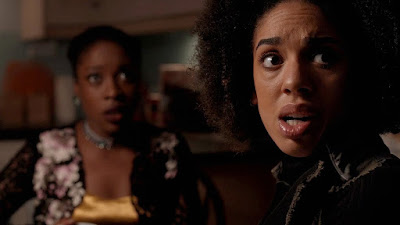
Whithouse didn't even include the most superficial parallels of the
Monks Trilogy in "The Lie of the Land," like a third version of
Bill's date with Ronke Adekoluejo's Penny. It would have been
nicely bleak, as fits the story. But he couldn't even manage that!
As I said in my review of the episode itself, “The Lie of the Land” was a profound screw-up of the highest order. It’s rare when I see a writer so profoundly fail to understand any of the interesting or innovative aspects of a story he’s commissioned for.

The Monks Trilogy was, in my view, the single most ambitious Doctor Who story Steven Moffat ever conceived and actually got on screen. But the messy realities of production meant that the worst writer in his whole stable got stuck having to stick the landing. Whithouse is the only writer in the current stable who’s gotten worse as time went on.

I don’t know that I’ve ever seen a Doctor Who story crash and burn as badly. I think it comes down to the need to have split the entire Monks Trilogy over three different writers. If the whole story could have relied on the one writer who conceived of it being in charge from beginning to end, we would have gotten at least a consistent script from the whole affair.

I count “The Return of Doctor Mysterio” as part of Capaldi’s last season for a few reasons. It’s established Nardole as a companion, foreshadows Bill’s arrival, and most importantly marked the return of Doctor Who since its gap year of 2016.

The show’s absence for an entire year was a strange period – it evoked echoes of the 1986 hiatus, even though the earlier gap was the function of a production and aesthetic catastrophe.

Doctor Who took on the superhero sci-fi genre for the first time with
"The Return of Doctor Mysterio," but couldn't figure out how to
overcome that genre's most ingrained problem, its deep sexism
and refusal to question the ego of the fragile male characters that
make up so many of its traditional protagonists.
Doctor Who was assured a comeback, of course – it was still one of Britain’s most popular television shows domestically, and its leading global export. The contrast was the most jarring aspect of the 2016 gap year.

Two years before, the BBC sent Peter Capaldi and Jenna Coleman did a round-the-world tour in a week to promote the premiere of “Deep Breath.” Now the show was going on break for a year?

So it was wonderful seeing a story as fresh and fun as “The Return of Doctor Mysterio” kick off the return of Doctor Who. And it was a straightforward story of Doctor Who riffing on a classic sci-fi genre it had never tackled before, with a few questionable sexual and romantic threads woven in without question. A fun story that left an icky feeling in me for a few days afterward.

Speaking of icky feelings, “Knock Knock.” Doctor Who goes full Freudian horrorshow with a script that dropped the ball on comprehensive characterization. Despite this, it had some fine camerawork that evoked the classic late 20th century aesthetic of Hammer horror, haunted house films, and a pre-watershed riff on the slasher genre.

Smile” worked out the same way, but Frank Cottrell Boyce crafted a better story overall. The inventiveness of the setting and the nature of the Vardy robots were its best features.

Good work overall in a very creative story. Frank Cottrell Boyce is
becoming Doctor Who's go-to for the trippiest settings and kinds of
existence in the writers' stable.
The visual storytelling was wonderful as well, the contrast of the Vardy surface city and the human spaceship underground overflowing with thematic and conceptual meaning. Boyce seems to be one of the best in the current Doctor Who stable at developing radically different kinds of life.

It was also a great decision to make most of the story a two-hander that gives Pearl Mackie a chance to stretch Bill’s character – a fairly generic approach to the companion lets the actor find her own nuances in the performance. But the very ordinariness of the basic story and plot weighed “Smile” down a little bit.

Speaking of ordinary stories, “The Pyramid at the End of the World” suffered from that a fair bit. Peter Harness’ commission consisted of repeating all the general military action story styles of “The Zygon Inva/ersion” but in a thematic context so different that they’re all kind of empty. He even brought us back to Turmezistan.

That was the main problem of “The Pyramid at the End of the World.” The psychological terror at the heart of the Monks as a concept didn’t fit the story style and setting of the international military thriller. Other than that, Harness understood their core concepts very well.

With “The Empress of Mars,” we really get into the brilliance of this season. Mark Gatiss told a simple fable of the immoral, criminal, petty, chauvinist, cruel, hateful nature of the too-often romanticized British Empire. Not a word or even an image was wasted (even if Friday kind of disappeared from the story in the last act and he just gave up on integrating Nardole into the story).

I'm kind of glad Mark Gatiss will probably never get to play the Doctor
officially, but he's already made a significant historic contribution to
the franchise in so many different ways. His work has only improved
as his time with Doctor Who has gone on.
He did it while expanding the culture of the Ice Warriors in creative and fruitful directions, so future writers have plenty of new places to take these creatures so deeply embedded in Doctor Who. This and “Sleep No More” were his most creative and ambitious stories.

Whether or not he writes for Doctor Who in the future, his best work is probably in front of him, and that’s fantastic.

The Pilot” was of similar quality – Steven Moffat can write tightly-structured, thematically-deep, characterization-rich companion introduction stories in his sleep by now.

Eaters of Light” is the best of the stories of A- rank because it was the story that best-balanced the TARDIS team of the Doctor, Bill, and Nardole in an everyday setting. It was also another stellar contribution to the general theme of this season, Doctor Who’s rejection of Brexit morality.

Like “Empress of Mars,” “Eaters of Light” was fundamentally about the rejection of militarism, imperialism, and nationalism to embrace a plural society whose powers are stronger for their diversity and mutual respect.

Its only real flaw was that the story structure of splitting the main cast up to explore the world efficiently through parallel adventures doesn’t have room to breathe in a single 45 minute episode. It was well-suited to the classic series, where stories were 100-150 minutes long. But now, it’s too rushed.

"Oxygen" was one of the few stories this year to make good use of
the three-person TARDIS team, involving Nardole significantly in
the action as well as Bill. I think a lot of Doctor Who writers don't
have the skill to weave a TARDIS crew of more than two people
into a story effectively, simply because most of the show has
featured only a two-person TARDIS crew. Future writers of a
three-person main case should study this episode, "Eaters of Light,"
this season's finale, and the Pond family era.
Oxygen” is a grade above because its story was perfectly in tune with the possibilities of the 45 minute episode. It was a simple setting – a base under siege – which the Doctor and Bill explored in a clear linear order, where each event revealed more about the central mystery of the story.

It carried another aspect of the anti-Brexit political message of this year’s Doctor Who with an intensely punk fire – a world that opens everything to be bought and sold as a commodity robs all dignity from people’s lives. Their own existences are only as good as their short-term profit margins – we aren’t lives, but assets to be managed or replaced.

Extremis” was the only part of the Monks Trilogy that carried off its core themes and ideas without a hitch, because the person who conceived it is also the one who wrote it. Steven Moffat’s most ambitious story perfectly designed and executed.

Thin Ice” was the clearest and best-executed story that carried Doctor Who’s opposition to Brexit ideology. It firmly punctured the Brexit myth that British isolation was a time of cultural, moral, and political greatness.

Bill visits a world where a petty, self-absorbed racist aristocrat has become an energy industry oligarch by enslaving an alien creature. Here’s a story where poor orphan children, a black lesbian, and an anarchist professor overthrow a repressive business leader and steal his fortune.

Most of the time in "The Doctor Falls," John Simm's Master is part of
the storyline focussing on that character. But it made for a fantastic
moment when he stepped into Bill's storyline to show, univocally,
what a wretched monster the Master is. His taunting her was a
collision that showed the high stakes and radical shift the current
Master was undergoing.
The finale was the pinnacle of this season’s success, however. “World Enough and Time” was a perfectly-made story that assembled a complex script built on a brilliant scientific conceit. Its time dilation narrative hook returned to the 54-year-old mandate of Doctor Who for popular children’s science education.

Meanwhile, that hook was also the lynchpin in a terrifying story of cybernetic body horror – the haunted hospital of living monstrosities, perversions of humanity, and manipulative villains in disguise.

But “The Doctor Falls” was where everything came together with such wonderful perfection.

Its three core stories – Nardole integrating with the Mondasian community, Bill adjusting to her existence as a mutilated Cyberman, and the Master’s ethical redemption – played in parallel with perfect balance. All the performances were at their A-game, perfectly fitting what was necessary for each of their central moments.

Pearl Mackie played her bombast at the epic scale it required – and Rachel Talalay shot it perfectly, cutting between Pearl and Cyber-Bill at just the right moments to maximize her story’s power. But Michelle Gomez gave the best performance of all, because of the subtlety and complexity of her own performance.

In the whole history of the Master's character, from 1971 to today,
46 years later, Michelle Gomez was the most epochal.
Pay close attention to her face and speech in the final confrontation between the Doctor and the two Masters. It tells you all you need to know about how radically the Master has transformed, all in the smallest details of facial expression and voice.

Ultimately, it was a tale of redemption, which is a narrative central to Doctor Who – there can always be a better way forward, even when there isn’t. There’s no better way to have ended the Capaldi years.

So this Xmas is going to have a lot to live up to.
• • •
How does all this stand up to previous Capaldi seasons? His second year was probably the most problematic. Several stories were excellent, particularly “The Zygon Inva/ersion” and “Face the Raven.”

“Heaven Sent” was a revolution for the show, a moment where Steven Moffat brought such talent and concentration to a story that it put an episode of Doctor Who on the same level as the best works of Philip K Dick or Ursula LeGuin.

But Capaldi’s second year suffered from Toby Whithouse’s worst (and now second-worst) script. Plus, there was a lack of thematic unity that led to a kind of scattershot unfolding.

At this point, the arc from "The Doctor Falls" to the Xmas Special is a
serious contender for the best regeneration story in the history of
Doctor Who. If you're going to go out, leave them wanting more.
Even after eight years.
Ashildir’s story was closest to supplying the unity that contemporary Doctor Who seasons need, but it often danced around the potential of her character, staying ultimately at a very superficial level.

The deepest she could explore her isolation was in the joke of naming herself Me, a few scenes of crying in “The Woman Who Lived,” and some bemused indifference in “Hell Bent.” It wasn’t due to Maisie Williams’ performance – she did very well with writing that had trouble grappling with the real existential depth of immortality’s horror.

“Heaven Sent” is where you go for that horror. But the season overall was a grab-bag of mostly disconnected stories with a few ideas – Clara’s recklessness, the experience of immortality – that recurred now and then. Would have been a brilliant construction in the classic era, or even the Davies years. But Moffat has raised the standards on season arcs too high for us to stay with this.

Capaldi’s first year was the tightest story – something of every episode contributed to developing the Clara-Danny love story and the Doctor’s role in it. Its conclusion in “Dark Water” and “Death in Heaven” was beautiful in its power.

But the season itself was so tightly bound to that story, even stories that had little to do with it like “Flatline” found themselves shoehorned in. So there are benefits and problems to that approach.

When it's all over, but not quite yet.
Where does the Capaldi era break down? What was the best season? Well, I can give two answers. One is just with math. Let’s count the number of A-level stories in each season and see what they are as a percentage of the whole.

I’m calculating Capaldi Year One simply as the main Fall run from “Deep Breath” to “Death in Heaven,” counting “Dark Water” and “Death in Heaven” as a single story. Both the Xmas specials “Last Christmas” and “The Husbands of River Song” are part of Capaldi Year Two because they serve as prologue and epilogue to that season’s main run.

Year Three is as I listed above, with a caveat that its score would change depending on the upcoming regeneration story. So the scores.

Year One: 7/11 64%
Year Two: 5/10 50%
Year Three: 8/13 62%

What’s my second answer? It’s about progress. How does each season innovate in what Doctor Who can do? Frankly, I think Capaldi Year Three did the most.

The show developed a strong, principled aesthetic and ethical response to the explosion of Brexit nationalism. In the Monks Trilogy, Moffat crafted his most ambitious piece of writing in a career in which he’s refused to stop pushing himself creatively (even if it did fall flat at the ending).

This season also completely rejuvenated and transformed the character of the Master, so that now the character will be defined by its pre-Gomez and post-Gomez nature. A snarling, cackling villain has now become a nuanced parallel to the Doctor’s own complexity.

That’s what we want Doctor Who (and all our storytelling) to do, right? Spin me a narrative that I haven’t quite heard before.

The Highest Nobility Is Our Virtue, Doctor Who: The Doctor Falls, Reviews, 02/07/2017

How much is going on in “The Doctor Falls,” really? Was I right to save the entire entry on this two-part story for the second week? Honestly, I think I was.

Was this also a scheme to boost a little visibility on Patreon once I start promoting my upcoming book of Capaldi Doctor Who essays? Honestly, I’ll openly tell you that of course it is.

The next few months of 2017, leading up to Peter Capaldi’s actual regeneration in the Xmas Special, will see me actually paying some attention to my Patreon page. I’ll be posting old Doctor Who philosophical reviews a couple of times each week, just to encourage some attention, and driving some social media attention to the page as well.

"The Doctor Falls" provides the narrative gravity of the beginning of a
(21st century Doctor Who style of a) regeneration story by bringing
powerful ideas out of a small setting. The Doctor's greatest nobility is
in the utterly innocuous, a setting without spectacle. Not the whole
Earth at risk, but just a small community of people.
Each of these old posts will be reposted through my Facebook fan page, and through Patreon too. The goal will be attracting a larger audience than my current small set of patrons to fund a larger project – re-editing the old essays, expanding some ideas, and ultimately launching my own book on Capaldi-era Doctor Who.

What more significant place to splash the first step of that promotional campaign than in my review of “World Enough and Time,” and “The Doctor Falls.”

The Weight of the Occasion

“The Doctor Falls,” as an episode of Doctor Who, was written so carefully that almost every line was maximally portentous. Steven Moffat has written eleven season finales or stories with the same symbolic importance.* What do I mean here, when I talk about the symbolic importance of a story.

* I'm counting “A Good Man Goes to War,” “Angels Take Manhattan,” all three “X of the Doctor” stories, and “The Husbands of River Song,” as having the same symbolic importance as a season finale. You’ll see why when I answer the above question.

Let’s start from a common theme that tends to occur in a lot of Doctor Who stories these days. Quite often – but especially so under Moffat’s tenure as creative director and in his stories – 21st century Doctor Who stories tend to include ethics statements for the character.

There's no more epic, intense moment in Doctor Who like a regeneration
story. It's when the entire show literally transforms.
There’ll be some moment in the story where the Doctor or some other character will make a big, powerful statement, highlighted by the narrative and the cinematic emphasis,** about why the Doctor does what he does.

** Big, rousing theme music. An arresting change in camera technique, often focussing more on close-ups to showcase emotionally evocative and powerful performances. Usually occurs at a turning point or a climax in the narrative.

This statement may be in the form of a speech, or an event. Here, it reiterates the point that Moffat made in “Time of the Doctor,” that you take a stand to protect people because the gesture of kindness itself justifies who you are. To be fundamentally kind is to put yourself entirely on the line to protect innocent people under siege.

An Improved Second Draft

Matt Smith’s regeneration story was a wonderfully epic statement of that theme, though the experimental format of “Time of the Doctor” kind of obscured the statement itself.

The extended time frame of that story – an entire community of people growing around the Doctor for centuries as he protected them from an intergalactic siege – kept us from building an emotional connection with any characters.

“The Doctor Falls,” makes, as well as excellent

SPOILERS!!

I loved the madness of the structural complexity that Steven Moffat
achieved in "Time of the Doctor," but I did find that it made the
Doctor into more of a fairy-tale himself than a character. That
fit the imagery Moffat was bringing to the Matt Smith era, but
it also showed a limit of where those images could work.
an excellent contrast. Where “Time of the Doctor” revelled in its jerking, piecemeal, patchwork of a narrative, “The Doctor Falls” keeps things simple. There’s one community, and we’re in it for a mere few weeks. We’re introduced to this community first, a whimsical solar farm under regular siege from the primitive Cyber army.

The cast from “World Enough and Time” breaks into this story and change everything. It’s an excellent example of one type of story – a rural horror story with a few BBC-copyright elements – being smashed into by a crew of sci-fi immortals.

We’re allowed to focus on a few key characters of this rural horror story, the girl Alit and the community matriarch Hazran. We get to know them well enough as an hour-long story can for a couple of supporting characters.

But they carry through to the end of the story, and provide a grace point for Nardole leaving the TARDIS crew. It’s a nice return to the old Doctor Who tradition of companions leaving for a new home, as does Bill.

We follow the same five main characters through the episode. Nardole grows closer to the community. Bill comes to grips with her cybernetic zombification. The Doctor and the Masters battle over whether the villain will ultimately turn.

What I loved best about Michelle Gomez's Master was the stealthy
coldness she kept under her quirky, smirking social personality.
Master of Her Domain

I saw some initial reviews of the episode that called it, “the battle for Missy’s soul.” I mean, that rather missed the point of who Missy actually is. Michelle Gomez and John Simm aren’t playing different characters – they are both the same person.

This is why I think it was a mistake to keep referring to Gomez’s Master as Missy. It implies that she’s actually someone other than the Master. It was brilliant move introduce so casually transgender regeneration.*** It was typical to undercut it with the irreverent playfulness of a Steven Moffat who’s so overjoyed with his own jokes that he’ll throw out exactly the wrong number too many.

*** And tease it in a so-not-really-a-throwaway line.

Understanding the true nature of the Master’s storyline in this episode means knowing all the way through that John Simm is Michelle Gomez for the same reason David Bradley is Peter Capaldi. Gomez and Simm are the Master.

This is a battle, of sorts, between the Doctor and the Master over what kind of person the Master will eventually be. It’s the story of a man seeing his own future and doing everything he can to reject it, and the older one has a few last doubts that this change in life is the right one.

John Simm's Master was – aside from being the only credible one
available – the best contrast for Gomez's most empathetic Master
ever. He was, of all of the major Masters, the one more thoroughly
consumed with hate and rage.
It’s an absolutely beautiful Time Lord story to tell, but one that you could never play with the Doctor. There’s been a constancy to the Doctor pretty much since the Daleks, which prevents you from thinking about the character like this.

For one thing, we see so much of the Doctor as a character – it’s their show, after all – that you don’t really get a big enough gap in our knowledge of him to get such a radical break as Simm to Gomez. Simm’s Master is literally from a totally different era – the Davies era.

Simm’s Master is solidly a Davies creation as well. That frenetic, feverish energy – the sheer giddy delight in the possibilities of the universe.**** Gomez’s Master is speaking of Davies just as much as she is of Simm when she whispers how she so loved the flaming power of being him.*****

**** Contrasting Moffat’s era to Davies’, especially being able to take in the entire Moffat era in memory, truly does show how very rooted in the theatrical gay aesthetic the previous era was.

*****Clearly, Moffat also knows that theatrical aesthetic just as well as Davies. He can see it – he just can’t write it.

This is a fitting end to Gomez's Master. Of course, as soon as two
Masters got together, it could only end with the two betraying
each other at the same moment. Betraying their ostensible allies
is an essential part of the Master's character. But maybe not
anymore.
Gomez’s Master is a cerebral eccentric, a seether. The differences between Gomez and Simm as characters power their story. It’s a story that still, despite the younger man’s intentions, profoundly transformed the Master as a character.

Don’t think that “You won’t regenerate” line is at all sincere. Doctor Who will technobabble its way to a new Master in a few years, whenever Chibnall or some future writer thinks of a good story for her. No, this is the end of Gomez’s Master, and Moffat has given the next writers of Doctor Who a wonderful gift.

What Is a Hero?

Gomez’s Master ended in a moment of genuine goodness – she was at the beginning of an act of kindness, of becoming genuinely heroic. She was already there, and it was utterly justified because she did do it without recognition, as the ethical standard of her season arc said.

To be good without any prospect of recognition or reward is an act of the supreme virtue – kindness. That’s exactly what the Doctor says as the two Masters are leaving the village. Kindness is a good life in itself because of the nobility of kindness – it’s a life without ulterior motive, at its most profound.

You can tell lies, have some hidden motives, because these are petty hypocrisies. It is most profoundly noble to do what you can for others in need with no expectation of your own aggrandizement because you don’t need reputation for the sake of your own self-worth.

The Xmas Special is clearly going to be extremely entertaining, and
the collision of these two Doctors will make for remarkable new
story possibilities. It'll probably be the happiest regeneration
story that we've ever gotten since at least John Hurt's Doctor.
The Doctor has always been this kind of character – pretty much since the second-last episode of “The Daleks.” That’s why such a complex multiple-Doctor story as what the Master went through here ever happen? No matter what can happen with a multiple-Doctor story, the Doctor never stops being a decent person.

The Master has chosen that kind of nobility. From now on, she can no longer be a villain because she has been kind. The Master always had kind of a limited act before now – the same kind of cartoonish villainy Terrance Dicks and Barry Letts thought of. Doctor Who’s very own scenery-chewing Snidely Whiplash.

Overcomplicated evil schemes, the quest for power over the universe, the ruthless embrace of destruction, the gloating obsession with the Doctor. It was as reliable as Daleks shouting “Exterminate!” while they conquer and destroy.

The Master is something different now. An ex-villain in Doctor Who. Someone who has the capacity to commit horrifying acts, who has a history of doing so, but has now turned against it.

The next Master doesn’t have to be a villain. She can be a chaotic, devious sage. A demented and depressed blend of Kali and St. Francis of Assisi. A mad inventor tearing worlds apart in absent-minded enthusiasm. A dedicated revolutionary in too much love with her own violent zealotry.

Michelle Gomez is probably the most significant actor to play the
Master in the character's entire history, simply for incubating so much
more possibility for the character than has ever existed before.
All those are possible directions for the Master’s character that I could think of in a minute’s thinking three hours after seeing where Moffat’s story and Gomez’s performance took her in “The Doctor Falls.” Chris Chibnall is being handed a beautiful present to play with in his era – a Master with more potential than the character’s ever had!

The Weight of the World

Season finales, companion departures, and regenerations are stories that, in the 21st century era of Doctor Who, are moments where the entire ethic of Doctor Who as a show and the Doctor as a character are summed up.

That format gets a slightly different mix every time, depending on what kind of event is the primary reason to maximize symbolic weight. Most sensibly, symbolic power gets its maximum hit from regenerations or companion departures.

The entire show has anchored itself around these characters, so the departure of a lead actor requires a moment of thematic summation. Their story climaxes, giving us the perfect moment to hear what Doctor Who is for this moment, for this companion, for this Doctor.

I could say many wonderful things about Bill. Pearl Mackie is
brilliant when she plays maximum soul-shattering emotional
intensity. Those moments were essential to Bill's story arc
throughout the season. Her transformation into an interstellar
proteus alongside a same-sex life partner already sounds like
the most awesome ending for a companion in the history of
Doctor Who. More about this arc in the book version, I think.
Bill's transformations will be the focus of my "World Enough
and Time" essay.
It wasn’t always this way. But our era of television has viewers that watch it with a special eye toward thematic resonance and meaning. Television literacy understands ideas and symbols with the same ease as plot, performance, and music. We’re pretty much all critics now, in the very good sense of the term.

What does the Doctor say? Not just those words about kindness, but a very existentialist version of them. Where you stand is also where you fall. Stake the possibility of your life or death on one moment.

What kind of person will you be in that moment when you face the possibility of death? That’s the core question of nobility. What is the most impressive and awesome character to embrace at such a critical moment?

Such a character is most inspirational to us ethically – in terms of our virtues – what makes us the best kind of people we can be. What kind of character uses all of humanity’s capacities in their optimal arrangement?

The kind person. That’s the entire ethical message of Doctor Who.
• • •
Read the full set of essays on this year's season of Doctor Who.
The Pilot / The Girl With the Star in Her Eye
Smile
Thin Ice
Knock Knock
Oxygen
Extremis
The Pyramid at the End of the World (1)
The Pyramid at the End of the World (2)
The Lie of the Land
The Monks Trilogy
Empress of Mars
Eaters of Light

Writing A New Master, Composing, 27/06/2017

So I took a break from my Doctor Who blogging, just for this one episode. Next Monday 3 July, I’ll post a review of the Epic Wicked Awesome Body Horror Master Team-Up, taking both episodes as a single story.

A separate essay on World Enough and Time will probably be part of the ebook I’ll publish later in 2018 on the Peter Capaldi years. Now that the Capaldi era is closing, I can actually get a pretty good idea of what that book would look like.

Right now, I have a general count of themes that I’m going to pursue through the Capaldi book. I’m not sure where any principle of unity would come from. I mostly just want to release a pleasantly stimulating book of essays about Doctor Who.

So what would it be about?

Sexual fluidity, for one. Russell T Davies introduced a universe of sexuality’s possibility into Doctor Who, but the TARDIS team itself was dominated by straightness throughout the Tennant and Smith years.

If the TARDIS team of the pansexual Captain Jack’s, the more open character of Rose’s first year, and the queerness of Eccleston’s Doctor had lasted more than three episodes, maybe things would have been different. As it is, we only got to explore a queer TARDIS crew in the Capaldi years.

Clara’s implicit queerness in her final season brought the idea openly into the TARDIS team again, and the main cast has doubled down on queerness through Bill.

But the regeneration of the Master into Michelle Gomez solidly slots 21st century Doctor Who into a queer narrative space. The Time Lords are now canonically and openly able to change genders casually. It’s become so taken for granted in the Capaldi era that there’s an expectation that the next Doctor will be a woman.

Even aesthetically, Gomez's Master dresses in a style that evokes
William Hartnell's Doctor, a science-fictional god in Victorian
inventor's garb.
I do want to explore the centrality of the Master in the Capaldi years. Her power as a narrative force, the new story ideas that Steven Moffat developed for her character. The Master in these years was a destructive anarchist. She no longer thinks of amassing power and conquest – she primarily loves to tear the world down.

Right there is the centre of her redemption arc. All previous versions of the Master were variations on power-hungry schemers. They were tinpot dictators and wannabe authoritarians.

Gomez was the first Master who fully gave in to the Master’s own impulses for destruction for its own sake. She was still a delightful sadist, but was content enough to leave a trail of chaos in her wake.

Just like the trails of chaos and revolution that the Doctor leaves behind him. At this critical point of the Master’s own embrace of the thrill of anarchism and destruction, she’s ripe for an intervention.

The Doctor can train her to channel her revolutionary energy into tearing down the world to provide it new life rather than simply tearing it to pieces. He can teach her that it’s more fun that way.

Just an idea for now.

The Real Enemy, Class: The Metaphysical Engine, Reviews, 30/11/2016

Well, having gotten the opportunity to watch “The Metaphysical Engine, Or: What Quill Did,” I think I can agree with Phil Sandifer’s review of the episode. It’s quite the hot mess. A really cool hot mess with loads of crazy and fascinating sci-fi ideas.

The story is balls out, whack-daddy, batshit crazy. But kind of ridiculous. Just the kind of crazy that Doctor Who has been good at since the early days.

Charlie's prohibition of Quill to use weapons carries a remarkable
double edge, given Rhodian pretensions. Rhodian morality is
insufferably Kantian: to think an evil carries the same burden of
guilt as actually carrying it out, and even their weapons are
condescending exercises in moral ego. You can only kill by taking a
blast backward and killing yourself: the ultimate embrace of the
permanence of sin.
With a storyline utterly all over the place, “The Metaphysical Engine” can only find an anchor in Katherine Kelly’s performance as Quill. And she’s thankfully pouring on the charisma, bringing Quill’s intensity to a fever pitch of anger.

To the audience, Quill has a very deceptive demeanour. Kelly’s physicality appears very cold and distant in the initial promotional material. They shoot her like an ice queen, and her behaviour in the early episodes displays a cold, manipulative aggressiveness.

Rage peeks out from Quill’s stony physiognomy occasionally. As do all her passions. Her genocidal anger at the Shadowkin. The desperate eros of her kiss with the android in “The Coach With the Dragon Tattoo.” The giddy glee of driving a bus into a grotesque alien tentacle.

Patrick Ness cheekily subtitled this episode “What Quill Did.” It’s a joke, a counterpoint to the bottle episode of the under-25s cast* stuck in their classroom in a nameless void.

* Class is positively 90210 in casting adults as teenagers. Charlie’s Greg Austin is 24. Fady Elsayad is 23. Vivian Oparah is 19, but she plays a 14 year old. April’s Sophie Hopkins is 26 years old and plays someone who just turned 18.

Quill's role in the early episodes of the show was to be held at a distance
from the main cast. She was the adult, but also a bodyguard, a slave, and
a sardonic commenter on the teen angst that often consumed the rest of
the characters. That aloofness held her distant from the audience too.
Katherine Kelly’s passion is completely unrestrained in “The Metaphysical Engine.” Not only are her emotions beaming from her, but she can turn her charisma up to the highest possible intensity as well.

She has to, because the episode is a ridiculous Maguffin chase. It succeeds only because its actors are totally dedicated to its madness.

More than just saving the episode from collapsing into a pile of disjunctive nonsense flying away in all directions, Kelly’s charisma as Quill effects a very important transformation in how the audience sees the show.

Heroes and Villains

I’ve come back several times to the moment in the first episode of Class, “For Tonight We Might Die,” where the Doctor admonishes Quill for a crime. She defends herself as a freedom fighter, because she’s long become accustomed to people calling her a criminal because of her guerrilla campaign against Rhodia’s monarchy.

But the Doctor’s upset with her because of how she tricked a Coal Hill student into killing himself firing Quill’s self-sacrificing Rhodian gun at a Shadowkin. The point of the moment is that Quill is not the self-evidently obvious villain that Charlie’s described her as.

The Doctor is the ethical compass of Doctor Who’s universe, and if he sympathizes with you, it’s a sign that you’re in the right. At least in part.

Quill's narrative is fundamentally about overcoming domination,
whether it's from the monarchist government of her homeworld, the
condescending slavery of Prince Charlie, or the pretentious
directions of the mysterious Governors who offer her a chance at
freedom. She's been a democrat the entire time.
Quill is a freedom fighter, but the show has been largely focussed on Charlie, his personal self-discovery, and the ensemble of his new friends. Throughout this episode, Quill is a charismatic adventurer fighting desperately for her freedom. There’s no more sympathetic story in our culture.

Because the under-25s are absent from this episode, we can let ourselves sit with Quill without interruption. She’s in every scene of “The Metaphysical Engine,” carrying the story almost entirely on her own.

This has never happened during the entire run of Class so far. She’s essentially locked the under-25s away where their ensemble can self-destruct and she’s taken over the show.

More than that, she deserves to take over the show by the time “The Metaphysical Engine” finishes. Though it constitutes

SPOILERS

to say so, this episode is her emancipation story. We’ve been shown how much Quill is willing to risk for her freedom from the biological weapon in her brain, enslaving her to Charlie.

The show has challenged Charlie on his treatment of Quill before, most obviously in “Co-Owner of a Lonely Heart.” So we’ve been primed to a more sympathetic view of Quill than the show first gave us when she was Charlie’s ice queen bodyguard and the most psychotic physics teacher you’ve ever had.

The episode includes several confrontations with apparent divinities,
which in a more conventional philosophical review series of Class,
would be the primary focus of this post. But what's more important in
the story itself is Quill's words for her god when they meet. The
encounter with God is an element in her own story of liberation: the
moment when she asks where God was when her people were
humiliated and then destroyed. She speaks the fundamental
existential rage in the human relationship with the divine.
But here, we have Quill’s own journey to free herself – travelling literally to realms that only exist as pure thought. The imagined afterlife of the Arn, the hell of Ballon’s people, the birthplace of the Quill god, the Cabinet of Light itself. All this to free herself. It’s a story of liberation that bestows heroism.

So if Quill has become a hero, Charlie would become even more villainous in contrast. It completes the journey from his squeaky clean appearance at the start of the series, through his critiques from Tanya and Matteusz, through his immense guilt and rage in “Detained.”

More than that narrative role, it shows more profoundly than Class has ever done yet what the nature of heroism is.

Right and Wrong

Because when you think about it, Quill has always been in a subject position. Consider the fact that Charlie – her literal master – always calls her by her surname. A surname that’s also the name for her people. It would be like calling someone “Black” or “China” as their name.

Considering that Andr’ath’s rebellion was the uprising of an oppressed class on Rhodia, there’s probably plenty of racism in Charlie’s condescension toward her. So while Charlie’s been positioned as the hero from the early press materials through the show’s first episodes, Quill is the most sympathetic figure according to all our political moralities.

She is a freedom fighter, and “The Metaphysical Engine” was her most intense fight for freedom yet. As an agent of liberation from racism, monarchy, and slavery, there’s no more pure representative of the good and of freedom than her.

Charlie has entered the role of oppressor, and Quill depicted completely as a freedom fighter.

We Can't Live With Our Scars, Class: Nightvisiting, Reviews, 01/11/2016

Check out my first two reviews of Class, of "For Tonight We Might Die" and "The Coach With the Dragon Tattoo." You can support more TV review projects like this and even bigger things down the road at my Patreon page.
• • •
Three episodes in makes me feel safe enough to offer a casual description of what Class is all about, at least in this first season. It’s grief. 

Exploring all the aspects of grief – how it appears in our lives, what scars and traces it leaves, how it shapes our personalities, the different ways to travel along grief’s line of flight. What grief makes of us and makes us become.

It doesn’t get more explicit in this episode, where,

SPOILERS!!

cited, a hideous alien fungus that feeds off the intense emotional energy of grief squirms through the bunghole of time and manifests in front of thousands of Londoners as their dead loved ones. It speaks with all of them to amp their feelings of grief, sadness, and loss as high as they can go, then wraps them up in its spores.

If I could say there was one issue I had with "Nightvisiting," it would be
that the dialogue was a little too clunky at times. Tanya herself had
some of the most dangerously expository dialogue, occuring in an
emotionally intense dramatic conversation that lasted almost through
the entire episode.
Our Stories Make Sense of Us

The major confrontation the creature has is its talk with Tanya, manifesting as her father Jasper on the two year anniversary of his sudden death from a stroke. 

But it also confronts several of the other cast members, or at least tries to. It appears to Ram as his murdered girlfriend Rachel, naturally, as her killing is the central traumatic event that drives his character. 

The creature talks about how much humans crave closure in their lives, that they let grief and mourning torture themselves so much more than any other species it’s come across.

The reason why is rooted in how we make sense of our lives. Humans understand ourselves by telling stories about ourselves. These are our histories, at all levels of human development, whether as a family, a community, globally, or as individuals. 

We want our narratives to be comprehensive, complete, and clear. Comprehensive in that a narrative offers a full view of what it describes. The story takes in everything that matters to the development it describes. 

This is different from a narrative’s completeness. Being complete is to be definitive – it’s the only story about a person or a development in a person’s life that you need to tell, once it’s been told.

And a narrative is clear when its meaning as it ends is unambiguous, delivering a transparent set of messages. This is “the moral of the story” if I can talk like a mediocre grade school teacher for a moment. 

The ending stuck with you precisely because it refused to be clear-cut.
Most of us had to figure out the true ending, unable to accept the actual
ending of genuine ambiguity. We hate ambiguity enough in real life,
where it happens all the bloody time.
I would say that clarity is the most important feature of a narrative in that introducing even the least unclarity or ambiguity to the meaning or end result of a story is more upsetting than a shortcoming in comprehensiveness or completeness. 

Think of how obsessed so many people were over the ending of Inception. There, the story’s clarity was carefully manipulated to encourage just that reaction among its audience. Constantly arguing and interpreting together whether Leonardo DiCaprio was or wasn’t still in a dreamscape became part of the West’s cultural conversation. 

In that case, it wasn’t a flaw of the story, but an attentively calibrated part of the story itself. The arguments we all had over the meaning of the story were themselves part of the story. It was how Inception literally incepted all of our minds.

Humans fundamentally want the stories we tell to be complete, comprehensive, and clear. This is ultimately true for the stories we tell about ourselves – which is how we make sense of ourselves entirely. We understand our lives by making ourselves into a story.

This is a narrative way of describing what in more ontological philosophy is called the principle of sufficient reason – everything that exists has a cause or reason for its existence that all fits together in a perfect, if madly complicated, order. That the world fits together is the fundamental premise of human reasoning.

My mother even says this as a platitude, and she’s far from the only one. So many times when I’ve faced unforeseen problems or crises, she says, “Everything happens for a reason” to reassure me.

For all that Tanya's Vivian Oparah gets the extra-moving melodramatic
scenes in "Nightvisiting," April's Sophie Hopkins demonstrates the
most virtuoso (and also underrated) skill of any actor: She has some
of the most stilted dialogue in the entire episode, explaining her
history with her abusive alcoholic father to Ram. It's a moment of
simultaneous exposition and emotional rawness, nearly
impossible to carry out at its knife-edge balance.
I respond that this idea only makes sense retroactively, after we’ve already dealt with whatever disaster has been foisted on us. In the moment, I still have to wade through whatever shit that I have to deal with. Mom, you're a Leibnizian who raised an existentialist, and I'm sorry about that.

Grief is so troubling to us because the event of sudden loss or sudden ending destabilizes that premise. For example, Tanya describes how she would check in on her father whenever he came home from a night shift as a police officer because his patrols were a time of danger. 

If one night, Jasper didn’t come home, it would have been terrible, but it would at least have made sense to Tanya. There would be a clear cause in the potentially dangerous work that he did to his own death. Dying of a stroke in the bathroom makes a mockery of that coherence in her life.

That's the real horror of an existentialist look at the world. You accept the fact that a cause isn’t the same as a reason and that our narratives of our life won’t necessarily (or even that often) have clear-cut meanings and results. 

What Our Grief Reveals

Grief is the emotional and subjective dissonance when our yearning for a rational order in our lives meets the fact of real complexity and chaos. These moments of crisis can be quite revealing for a person, as it shows what we depend on to make sense of our existences.

The most illuminating conversation the creature has is with Quill, where it manifests as her sister. This sequence is the most sustained sequence of character development we’ve gotten for Quill so far, as we not only get to see her people’s paradoxical familial relationships, but also a look into her own motives.

Quill’s grief over her family and people – wiped out in the genocide of Rhodia – manifests as an image of who she should be. Ultimately, it isn’t love for her sister that most tempts Quill to let the creature capture her. In human ways of thinking, the pain of sudden loss would be the most enticing lure. 

One criticism that Phil Sandifer's review of the episode mentioned was
that the notion of Tanya's grief over her father being the strongest such
feeling in London seemed a touch sloppy. But I prefer to think of the
creature's focus on Tanya being a matter of her regular proximity to
the time bunghole as well, a mild piece of metafiction that the
interdimensional dangers of the rift affect the show's main cast the
most because it's their job to draw the rift's fire. They're the front
lines on these emotionally vulnerable alien invaders. Sounds like a
fine part-time job while you're finishing up high school.
But for Quill, it’s the fact that she’s been rendered impotent in so many ways. What truly draws her in is the prospect of being a true warrior again. The real object of her grief isn’t even the destruction of her people, but her loss of how she conceived of herself. The loss of her dignity as a warrior.

Charlie always held such emotional distance from his own family that he has no real grief. So the creature can’t even really manifest to him. Charlie’s story doesn’t have a rupture of the sort that breaks his sense of who he is. His narrative remains coherent as the guardian of the souls of his people in the Cabinet of Light.

We’ve already worked through Ram’s grief in the last episode, so Rachel’s spectre freaks him out, but then sends him out on the proactive role that he took on by the end of “The Coach With the Dragon Tattoo.” 

And April has, like Charlie, already repaired whatever breaks in her narrative were caused by the violent abuse of her alcoholic father. The events of her father’s violence became the foundation of her personal strength.

As for Tanya, her defeat of the creature makes clear what seems to be another theme of Class in this first season. She severely weakens the creature by feeding it with her anger instead of the subjective breakdown of grief, so that Quill’s physical attack can force it back into the rift. 

It's literally an instance of a character using the force of her personality to defeat the story’s monster, just as Ram did last week talking the dragon into leaving Earth. So here we have the moral of the story – each of us can find the strength within ourselves to vanquish our demons and become who the world demands we are.

Laugh Until It Hurts, Composing, 14/06/2016

After some email chats with my creative partner on the You Were My Friend film project, I’m diving into the editing process. Samwise sent me back an enormous list of ideas for tweaks, cuts, and streamlines. I sent back an equally enormous list of ideas for some of the same tweaks, different cuts, and streamlining along parallel and similar directions.

Our communications on this are a kind of disjunctive synthesis. One of us will make a suggestion, the other will react, “That’s absolute madness! I’ll get right on it.” At the end of the day, we’ll have an even better script than the one we started with,* which will probably change radically again once we’ve filmed it and we’re in front of the editing suite.

* Which was already brilliant because I wrote it.

Pretentious note. The way we talk back and forth about structure and character kind of reminds me about how I’ve read Gilles Deleuze and Félix Guattari used to write together. Samwise, I promise you that’s a compliment.

I'm not going to get too much into the details of how we’re changing the script, because spoilers and privacy. But I do want to talk about how I approach the two main characters. There have been quite a few posts in the past where I talk about the two central characters of You Were My Friend, mostly from the time of its theatrical production.

That chat with Samwise helped me put my finger on a very important difference between the two characters, Vicki and Madison. We see a decent amount of Vicki’s family life in You Were My Friend

We see her abusive mother, her mostly-absent father, as well as her circle of friends whose abuse and betrayal kick the story into gear. That's the heart of Vicki's development from the start to the end of the narrative – emerging from an environment that never gave her a chance, determined to push against her circumstances and live the life she wants.

Madison comes from an entirely different background. We don’t see her family background at all. At most, all you’re going to get are a few throwaway comments about how boring her neighbourhood is. She grew up in an unremarkable upper-middle class home in the Greater Toronto Area. Maybe I’ll even change her hometown to Oakville so she can come from Upper Middle Road.

That is a real place. But no. No, that would be too ridiculous.

What the movie needs to show for the characters’ histories are the prime influences on their actions in the story itself. And what matters for Madison’s story is her growing disappointment in herself as her career falls to pieces around her.

But Madison’s story amounts to a comedy of errors. Not always necessarily her own errors. She’s a bit like George Costanza or Elaine Benes in a way. She’s a reasonable enough worker, but is constantly stuck in situations that leave her worse off for all her striving.

She goes to work for businesses that sell themselves as dynamic hothouses of innovation. But all their wild new business models turn out to be completely unsustainable because they’re based either on the most horrific sharing economy labour exploitation or their executives simply never thought through how to monetize their work.

In other words, she works for the type of company that populates virtually the entire Toronto startup scene. It's a source of serious hilarity – an entire business world of blowhards who barely even think ahead enough to figure out how their business will even make money. 

Not every startup in the city works like this, but quite a few of them contribute to the economy by spinning their wheels and spending their investors' money until the final collapse.

And working in this insane environment saps Madison's confidence in herself, in her ability to make a decent living, and her ability to think her networks and friendships have any value left at all. 

That's the chemical reaction at the heart of the story.** A young woman who’s building the confidence and personal strength to succeed against long odds builds a close bond with a young woman who’s having all her confidence and strength stripped away.

** Pretentious note two. I sometimes think of how I smash characters together in terms of chemical reactions. Elective affinities, as Goethe once called them. So bloody pretentious.

It's a comedy because their situations are so ridiculous that you laugh. But it's also deadly serious because the reality of their own life on a knife-edge of financial collapse is constantly present. Laughter with a terrible sense of foreboding.

Never Give Up and Never Give In, A History Boy, 08/04/2016


Human politics driven by our ideals puts us at war with the cosmos itself. It means that the ideal of human politics is to demand a better world than the universe is able to give you – if I can’t find it in the world as it is, I’ll build it.

It’s the demand to God herself – I won’t submit to your theodicy; I won’t justify the raw deal of human suffering. My ideal is a world where everyone lives in peace and happiness. Where a single crying child is too much pain to be right, to be justified.

For a Dostoyevsky fan, I've never been that into Crime
and Punishment
, though I do love it. It's a beautiful
book and a fantastically intense character. But I
found the characters themselves tended to become
ciphers for ideas a little too easily. The Wikipedia
page
gives a pretty good sign of how irritatingly
up-front the book is about this breakdown.
Hmmm. Where have I heard that before?

This week’s posts have become a very unexpected series. They aren’t even really a series, as I’ve typically presented these things. Just picking up from the end of one post, moving in a tangent that it suggests, and then repeating the same from another tangent. Today is more of the same. And I hope it’s a little illuminating.

I’ve talked about my love of Fyodor Dostoyevsky’s novels on the blog before, and how much he’s influenced my political thinking. Today, I want to tease out how it makes sense for a strict Russian Orthodox Christian monarchist to have influenced views and ideas like mine.

Begin with the beginning. Dostoyevsky was a radical anti-monarchist revolutionary and atheist. And he got caught. He expected to be executed, because this was 1840s Russia, of course. But the Czar played kind of a cruel trick on him and his co-conspirators. 

Dostoyevsky was led out to a firing squad field, and the execution was proceeding entirely according to protocol. Then as the guns were about to fire, the squad put down their weapons and the drill sergeant announced that their death sentences were commuted by royal decree to several years in Siberia. This isn’t a myth – it was a real event that happened.

That moment of facing the certainty of his own death, seemingly within minutes and seconds, rekindled Dostoyevsky’s faith in God. And he was a dedicated Orthodox Christian and grumpy royalist for the rest of his life. A life he spent tortured by alcoholism and gambling addiction, as well as building one of humanity’s most legendary writing careers. 

Akira Kurosawa made one of the few attempts to adapt
Dostoyevsky's sprawling epic of our interior lives, the
novel of his that first hit my soul, The Idiot.
Because Dostoyevsky didn’t become one of those unfortunate religious converts whose works become an excuse to spout dogma. This isn’t Kirk Cameron we’re talking about here. 

What was most important to Dostoyevsky were the crises themselves – depicting in his art narrative and mental moments of the same terrifying intensity as he experienced up against that wall as a young man. Characters with the singular uniqueness as he felt in that moment when he knew he was going to die – there was never going to be another like him.

The list of Dostoyevsky characters that affected me over the years began with Prince Lev Myshkin in The Idiot, and Parfyon Rogozhin as well. One was the most beautiful vulnerability I had ever seen in a fictional character, and the other was a remarkable, malevolence that would make a heart burn with blackened flame.

After I read The Idiot, I thought that if I could ever create a character in fiction or film with the same intensity and singularity of Myshkin, even if only once, it would be worth all the work to devote at least a part of my life to make art.

I actually read Ivan Karamazov’s monologue about why he’s an atheist before I read the entire book. It was one of the readings from an undergrad course I took on philosophy of religion, presented as a straightforward argument for atheism. 

A poster for the 1969 Russian film
adaptation of The Brothers Karamazov.
It was co-directed by the actors who
played Dmitri and Ivan after the death of
original director Ivan Pyryev, Mikhail
Ulyanov and Kirill Lavrov.
It’s probably the best argument for atheism that exists – it certainly blows away anything Hitchens or Dawkins may have written. It justifies and contributed to my belief that only someone with a deep and complex relationship with the divine can actually explain the deepest philosophical and ethical meaning of atheism.

Essentially, I hold that atheism. It’s an atheism that still believes in God. If you believe that’s contradictory, then you’ve been reading too much Dawkins and you think all you need to do to be a thorough atheist is not go to church and act like scientific knowledge is absolutely perfect.*

* Let’s not get into the contingency of scientific knowledge existing simultaneously with its systematic reliability, or we’ll be here for a whole damn book. And if you want me to write that book, you can subsidize it directly now.

Simply not believing in God because scientific knowledge can’t prove God’s existence is a kind of alienation from the divine. You’re alienated because you may once have expected something to be there that isn’t and never will be.

Ivan Karamazov’s is the atheism that embodies the most robust alienation from God – the ethical. It refuses to accept the legitimacy of the world’s ultimate goodness in the fact of suffering and destruction. 

Theodicy, traditionally speaking, is the moral justification of God’s existence and goodness. Speaking very simply and quickly, it justifies the order and history of the universe as the overall product of God’s plan. All the suffering, cruelty, and destruction of the world is a function of God’s love.

It’s a refusal that the world could be better than it is. The human dedication to political ideals is a profound engagement with reality – a refusal of reality as it exists and an overwhelming desire to rewrite reality. That reality is the reality of God – Reality is the material expression of God. If you have a problem with reality as it is, then you have a problem with God.

Ivan Karamazov is Dostoyevsky the revolutionary. Learning who really murdered his father is Dostoyevsky’s moment in front of the firing squad. The desire to change the world for the better is real. The rage at the world is real. That rage has to build a new world.