There’s no way to write about Gilles Deleuze’s philosophy of art – or theory of art, or conception of art, or however you want to categorize it depending on context – without sounding dirty. So let’s agree that there are going to be double-entendres all over this discussion and move on.
As he writes in What Is Philosophy?, there are three ways to capture the diversity of existence in human activity. He calls these ways chaoids, then never talks about them again because the phrase comes in the conclusion of his last book.
What does that mean for art? It means that art captures and preserves all the varieties of sensations in complex media in a pure manner. This even includes narrative art like fiction and non-fictional writing, and the stories of movies and television series. It includes the aural arts like music, singing, and audio narrative.
Examples of visual arts like painting and sculpture are easy to embed in a written blog post, but Deleuze would never be so reductive about something like this, and if you think he is, you’re misunderstanding his writing.
What could Deleuze mean by ‘pure’ in this case, though? That art preserves sensations in all their varieties in a pure manner. Think about it this way.
If you want to build most things, you have to add something – some material, some representation – to the event that you want to preserve. A monument is the preservation of an event, whether it’s a person’s life or a moment in history. But monuments themselves never preserve the event itself.
Artistic works don’t have the same ambition. You can interpret the hell out of an artwork, looking at what it signifies and represents, of course. Entire intellectual industries are built on this kind of interpretive work, for better or worse. But the art itself doesn’t exist for the sake of what it means or represents.
Even in reading and narrative, meaning becomes sensory, and meaning only returns through more complicated critical readings and interpretations. Interpretation is a separate contribution to the sensory assemblage of an artwork – an assembly of sensation.
His explanation of this in What Is Philosophy? actually did fit with the way I’ve made art – my stories, novels, scripts, and plays. As I outline a story, conceive of a character, interpretation and appearance play back and forth in my mind as I think about the possible meanings of what I’m assembling.
But ultimately, a character is an assemblage of action and thought, and a story is an assemblage of events, whether of plot or of more dynamic character collision. As a machine of interlocking components – characters, plots, settings, imagery – my fiction works in different genres and media build their own logic, their own structure.
An artwork is a machine. Its reality is its functioning, the dynamic interlocking of all its components. Meaning comes later, if at all. Its existence is brute. There-ness. Enter the gallery. Pick it up. Press play.
The everyday contributions of a multi-disciplinary writer and researcher to his own projects
Showing posts with label Aesthetics. Show all posts
The Rankings: Peter Capaldi Year 3, Doctor Who Reviews, 09/07/2017
Sad to see the Peter Capaldi Doctor on his way out, but as far as I’m concerned, the future looks bright. Soon, we’ll see the rumours truly swelling and the name of the next Doctor announced this Fall – I and many others have high hopes for her.
What's interesting is that, as I take stock of the last Capaldi season, I find myself in a bit of a contrarian attitude about it. Maybe it was just the hangover from fandom’s major public love with Clara Oswald, but my sense of the consensus was that the 2017 season was a little underwhelming.
But I thought it was fantastic. In my immediate experience of watching and in my critical evaluations in retrospect, it’s on par with Capaldi’s near-universally loved first year in quality.
Here’s how the rankings themselves worked out. Stories with the same letter grade are arranged according to small gradations of quality, complexity, and dynamic aesthetic harmony.
Quality: How well a story is executed technically, its craftsmanship from idea to script to set to editing suite to screen.
Complexity: How many creative ideas across setting, character, narrative, and theme fit together.
Harmony: How well all those complexities interact to produce a philosophically thick final product – a text which always rewards you with new dimensions every time.
The Doctor Falls A+
World Enough and Time A+
Thin Ice A+
Extremis A
Oxygen A
Eaters of Light A-
The Pilot / The Girl With a Star in Her Eye A-
Empress of Mars A-
The Pyramid at the End of the World B
Smile B
Knock Knock B-
The Return of Doctor Mysterio B-
The Lie of the Land F
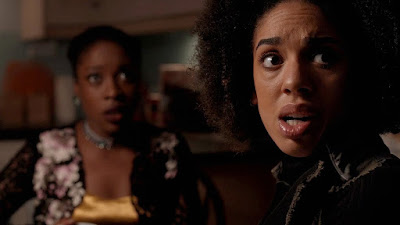
The Lie of the Land” was a profound screw-up of the highest order. It’s rare when I see a writer so profoundly fail to understand any of the interesting or innovative aspects of a story he’s commissioned for.
The Monks Trilogy was, in my view, the single most ambitious Doctor Who story Steven Moffat ever conceived and actually got on screen. But the messy realities of production meant that the worst writer in his whole stable got stuck having to stick the landing. Whithouse is the only writer in the current stable who’s gotten worse as time went on.
I don’t know that I’ve ever seen a Doctor Who story crash and burn as badly. I think it comes down to the need to have split the entire Monks Trilogy over three different writers. If the whole story could have relied on the one writer who conceived of it being in charge from beginning to end, we would have gotten at least a consistent script from the whole affair.
I count “The Return of Doctor Mysterio” as part of Capaldi’s last season for a few reasons. It’s established Nardole as a companion, foreshadows Bill’s arrival, and most importantly marked the return of Doctor Who since its gap year of 2016.
The show’s absence for an entire year was a strange period – it evoked echoes of the 1986 hiatus, even though the earlier gap was the function of a production and aesthetic catastrophe.
Two years before, the BBC sent Peter Capaldi and Jenna Coleman did a round-the-world tour in a week to promote the premiere of “Deep Breath.” Now the show was going on break for a year?
So it was wonderful seeing a story as fresh and fun as “The Return of Doctor Mysterio” kick off the return of Doctor Who. And it was a straightforward story of Doctor Who riffing on a classic sci-fi genre it had never tackled before, with a few questionable sexual and romantic threads woven in without question. A fun story that left an icky feeling in me for a few days afterward.
Speaking of icky feelings, “Knock Knock.” Doctor Who goes full Freudian horrorshow with a script that dropped the ball on comprehensive characterization. Despite this, it had some fine camerawork that evoked the classic late 20th century aesthetic of Hammer horror, haunted house films, and a pre-watershed riff on the slasher genre.
“Smile” worked out the same way, but Frank Cottrell Boyce crafted a better story overall. The inventiveness of the setting and the nature of the Vardy robots were its best features.
The visual storytelling was wonderful as well, the contrast of the Vardy surface city and the human spaceship underground overflowing with thematic and conceptual meaning. Boyce seems to be one of the best in the current Doctor Who stable at developing radically different kinds of life.
It was also a great decision to make most of the story a two-hander that gives Pearl Mackie a chance to stretch Bill’s character – a fairly generic approach to the companion lets the actor find her own nuances in the performance. But the very ordinariness of the basic story and plot weighed “Smile” down a little bit.
Speaking of ordinary stories, “The Pyramid at the End of the World” suffered from that a fair bit. Peter Harness’ commission consisted of repeating all the general military action story styles of “The Zygon Inva/ersion” but in a thematic context so different that they’re all kind of empty. He even brought us back to Turmezistan.
That was the main problem of “The Pyramid at the End of the World.” The psychological terror at the heart of the Monks as a concept didn’t fit the story style and setting of the international military thriller. Other than that, Harness understood their core concepts very well.
With “The Empress of Mars,” we really get into the brilliance of this season. Mark Gatiss told a simple fable of the immoral, criminal, petty, chauvinist, cruel, hateful nature of the too-often romanticized British Empire. Not a word or even an image was wasted (even if Friday kind of disappeared from the story in the last act and he just gave up on integrating Nardole into the story).
He did it while expanding the culture of the Ice Warriors in creative and fruitful directions, so future writers have plenty of new places to take these creatures so deeply embedded in Doctor Who. This and “Sleep No More” were his most creative and ambitious stories.
Whether or not he writes for Doctor Who in the future, his best work is probably in front of him, and that’s fantastic.
“The Pilot” was of similar quality – Steven Moffat can write tightly-structured, thematically-deep, characterization-rich companion introduction stories in his sleep by now.
“Eaters of Light” is the best of the stories of A- rank because it was the story that best-balanced the TARDIS team of the Doctor, Bill, and Nardole in an everyday setting. It was also another stellar contribution to the general theme of this season, Doctor Who’s rejection of Brexit morality.
Like “Empress of Mars,” “Eaters of Light” was fundamentally about the rejection of militarism, imperialism, and nationalism to embrace a plural society whose powers are stronger for their diversity and mutual respect.
Its only real flaw was that the story structure of splitting the main cast up to explore the world efficiently through parallel adventures doesn’t have room to breathe in a single 45 minute episode. It was well-suited to the classic series, where stories were 100-150 minutes long. But now, it’s too rushed.
Oxygen” is a grade above because its story was perfectly in tune with the possibilities of the 45 minute episode. It was a simple setting – a base under siege – which the Doctor and Bill explored in a clear linear order, where each event revealed more about the central mystery of the story.
It carried another aspect of the anti-Brexit political message of this year’s Doctor Who with an intensely punk fire – a world that opens everything to be bought and sold as a commodity robs all dignity from people’s lives. Their own existences are only as good as their short-term profit margins – we aren’t lives, but assets to be managed or replaced.
“Extremis” was the only part of the Monks Trilogy that carried off its core themes and ideas without a hitch, because the person who conceived it is also the one who wrote it. Steven Moffat’s most ambitious story perfectly designed and executed.
“Thin Ice” was the clearest and best-executed story that carried Doctor Who’s opposition to Brexit ideology. It firmly punctured the Brexit myth that British isolation was a time of cultural, moral, and political greatness.
Bill visits a world where a petty, self-absorbed racist aristocrat has become an energy industry oligarch by enslaving an alien creature. Here’s a story where poor orphan children, a black lesbian, and an anarchist professor overthrow a repressive business leader and steal his fortune.
World Enough and Time” was a perfectly-made story that assembled a complex script built on a brilliant scientific conceit. Its time dilation narrative hook returned to the 54-year-old mandate of Doctor Who for popular children’s science education.
Meanwhile, that hook was also the lynchpin in a terrifying story of cybernetic body horror – the haunted hospital of living monstrosities, perversions of humanity, and manipulative villains in disguise.
But “The Doctor Falls” was where everything came together with such wonderful perfection.
Its three core stories – Nardole integrating with the Mondasian community, Bill adjusting to her existence as a mutilated Cyberman, and the Master’s ethical redemption – played in parallel with perfect balance. All the performances were at their A-game, perfectly fitting what was necessary for each of their central moments.
Pearl Mackie played her bombast at the epic scale it required – and Rachel Talalay shot it perfectly, cutting between Pearl and Cyber-Bill at just the right moments to maximize her story’s power. But Michelle Gomez gave the best performance of all, because of the subtlety and complexity of her own performance.
Pay close attention to her face and speech in the final confrontation between the Doctor and the two Masters. It tells you all you need to know about how radically the Master has transformed, all in the smallest details of facial expression and voice.
Ultimately, it was a tale of redemption, which is a narrative central to Doctor Who – there can always be a better way forward, even when there isn’t. There’s no better way to have ended the Capaldi years.
So this Xmas is going to have a lot to live up to.
• • •
How does all this stand up to previous Capaldi seasons? His second year was probably the most problematic. Several stories were excellent, particularly “The Zygon Inva/ersion” and “Face the Raven.”
“Heaven Sent” was a revolution for the show, a moment where Steven Moffat brought such talent and concentration to a story that it put an episode of Doctor Who on the same level as the best works of Philip K Dick or Ursula LeGuin.
But Capaldi’s second year suffered from Toby Whithouse’s worst (and now second-worst) script. Plus, there was a lack of thematic unity that led to a kind of scattershot unfolding.
The deepest she could explore her isolation was in the joke of naming herself Me, a few scenes of crying in “The Woman Who Lived,” and some bemused indifference in “Hell Bent.” It wasn’t due to Maisie Williams’ performance – she did very well with writing that had trouble grappling with the real existential depth of immortality’s horror.
“Heaven Sent” is where you go for that horror. But the season overall was a grab-bag of mostly disconnected stories with a few ideas – Clara’s recklessness, the experience of immortality – that recurred now and then. Would have been a brilliant construction in the classic era, or even the Davies years. But Moffat has raised the standards on season arcs too high for us to stay with this.
Capaldi’s first year was the tightest story – something of every episode contributed to developing the Clara-Danny love story and the Doctor’s role in it. Its conclusion in “Dark Water” and “Death in Heaven” was beautiful in its power.
But the season itself was so tightly bound to that story, even stories that had little to do with it like “Flatline” found themselves shoehorned in. So there are benefits and problems to that approach.
Where does the Capaldi era break down? What was the best season? Well, I can give two answers. One is just with math. Let’s count the number of A-level stories in each season and see what they are as a percentage of the whole.
I’m calculating Capaldi Year One simply as the main Fall run from “Deep Breath” to “Death in Heaven,” counting “Dark Water” and “Death in Heaven” as a single story. Both the Xmas specials “Last Christmas” and “The Husbands of River Song” are part of Capaldi Year Two because they serve as prologue and epilogue to that season’s main run.
Year Three is as I listed above, with a caveat that its score would change depending on the upcoming regeneration story. So the scores.
Year One: 7/11 64%
Year Two: 5/10 50%
Year Three: 8/13 62%
What’s my second answer? It’s about progress. How does each season innovate in what Doctor Who can do? Frankly, I think Capaldi Year Three did the most.
The show developed a strong, principled aesthetic and ethical response to the explosion of Brexit nationalism. In the Monks Trilogy, Moffat crafted his most ambitious piece of writing in a career in which he’s refused to stop pushing himself creatively (even if it did fall flat at the ending).
This season also completely rejuvenated and transformed the character of the Master, so that now the character will be defined by its pre-Gomez and post-Gomez nature. A snarling, cackling villain has now become a nuanced parallel to the Doctor’s own complexity.
That’s what we want Doctor Who (and all our storytelling) to do, right? Spin me a narrative that I haven’t quite heard before.
What's interesting is that, as I take stock of the last Capaldi season, I find myself in a bit of a contrarian attitude about it. Maybe it was just the hangover from fandom’s major public love with Clara Oswald, but my sense of the consensus was that the 2017 season was a little underwhelming.
![]() |
| You've all done amazing work, everyone. Applause all around. |
Here’s how the rankings themselves worked out. Stories with the same letter grade are arranged according to small gradations of quality, complexity, and dynamic aesthetic harmony.
Quality: How well a story is executed technically, its craftsmanship from idea to script to set to editing suite to screen.
Complexity: How many creative ideas across setting, character, narrative, and theme fit together.
Harmony: How well all those complexities interact to produce a philosophically thick final product – a text which always rewards you with new dimensions every time.
The Doctor Falls A+
World Enough and Time A+
Thin Ice A+
Extremis A
Oxygen A
Eaters of Light A-
The Pilot / The Girl With a Star in Her Eye A-
Empress of Mars A-
The Pyramid at the End of the World B
Smile B
Knock Knock B-
The Return of Doctor Mysterio B-
The Lie of the Land F
The Lie of the Land” was a profound screw-up of the highest order. It’s rare when I see a writer so profoundly fail to understand any of the interesting or innovative aspects of a story he’s commissioned for.
The Monks Trilogy was, in my view, the single most ambitious Doctor Who story Steven Moffat ever conceived and actually got on screen. But the messy realities of production meant that the worst writer in his whole stable got stuck having to stick the landing. Whithouse is the only writer in the current stable who’s gotten worse as time went on.
I don’t know that I’ve ever seen a Doctor Who story crash and burn as badly. I think it comes down to the need to have split the entire Monks Trilogy over three different writers. If the whole story could have relied on the one writer who conceived of it being in charge from beginning to end, we would have gotten at least a consistent script from the whole affair.
I count “The Return of Doctor Mysterio” as part of Capaldi’s last season for a few reasons. It’s established Nardole as a companion, foreshadows Bill’s arrival, and most importantly marked the return of Doctor Who since its gap year of 2016.
The show’s absence for an entire year was a strange period – it evoked echoes of the 1986 hiatus, even though the earlier gap was the function of a production and aesthetic catastrophe.
Two years before, the BBC sent Peter Capaldi and Jenna Coleman did a round-the-world tour in a week to promote the premiere of “Deep Breath.” Now the show was going on break for a year?
So it was wonderful seeing a story as fresh and fun as “The Return of Doctor Mysterio” kick off the return of Doctor Who. And it was a straightforward story of Doctor Who riffing on a classic sci-fi genre it had never tackled before, with a few questionable sexual and romantic threads woven in without question. A fun story that left an icky feeling in me for a few days afterward.
Speaking of icky feelings, “Knock Knock.” Doctor Who goes full Freudian horrorshow with a script that dropped the ball on comprehensive characterization. Despite this, it had some fine camerawork that evoked the classic late 20th century aesthetic of Hammer horror, haunted house films, and a pre-watershed riff on the slasher genre.
“Smile” worked out the same way, but Frank Cottrell Boyce crafted a better story overall. The inventiveness of the setting and the nature of the Vardy robots were its best features.
![]() |
| Good work overall in a very creative story. Frank Cottrell Boyce is becoming Doctor Who's go-to for the trippiest settings and kinds of existence in the writers' stable. |
It was also a great decision to make most of the story a two-hander that gives Pearl Mackie a chance to stretch Bill’s character – a fairly generic approach to the companion lets the actor find her own nuances in the performance. But the very ordinariness of the basic story and plot weighed “Smile” down a little bit.
Speaking of ordinary stories, “The Pyramid at the End of the World” suffered from that a fair bit. Peter Harness’ commission consisted of repeating all the general military action story styles of “The Zygon Inva/ersion” but in a thematic context so different that they’re all kind of empty. He even brought us back to Turmezistan.
That was the main problem of “The Pyramid at the End of the World.” The psychological terror at the heart of the Monks as a concept didn’t fit the story style and setting of the international military thriller. Other than that, Harness understood their core concepts very well.
With “The Empress of Mars,” we really get into the brilliance of this season. Mark Gatiss told a simple fable of the immoral, criminal, petty, chauvinist, cruel, hateful nature of the too-often romanticized British Empire. Not a word or even an image was wasted (even if Friday kind of disappeared from the story in the last act and he just gave up on integrating Nardole into the story).
![]() |
| I'm kind of glad Mark Gatiss will probably never get to play the Doctor officially, but he's already made a significant historic contribution to the franchise in so many different ways. His work has only improved as his time with Doctor Who has gone on. |
Whether or not he writes for Doctor Who in the future, his best work is probably in front of him, and that’s fantastic.
“The Pilot” was of similar quality – Steven Moffat can write tightly-structured, thematically-deep, characterization-rich companion introduction stories in his sleep by now.
“Eaters of Light” is the best of the stories of A- rank because it was the story that best-balanced the TARDIS team of the Doctor, Bill, and Nardole in an everyday setting. It was also another stellar contribution to the general theme of this season, Doctor Who’s rejection of Brexit morality.
Like “Empress of Mars,” “Eaters of Light” was fundamentally about the rejection of militarism, imperialism, and nationalism to embrace a plural society whose powers are stronger for their diversity and mutual respect.
Its only real flaw was that the story structure of splitting the main cast up to explore the world efficiently through parallel adventures doesn’t have room to breathe in a single 45 minute episode. It was well-suited to the classic series, where stories were 100-150 minutes long. But now, it’s too rushed.
Oxygen” is a grade above because its story was perfectly in tune with the possibilities of the 45 minute episode. It was a simple setting – a base under siege – which the Doctor and Bill explored in a clear linear order, where each event revealed more about the central mystery of the story.
It carried another aspect of the anti-Brexit political message of this year’s Doctor Who with an intensely punk fire – a world that opens everything to be bought and sold as a commodity robs all dignity from people’s lives. Their own existences are only as good as their short-term profit margins – we aren’t lives, but assets to be managed or replaced.
“Extremis” was the only part of the Monks Trilogy that carried off its core themes and ideas without a hitch, because the person who conceived it is also the one who wrote it. Steven Moffat’s most ambitious story perfectly designed and executed.
“Thin Ice” was the clearest and best-executed story that carried Doctor Who’s opposition to Brexit ideology. It firmly punctured the Brexit myth that British isolation was a time of cultural, moral, and political greatness.
Bill visits a world where a petty, self-absorbed racist aristocrat has become an energy industry oligarch by enslaving an alien creature. Here’s a story where poor orphan children, a black lesbian, and an anarchist professor overthrow a repressive business leader and steal his fortune.
World Enough and Time” was a perfectly-made story that assembled a complex script built on a brilliant scientific conceit. Its time dilation narrative hook returned to the 54-year-old mandate of Doctor Who for popular children’s science education.
Meanwhile, that hook was also the lynchpin in a terrifying story of cybernetic body horror – the haunted hospital of living monstrosities, perversions of humanity, and manipulative villains in disguise.
But “The Doctor Falls” was where everything came together with such wonderful perfection.
Its three core stories – Nardole integrating with the Mondasian community, Bill adjusting to her existence as a mutilated Cyberman, and the Master’s ethical redemption – played in parallel with perfect balance. All the performances were at their A-game, perfectly fitting what was necessary for each of their central moments.
Pearl Mackie played her bombast at the epic scale it required – and Rachel Talalay shot it perfectly, cutting between Pearl and Cyber-Bill at just the right moments to maximize her story’s power. But Michelle Gomez gave the best performance of all, because of the subtlety and complexity of her own performance.
![]() |
| In the whole history of the Master's character, from 1971 to today, 46 years later, Michelle Gomez was the most epochal. |
Ultimately, it was a tale of redemption, which is a narrative central to Doctor Who – there can always be a better way forward, even when there isn’t. There’s no better way to have ended the Capaldi years.
So this Xmas is going to have a lot to live up to.
• • •
How does all this stand up to previous Capaldi seasons? His second year was probably the most problematic. Several stories were excellent, particularly “The Zygon Inva/ersion” and “Face the Raven.”
“Heaven Sent” was a revolution for the show, a moment where Steven Moffat brought such talent and concentration to a story that it put an episode of Doctor Who on the same level as the best works of Philip K Dick or Ursula LeGuin.
But Capaldi’s second year suffered from Toby Whithouse’s worst (and now second-worst) script. Plus, there was a lack of thematic unity that led to a kind of scattershot unfolding.
The deepest she could explore her isolation was in the joke of naming herself Me, a few scenes of crying in “The Woman Who Lived,” and some bemused indifference in “Hell Bent.” It wasn’t due to Maisie Williams’ performance – she did very well with writing that had trouble grappling with the real existential depth of immortality’s horror.
“Heaven Sent” is where you go for that horror. But the season overall was a grab-bag of mostly disconnected stories with a few ideas – Clara’s recklessness, the experience of immortality – that recurred now and then. Would have been a brilliant construction in the classic era, or even the Davies years. But Moffat has raised the standards on season arcs too high for us to stay with this.
Capaldi’s first year was the tightest story – something of every episode contributed to developing the Clara-Danny love story and the Doctor’s role in it. Its conclusion in “Dark Water” and “Death in Heaven” was beautiful in its power.
But the season itself was so tightly bound to that story, even stories that had little to do with it like “Flatline” found themselves shoehorned in. So there are benefits and problems to that approach.
![]() |
| When it's all over, but not quite yet. |
I’m calculating Capaldi Year One simply as the main Fall run from “Deep Breath” to “Death in Heaven,” counting “Dark Water” and “Death in Heaven” as a single story. Both the Xmas specials “Last Christmas” and “The Husbands of River Song” are part of Capaldi Year Two because they serve as prologue and epilogue to that season’s main run.
Year Three is as I listed above, with a caveat that its score would change depending on the upcoming regeneration story. So the scores.
Year One: 7/11 64%
Year Two: 5/10 50%
Year Three: 8/13 62%
What’s my second answer? It’s about progress. How does each season innovate in what Doctor Who can do? Frankly, I think Capaldi Year Three did the most.
The show developed a strong, principled aesthetic and ethical response to the explosion of Brexit nationalism. In the Monks Trilogy, Moffat crafted his most ambitious piece of writing in a career in which he’s refused to stop pushing himself creatively (even if it did fall flat at the ending).
This season also completely rejuvenated and transformed the character of the Master, so that now the character will be defined by its pre-Gomez and post-Gomez nature. A snarling, cackling villain has now become a nuanced parallel to the Doctor’s own complexity.
That’s what we want Doctor Who (and all our storytelling) to do, right? Spin me a narrative that I haven’t quite heard before.
This Mad British Monster II: “He’s My Hero, Man” Jamming, 13/02/2016
This weekend, I’m back to my series on the production eras of Doctor Who. After pausing it for weeks and writing the last part second. And again, the history of Doctor Who has been catalogued for decades by better qualified people than me.
But there's a development in Doctor Who of the 1970s that changed the show forever. The Doctor became an action hero.
Now, the Doctor had been a hero since pretty much the seventh episode just after the start of 1964. But he wasn’t an action hero. The original TARDIS crews of the Doctor, Barbara, Ian, Susan, and then Vicki were ensemble casts.
William Hartnell played the role as a mischievous wizard. In Hartnell’s actual stories on TV, it was only his last full season that moved his character to the centre of the cast. And this was under a producer whose approach did the character few favours, either outright losing, winning with unacceptable costs, or standing up for racist regimes.
It was really only in The War Machines that Hartnell’s Doctor played the lead hero unambiguously, though we can write all kinds of ancillary stories and fan fiction can explore his character in that role. Patrick Troughton’s Doctor was unambiguously heroic, but always maintained a similar aura of the elfin wizard or mad scientist.
Jon Pertwee’s Doctor was a clear, in-your-face action hero. He played a large role in shaping his own performance, but Doctor Who’s creative producers themselves had similar ideas about the character.
Terrance Dicks, script editor during the Pertwee years, was probably the most traditional adventure writer ever to work for Doctor Who. You can see it most clearly in the novelizations of televised stories, many of which he wrote, and which have a cracking, fast pace typical of mid-20th century young adult books targeted toward boys.
![]() |
| Barry Letts on the left, Terrance Dicks on the right. |
Producer Barry Letts accepted this action-oriented direction for the show as part of his radical transformation of Doctor Who. That radical change was a product of necessity, as the Troughton era was very nearly Doctor Who’s last.
The highs of the Troughton era (The Macra Terror, The Power of the Daleks, The Evil of the Daleks, The Enemy of the World, The Mind Robber, The War Games) were very high indeed. But the psychedelic values and tone that Troughton’s weirdest stories carried clashed with the priorities of the producers to make a straight-ahead action show to compete with American imports of Adam West’s Batman.
The result was a fascinating, but very uneven and schizophrenic show whose audience in 1969 was just over a third of what it was in 1966. Letts’ mission was to save the show.
So just in time for Adam West’s Batman to stop production in 1970, Letts, Dicks, and Pertwee launched a Doctor Who that could have won the competition. Keeping the Doctor mostly on Earth for three seasons and giving him a large supporting cast of camp soldiers tasked with protecting the Earth from science-fictional threats paid enormous dividends throughout the era.
It was full-colour, it was action-packed, it had a large recurring cast that included a regular villain in Roger Delgado’s Master. It fit in perfectly with the spy-fi shows that were popular at the time.
![]() |
| There's a 12-minute video on YouTube of Jon Pertwee's Doctor having an adventure in anime style. If I ever get the opportunity to make whatever Doctor Who property I want, I think I'll pair up with a comics artist and make a Jon Pertwee Doctor Who manga. The visual weirdness of his era is perfectly suited to the style. |
Letts and Dicks produced Doctor Who with the high octane style of Adam Adamant, the camp fun of The Avengers, the surreality of The Prisoner, a visual style that was of a piece with the fiery madness of Ziggy Stardust. Even when Letts-Dicks-Pertwee era Doctor Who fell on its face, it did so with such a spectacular insanity that you couldn’t look away.
And Jon Pertwee’s Doctor was the egotistical patrician middle-aged drag queen kung-fu master whose unflappable charm held all this craziness together. He was frequently the (didactic) voice of Letts’ firm ethics, which had fascinating roots in his peace activism, vegetarian morality, and Buddhist religion. It made this Doctor a wonderfully insane assemblage.
But every style runs out of steam eventually and nothing lasts forever. By Letts and Dicks’ fifth year at the helm, they were tired of the grind, and everyone was demoralized by the death of Roger Delgado in a car crash as The Green Death wrapped filming.
So Dicks ceded his script editor’s chair to his era’s best regular writer, Robert Holmes. And Letts helped his successor’s transition, Philip Hinchcliffe. They took Doctor Who into an explicit horror sci-fi style.
Their stories were designed to frighten, a combination of H. P. Lovecraft’s existential terror at the alien unknowable and a visceral body horror that’s of a low-budget piece with the masterworks of David Cronenberg.
At the centre of it all was Tom Baker, the most famous and longest-running of the classic series Doctors. He had a charisma (and an ego as a performer) that put him at the centre of every scene he was in.
![]() |
| Tom Baker and the first appearance of Davros, in Genesis of the Daleks. |
Every actor who appeared with him in Doctor Who had to tune their performance in relation to his. This was a virtue in creating a strong, attractive leading man for a show that anchored the BBC’s Saturday night programming.
And the best scripts put this unflappable anchor in dangerous, horrifying situations – the terror came from the fact that this man was taken from his usual total control over a situation to a position of immense danger.
That was the drama of the Hinchcliffe era to me. You can talk about the aesthetic of horror pastiche in a sci-fi context, which does define their style. But the narrative hooks of the best Hinchcliffe stories are about making you feel the real danger the characters experience when even the supremely confident Tom Baker gets terrified.
Ultimately, that narrative hook brought the Hinchcliffe years to its premature end. Britain’s highest-profile moralistic Christian whack job Mary Whitehouse had, since the horror pastiche aesthetic took hold on Doctor Who, coordinated a letter writing campaign to the BBC calling for its end.
Whitehouse considered the only appropriate programming for the BBC to be 24 hours of G-rated inspirational programming about Christ and British patriotism, with Blyton-level pablum for the children. But she was able to mobilize enough of her fellow repressed ogres to make BBC brass very uncomfortable.
So they caved. Hinchcliffe took over the cop show Z Cars, and Z Cars’ producer Graham Williams took over the production of Doctor Who. Williams had a mandate to tone down the horror of the show. So he rebuilt Doctor Who as a sci-fi adventure-comedy.
This resulted in notes from the BBC brass to tone down the comedy, as executives felt Doctor Who was becoming too silly, at least according to notes from Williams’ therapist.
In terms of quality, the Williams years are something of a mixed bag. A lot of this is because the production values are terrible. Late-1970s Britain was undergoing a period of terrible inflation, and BBC budgets weren’t adjusted in kind. So the money just wasn’t going as far as it used to.
So Williams tried to help his writers develop a tone where the low budgets and largely silly effects contributed to a satirical message. A light-hearted tone that masked incisive messages, themes, and metaphors that explored the injustices of modern Britain and the modern West at every level of cultural analysis.
Stories explored heady topics like freedom of speech in a religious society, how autocratic governments use welfare state policies to silence opposition to war crimes, the collusion of the wealthy with a violent international drug trade, and the oppression of indigenous peoples to strip natural resources from their land.
I mean, wow! Why isn’t the Williams era remembered as the satirical tour de force that it clearly is from that description?
Because while the first two of those stories are Robert Holmes’ masterpiece The Ribos Operation and Douglas Adams’ The Pirate Planet, the other two are the disastrously made Nightmare of Eden and Robert Holmes farting up a first draft and walking away from the program with The Power of Kroll.
That aesthetic is actually very difficult to sustain. For one, the writer must be a genius of balancing tone and characterization while keeping the plot tight and weaving countless themes and ideas into as many different elements of the story as possible. And the rest of the production has to approach the story with the same deft skill, especially when trying to do sci-fi on a late-70s BBC budget.
That’s why the most successful and essential stories of the Williams era were by Douglas Adams.
Because that is, basically, what the Williams era was trying to do. When it was firing on all cylinders, Doctor Who was pretty much indistinguishable from Hitchhikers’ Guide to the Galaxy.
The problem is that Doctor Who has always been a massive show to make, and there are so many cylinders that getting every aspect of production up to that quality is extremely difficult. The Williams era was a wonderful idea that rarely had the resources to succeed.
Some modern writers have tackled the aesthetic of the Williams era pretty successfully. Gareth Roberts is probably the most notable, and his scripts for the Moffat era have achieved a tone and approach similar to what Adams did on his best days. But that era remains best for its few highs, and what we imagine that it could have been.
And ideally, what we can write ourselves today.
Difference and Complexity Makes Good Art, Composing, 24/04/2015
Yesterday, I made a modest contribution to the progressives’ side of the Sad and Rabid Puppies debate. I wrote that post from my perspective as a fan of science-fiction literature (as well as literature in general) and a political progressive who believes that our life improves through complexity, diversity, change, and difference.
But I'm also a science-fiction writer, even if I'm just at the start of my career and I've barely been able to do any promotion. And as a science-fiction writer, I believe that good art comes from exploring diverse styles of narrative, figuring out concepts and characters that have never quite been seen before. The collision of characters with different cultural histories and ways of seeing the world make for new personalities in literature.
Diversity in this context is literally the injection of difference in art. So of course I'm opposed to the ideology of the Puppies. Art made without bothering to explore difference, whether inserting cultural differences or colliding genres, is not good art. Good art doesn’t repeat the same ideas that it always has. It innovates.
Not only do the Puppies believe that art whose themes express cultural diversity could only win awards through a conspiracy of empty affirmative action, they believe that award winning art should be simple and conservative. The first insults minorities. The second insults all our intelligences.
![]() |
| Being disturbed is part of enlightenment. Just go with it. |
I have a single book of sci-fi available right now. You can still buy Under the Trees, Eaten at Amazon, and I encourage you to do that. Its protagonist is a female, its other major character is a Métis man from Quebec. Exploring their cultural and gender differences are a key underlying tension in the entire book’s narrative.
And that isn’t even the main focus of the story. It just accompanies it, giving you an extra layer of ideas in the text for you to think about. I like stimulating art, and so I write it. I’m sorry I haven't been able to promote it much because so much of my time has been taken up by my communications college program. Now that I have more time to explore Toronto, I can find venues for readings and prepare some of the multimedia shows that I want to work on.
Also, artistic impulses never stop until after you die. So I'm already trying out new ideas for fiction work, and I want to keep working in sci-fi.* The Star Trek story I was playing with last month has a curious potential to it.
* I’m going to start revising the A Small Man's Town novel manuscript into linked short stories. But I don't really feel like this is a new project as much as a remix of an old work into a more marketable format.
The Puppies have actually inspired me to expand this idea into something more than an exercise. The sub-genre that the Puppies, especially the Sad ones, believe is ignored would be military science fiction. These are usually sci-fi war novels, the worst of which tend to culturally conservative themes that one-dimensionally value militaristic jingoism, empty patriotism, and an aesthetic of ubiquitous violence.
Star Trek provides an interesting quandary, which the excellent Vaka Rangi blog has led me to explore. Star Trek is a military setting, as Starfleet is an openly military organization, but the overall professed values of the Federation and the values that the Enterprise crew try to live, are those of peace, diversity, and enlightened openness. They live these values not just culturally, but ethically and ontologically. They sometimes face problems that can only be solved by conceiving of entirely new modes of existence.
Why should only Star Trek have a monopoly on such a progressive vision for military science-fiction and humanity as a whole? The characters are all already original. Why not change all the details of the world of Beyond the Farthest Stars, and release it as an epic military sci-fi novel motivated by progressive, diversity-minded political and ethical ideas?
Here’s how such a book would go. I'd drop the episodic structure of a television show and integrate the storylines. The first part would play out pretty much as the first episode summary I wrote on the blog in March.
Ensign Quentin Nichols joins the crew of the Illumination in a series of comedic incidents as the Academy valedictorian befriends the hard-partying men of the bridge crew, including the pan-sexual helmsman Paul Diamond.
The eight-person cast of characters is introduced, with a special focus on Security Chief Natalie Bondar's personal history. A standard pilot episode's plot unfolds where main characters are endangered while rescuing the crew of a damaged freighter, but everyone is excitingly saved.
The freighter itself is carrying contraband, the matter transmuter devices that have made capitalist production obsolete in the Confederation. These machines are tightly controlled because it gives the Confederation their decisive advantage in galactic politics: their entire population is prosperous without any dependence on boom-bust market cycles. The realization of what is essentially a communist utopia has been turned into a weapon of realpolitik and imperial expansion.
In the shadow of the first adventure, BFS’ main plot is introduced. A rival galactic empire may be stoking new conflict on a human colony, a Confederation protectorate that spent 15 years in brutal civil war. The world and the war where Bondar was born.
Part Two finds the Illumination pursuing a lead on the Lacedian covert operative who fuelled the arms trade to the two sides in that war, Lovanek. Through a reasonably plausible narrative contrivance, he and Bondar have personal history. When Bondar and Captain Bajwa find Lovanek, they come under fire from gangsters who’ve come to kill Lovanek, so the crew find themselves having to protect a gunrunner and war criminal. I imagine patterning them after Mexican cartels like the Zetas.
After fighting off the gangsters, the crew discovers evidence linking the Space-Zetas to the stolen matter transmuters, which means Lovanek is involved there too. Bajwa finds himself having to promise Lovanek asylum in the Confederation if he’ll hand over all his evidence about the contraband transmuter trade and betray the Lacedian conspiracy on Bondar’s homeworld.
While all that political narrative is playing out, I’ll also have a story more like a typical first contact story. A scientist on a world that doesn’t yet have interstellar travel is experimenting with a transporter while the Illumination is doing a scientific scan near the planet. He’s beamed aboard for a short set of adventures, learns much about the potential for creatures of many kinds to live among the stars, and returns home confirmed in his conviction to progress his civilization.
The details of the overall story are still sketchy, of course. I’m not yet sure what that conspiracy involving starting a new war on Bondar’s homeworld will involve. I know it’ll have something to do with the transmuter smuggling and the moral consequences of the Confederation so callously manipulating galactic politics with utopian technology. I know it’ll involve a trip to Khohav ben Zion, the Jewish-Yazidi world-ship where Chief Science Officer Solomon was raised. I know the book will have four parts. I imagine I’ll steal a lot of narrative and world-building construction techniques of balancing micro and macro social scales from Tolstoy’s War and Peace, and from Stendahl’s The Red and the Black.
Above all, the climax of the story must come on Bondar’s homeworld, and it must involve an intense sequence of action and character narrative between Bondar and Nichols. Nichols is a creature of privilege: not only is he valedictorian in an institution that values intelligence, and clearly the meta-textual Mary Sue figure of the story, but he lives in an entirely privileged society.
Ubiquitous matter transmutation technology means that no one is poor, hungry, or starving. Prosperity is genuinely universal on worlds where the Confederation government allows transmuters, and Nichols has never lived on worlds without this privilege.
Bondar is literally a child of war. Her entire childhood and adolescence, from age 2 to 17, was consumed by a planet-wide civil conflict. She didn’t join the Confederation because of its material prosperity, which she found hypocritical because prosperity is dispersed as a reward for compliance. She joined the Explorer Fleet because her friend Sidarth Bajwa showed her how journeying through the skies progressing and learning was the greatest life there could be.
Friedrich Nietzsche's Casual Greatness; A History Boy, 23/06/2014
This weekend, I read Nietzsche’s essay “The Case of Wagner,” largely because I felt like it. Nietzsche has been a major philosophical influence on me, to the point where I can say that if I hadn’t read him, I would be a completely different author and person. Nietzsche is another figure in the history of philosophy that I’ve never been taught in class in any great detail. I started reading his work on my own, without any detailed direction from any other professors or similar authority figures.
![]() |
| The egotistical, German nationalist, anti-Semitic Richard Wagner. History has come down on Nietzsche's side in this dispute, I think. |
The Wagner essay is a little minor, not exactly a home of Nietzsche’s most profound or influential ideas, but it’s a beautiful piece that demonstrates his skill as a writer and thinker. But it uses those central ideas in an essay with a specific purpose, a critique of the enormous cultural power of Richard Wagner’s aesthetics in the Germany of his day. Wagner’s art, goes the essay, is an assemblage of pathos. His character arcs are reactive and rather unoriginal (every one of his women, says Nietzsche, has essentially the same narrative arc as Flaubert’s Madame Bovary). His art exists to impress you, to overwhelm you with emotion.
And that’s basically fine, but holding this set of aesthetic goals, as Wagner’s works were, as the pinnacle of a culture’s artistic achievement, speaks terribly for the culture. For me, at least, this gets at the heart of what Nietzsche means when he calls Wagner’s art an expression of cultural decadence. To call an art that revolves entirely around cookie-cutter narratives whose presentation is solely to evoke strong emotion the pinnacle of the form, ignores the multifaceted power of art. To say that this is all you want out of your art reveals how shallow you are.
Because art can encourage philosophical and moral thinking, fiercely radical ideas on personal, moral, political, and even cosmological scales. My girlfriend and I were watching Slavoj Zizek’s new documentary The Pervert’s Guide to Ideology,* which included a discussion of Beethoven’s Ninth. Zizek discusses how the climactic choral movement switches from a bombastic explosion of instrumental and vocal power to a carnivalesque jaunt (in other words, it switches from the famous enormity we’re familiar with from the Ninth to the music that was playing in the record shop where Alex DeLarge picked up those chicks in A Clockwork Orange).** Beethoven here lets his own art critique the bombast of symphonic music; the music moves you and simultaneously carries out a dense task of philosophical aesthetic criticism.
* That’s how cool my girlfriend is; we watch Zizek documentaries together.
** Another aspect of A Clockwork Orange which makes it infinitely superior to the novel, a book remarkable in itself, in that its own author ruined it. It took a fearless filmmaker to bring it to its true greatness.
![]() |
| Fitzcarraldo was sublime in its imagery and fascinating in its philosophical density. |
My own rant about A Clockwork Orange is a Composing post for another time, which will focus on the importance of thematic multiplicity as a necessary condition for a truly great work of art. Werner Herzog is actually a counterpoint to Wagner, as far as explaining the power of the operatic. Arguing against Wagner makes Nietzsche in this essay rather hostile to the operatic form of art itself, which I can understand. So much of opera truly is about the evocation of enormous feeling above all else, an emotional sublime. This is a power to be reckoned with, but Herzog’s art is a creative answer to Nietzsche’s criticism of opera as able to be little more than this.
In his quest for the most remarkable images in the world, Herzog was creating a cinema of opera. Only during the production of Fitzcarraldo did he realize that much of what he had done in his own art was an operatic mode: searching for incredible intensity to capture and put before an audience. One reason he made fewer films in the 1980s was because he was in Germany making operas.
But Herzog’s films were not only acts of emotional intensity; his images evoked concepts and sparked chains of thought that encompassed so many philosophically vital aspects of life. Here are just three examples. An ecologically philosophical meditation on the weakness of simplistic human imperial drives in the face of an implacably complex nature: Fata Morgana, Aguirre, Grizzly Man, Lessons of Darkness. The alien nature of human madness: Stroszek, Woyzeck, Heart of Glass, My Son My Son What Have Ye Done. An exploration of the pinnacle of human virtue and the creation of new moral paradigms through implacable situations: Signs of Life, Fitzcarraldo, Rescue Dawn, Invincible, Bad Lieutenant. This is operatic cinema with the philosophical power of which Nietzsche thought opera was incapable.
• • •
I doubt my own thoughts on “The Case of Wagner” are all that original, however. Werner Herzog has long been associated with existentialism in cinema. The relationship of Nietzsche with Wagner, both the man and his art, have been the focus of works by many philosophers and historians of art and culture. Nietzsche’s concept of decadence as it applies to culture and art is the subject of countless articles across several specialties of modern academic philosophy. Since I’ve been locked out of university libraries for the last year, I’ve had no access to any of the databases whose journals could corroborate my ideas, or indicate just how unoriginal they are.
![]() |
| Friedrich Nietzsche anticipated not only many ideas of 20th century philosophy, but also hipster fashion. |
This is part of why, when I was more firmly inside the academic system, I was always hesitant to focus my research on the history of philosophy. The major and minor figures of the philosophical tradition have been the object of so much scholarship already that it’s difficult to find your own place. You almost have to contort yourself in a ridiculous shape to find anything original to say at all. I was most interested in producing philosophically original work, and still am, which is why I focussed my research on problems from which I could draw upon a wide range of scholarship across debates, disciplines, and fields of knowledge.
Another problem regarded relevance. Nietzsche himself wrote a wonderful character in Zarathustra, the man who was the foremost expert on the brain of the leech. He was brilliant and knowledgable, but his knowledge was so intensely specialized that it was practically useless, and he couldn’t even coordinate his knowledge of the leech’s brain with other biological, neurological, or ecological studies. He knew his narrow corner intimately, but the rest of the world was darkness.
This is how I felt when I learned what kind of scholarship would be necessary to become an expert in a specific figure in the history of philosophy. Reading the primary material of the thinker in question was no problem — these were the philosophically dense and interesting works that started the firestorm of the self-named sub-discipline in the first place.
The ancillary material was a different matter. One would not only have to become an expert in philosopher X, but an expert in all the other experts of philosopher X. This, especially for a central figure in the tradition like Nietzsche or Wittgenstein, would essentially make you into the leech brain expert. Brilliant and knowledgable, but unable to connect any of his work to outside applications. You lived in a brightly illuminated bubble which could light nothing of the darkness around it.
I chose a disciplinary specialty outside of the history of philosophy or the production of secondary material on a historical figure because I wanted my works to contribute to the tradition of which those primary texts were a part: a tradition of philosophical writing and thinking that sought to understand and change the world. Even, perhaps especially, now that I'm outside the formal academic system of the modern university, they still can.
Cross Breeding Literature With Philosophy, Research Time, 12/11/2013
Over the past few days, I’ve read some Arendt, and I’ve read some Said. I’ve had plenty of ideas, but I think the most interesting one revolves around how we understand art, that disciplinary philosophical priorities may not concentrate on what is most interesting philosophically interesting about art.
Reading Joe Margolis’ book on aesthetics helped me get a solid sense of at least one healthily significant debate in North American philosophy of aesthetics, the analysis of beauty and of standards or categories of aesthetic judgment. But this, to me, is not the overriding purpose of aesthetic philosophy. At this point, I will give the caveat that I’m looking into North American aesthetics philosophy only for the first time, as part of a philosophical idea I only recently thought of. I still don’t know the full shape of the wider field, but this post is about just what I’m beginning to learn.
Because reading Said’s Culture and Imperialism so soon after an introduction to the debates of beauty and aesthetic judgment brings two very different debates into very close contact. I don’t know that I would be thinking about this contrast if I had not read the books within a month of each other. But Said is, in some chapters, uncovering and interpreting a political philosophy of colonialism through the analysis of artworks like Joseph Conrad’s Heart of Darkness, Giuseppe Verdi’s Aida, and several telling references to sugar plantations in Antigua in Jane Austen’s Mansfield Park. Through the tools of literary analysis, he is crafting an account of a political philosophy that none of the canonical philosophical thinkers of the same period, the 19th century in Western Europe, openly develop. Or at least, we don’t remember that the central thinkers of liberal traditions have applied their skills at thinking to the justification of empire.
| Diderot was one of the great polymath intellectuals, author of some books that can't be fit into a single category. I consider this high praise. |
Now, an initial reaction might be to say that the action of literary analysis belongs to literary studies, or cultural studies. And that would be true. But a philosopher may have to keep such an ability among his tool chest, in case it turns out to be useful. After all, it’s often no trouble in philosophy to draw upon literature for examples to illustrate a concept.
A book by Timothy Morton, Ecology Without Nature supplied ideas that were very important to my revisions of the ecophilosophy project, and much of that book involved analysis of environmental themes in Romantic literature. When we go back to the Romantic period, we find literature taking on philosophical concerns, and philosophy being composed more like literature. One doesn’t have to be a Romantic itself for that latter, as I think the best examples are Rameau’s Nephew and D’Alembert’s Dream by Denis Diderot, a man who predates the Romantic period.
Even an idea as small-scale as my whimsical weekend blog posts about a fictional television sci-fi show illustrates how philosophical ideas can be woven into popular fiction. If literature and philosophy are to gain from each other, perhaps a solid direction for philosophers to pursue in future is to combine these traditions in new ways.
Love of Wisdom Doesn’t Mean Seeking Eternal Truth, Research Time, 23/10/2013
Some final thoughts after finishing Joe Margolis’ Aesthetics book. The last argument of this short, but dense and rewarding, book is a sustained critique of the major theorist of aesthetics in the English language since the mid-twentieth century, Arthur Danto. An impartial survey this book is not. Ultimately, Margolis sees a fundamental problem in how Danto combines his universalism with his historicism. He says you can combine these productively, but that Danto doesn’t.
Some disclaimers before I riff for a while. One, I don’t yet know a whole hell of a lot about contemporary aesthetic philosophy, and Margolis’ book serves as a critical (and boy, is it ever critical) introduction to Danto’s aesthetic theories. I went to Margolis as a starting point, an entry to the field. I’ve always tried to avoid general survey books or books that claim impartiality when I really want to engage with a new field of thought. It’s the same reason I don’t trust textbooks anymore: they simplify a complex field of thought too much. I’d rather leap into a new field with the help of works by writers whose work I already trust. Like Jean-Paul Sartre helping me dive into Marxism, Joseph Margolis is helping me dive into aesthetic theory.
Two, my remarks today are more general thoughts on whether philosophy, as a discipline, should pursue the truth, rather than pursue truthfully understanding the world. There is a difference between the two.
Danto is quoted, “I am . . . an unabashed essentialist, as much concerned with specifying necessary and sufficient conditions as I would be were I in the immediate company of Socrates, engaged with him in the pursuit of definitions. What may look like historicism on my part is my recognition that except and until art revealed its deep philosophical nature through history, there was nothing philosophers could do, not knowing the way art was to reveal itself.”
Basically, this is sham historicism. Genuine and honest historicism is the view that all of existence is subject to change. We don’t know how that change will come or what will come about, but all is changeable, and will change eventually if you wait long enough. This makes the traditional philosophical quest for the eternal unchanging truth about the world impossible.* In the kind of historicism Danto describes as his own, the flux of history is a means by which conditions eventually arise that reveal eternal truths to us. If we’re paying attention at the right time, eternal truths appear for us to recognize and accept. They could be about any subject: the nature of the good, the character of God, the structure of justice, or the essence of art.
*I don’t think very many people in the discipline think philosophy is about the discovery of eternal truths through pure reason anymore. But it’s an unfortunate tendency of thinking among some mediocre practitioners and some particularly annoying undergraduates.
This isn’t real historicism. It’s lip service to historicist insights so those ideas can be more easily dismissed from an essentialist perspective. If you accept contingency as the nature of the world, then you won’t want an essentialist perspective on the universe. You won’t believe in The Good, but in various goods for creatures and bodies of various types, and their relations. You won’t believe that art has an invariant essence, that there could ever be an unchanging categorical definition of what art is that “carves nature at the joints.”
That old Platonic saying doesn’t realize that the joints of nature change over time, and that a clearly true idea in one context isn’t true in another. This isn’t an arbitrary relativism, because philosophy takes on an ordering task in this vision of truth. Philosophy becomes about mapping truths to their conditions of validity, understanding how the flux of history operates. I think that’s actually a much better practice than how philosophy has been conceived as seeking eternal truths through pure reason. After all, on that latter conception of philosophy, it has an end: when all the truths are discovered, philosophers must retire because the task is done. On my conception of philosophy, the practice need never end, but only change.
Where Is My (Place in the Philosophy of) Mind? A History Boy, 22/10/2013
I suppose I need have had no serious concerns about arguments between Joe Margolis and myself over his treatment of the nature-culture relationship in his Aesthetics book. The last quarter begins with Margolis making the same point I did yesterday about culture being an emergence from natural processes.
This last quarter of the book is where he makes a statement that I knew was lurking under the surface of his analysis for a while, and that I very much agreed with, despite not always wanting to say so. When someone becomes very skilled not only at writing philosophy, but also thinking it, that person can understand how concepts that are at the forefront of one sub-discipline may occur implicitly in a different, seemingly unrelated, field. Margolis is able to connect the tendency of Analytic aesthetics to presume that no cultural knowledge or background is required to understand an artwork, with the principles of eliminativism in philosophy of mind. Both presume that there is nothing about cultural or mental propositions that cannot be explained by reducing them to propositions about natural bodies or mere being in aesthetics, and the brain in theory of mind.
I became fascinated with the problems of the theory of mind in my late undergrad, and wrote my MA thesis on the problem of the relationship of mind to the outside world. I argued, basically, that worldly perception was a part of thought and everything else associated with mind. Internalism about mind makes no sense, the brain in a vat is not a real problem, and one can’t build a workable theory of mind that doesn’t integrate mind with the perceptual relationships of the real world. Basically, exactly Margolis’ point: any account of the human mind and personality is incomplete if it doesn’t include cultural factors, a person’s actual life in the world.
My last public work in philosophy of mind was a commentary I gave at the 2010 Canadian Philosophical Association conference at Concordia University, in Montréal. The paper was about the spectrum inversion problem in philosophy of mind: Victoria sees a particular patch as red, and has seen that colour as red all her life, while Jamie sees and has seen such patches as green, but they both use the word ‘red’ to refer to the colour in question and have no problems saying true propositions about the colour; who sees it correctly?
The most explicit reason why I left philosophy of mind is a question of style. Writing style: the essays in the sub-discipline abound in ridiculously obtuse technical language. Most papers in philosophy of mind contain so much technical shorthand as to make it utterly inaccessible to non-experts. Not just non-philosophers, but non-experts in philosophy of mind. Sometimes even non-experts in that particular sub-discipline of the sub-discipline (which would mean they’ve created sub-sub-disciplines?).
An even worse problem I think was more fundamental. What today is called philosophy of mind has its heritage in cybernetics and the cognitive science that arose from it. This was a very multi-disciplinary community: in addition to philosophers, there were computer scientists, mathematicians, robotics engineers, neurologists, psychologists, and biologists. But as the field evolved, it splintered into a cornucopia of different debates and problems with their own concerns and sets of problems. An intellectual movement that began as a wide variety of disparate researchers coming together fragmented into highly technical debates whose terms and problems have become mutually incompatible.
The paper focussed on the problem of Jamie and Victoria's phenomenal experience. My commentary focussed on what grounds anyone has to say what perceptual qualities are normal in the first place. My critique came from far outside the typical terms of the debate on this problem in philosophy of mind, but I thought it made an interesting challenge. The audience, including a former professor of mine, found my ideas interesting. Through the question period after I delivered my commentary, the presenter didn’t even acknowledge my presence in the room and when the session was over, he stormed out.
What I find the most moribund sub-fields of philosophy of mind are the ones that refuse to accept what Margolis and I understand: that mind is incomplete without its world. The few, like Andy Clark, who try to explain this in the terms of philosophy of mind end up resorting to ridiculous arguments about shopping lists and iPhones. They try to prove that the mind exists in the world because actions we consider mental, like memory, can be carried on outside the skull. With, for example, shopping lists and iPhones.
Having to put the argument in the terms of philosophy of mind makes a profound and intriguing argument sound silly. Margolis, and the Adam Riggio of 2007, are trying to explain how worldly perception grounded in a historically contingent and dynamic set of cultural practices and processes is necessary for a complete understanding of the human mind. I find it incredibly difficult to understand how some highly intelligent people need to have it drummed into their skulls that, in the words of Hilary Putnam, meaning “just ain’t in the head.”
Natural Culture, Research Time, 21/10/2013
A curious idea occurred reading Joe Margolis’ Aesthetics book this weekend. The central motive of the book is that the contemporary Analytic aesthetics discourse in the discipline of philosophy either ignores or refuses to believe an important truth: culture is separate from nature, and cannot be explained entirely in naturalistic terms, referring only to individual thinkers and universal terms. The precise argument I won’t go over here, because it’s extremely complicated, involving an exploration of the Hegelian model of historicizing our aesthetics. I’m writing an 800 word daily blog post, which has a slightly smaller mission statement.
So take it for granted that the framework of aesthetic production and critical appreciation is conditioned by historical contexts and developments. From this, it follows that peculiarly cultural processes are the only such processes that can create what we call art in all its forms, disciplines, and genres, and art’s appreciation and criticism.
![]() |
| If you ever need a visual explanation of the natural character of human culture, watch Werner Herzog's Fata Morgana. Among many things, it shows how even empires rot. |
This would appear at first to put me at odds with my older colleague. My ecophilosophy manuscript describes a conception of culture that is itself a naturally generated process: the plasticity of the human brain enables a creative sense with our artifacts and tools because we become self-conscious of our relationship with the world. Engagement with the world actually drives and shapes the intelligence and personality — self-consciousness — as the higher brain develops through practical action as an infant and toddler. An evolved human trait, a trait that emerged from ecological selective processes, our brain plasticity creates culture.
I latch onto this as the only way to conceive of humanity, as a natural creation, that can condition an unalienated environmental activism. If we see our ecological crises today as a war between the good creative nature and the bad destructive culture, we end up with a politically dangerous environmentalism that devalues humanity through making ourselves other than nature. Overcoming this, we can more easily conceive of humans as natural creatures ourselves, subject to natural happenings like self-extinction from drowning in our own waste matter. How we overcome it is understanding culture as a product of nature, a peculiar adaptation that may be beneficial for some contexts, but not for others.
How to adapt my suspicions that an aesthetically informed ethics can be the philosophical science of virtues that can show us how best to live? If the whole solution to whatever impasse in which contemporary aesthetics finds itself stuck can be solved only be separating nature and culture?
Easy. Just because culture is a natural process doesn’t mean specifically cultural products are of the same kind as non-cultural parts of nature. After all, if cultural products weren’t a radical innovation from what had come before, we cultured creatures wouldn’t have built any of the systems like technology, government, economies, or art. It’s clearly of a different order from what came before.
The ecophilosophy project doesn’t reduce culture to anything. It expands the concept of nature to cover all of what is. Culture is a brand new, peculiar, remarkable creation of nature with its own singular order.
Subscribe to:
Posts (Atom)


