Showing posts with label Reviews. Show all posts

Teaching Prosperity in the Underground, Composing, 29/07/2018

So it’s been almost a week since the last post. I didn’t mean to do this on purpose – it’s just been a busy week. Thankfully, it’s mostly been busy with some promising business opportunities starting to come together.

And sometimes, just some incredibly long days. So long that I’d run out of energy before getting down to write. At least to write this, as I’ve mostly been working on other things that I actually get paid for. The blog is meta – a writing project about my writing projects – meta takes a back seat to actual.

I'm one person, not a mechanical writing machine. I'm powered by
food, coffee, and serotonin.
I’ve started work on a small media project that will involve interviews, and I’m starting to line those up for later in August. More updates to come.

But there are some other interesting developments in my teaching job as well. As you might remember, I published my review of Raphael Sassower’s book The Quest for Prosperity last week. I read it months ago, and only got around to writing it all now.

But that means I’ve had a few months to stew over its arguments and ideas. I think the book does come up short in some areas. But its critical chapters on the political economy of the 21st century global economy are wonderfully insightful.

There's a lot going on in those early chapters of The Quest for Prosperity that I couldn’t fit in all their detail into the main review. I only had so much space and so much time to write the thing. But in working over the ideas, I've begun incorporating them into my teaching work.

To give you an update, I’m the head of a program in Business Administration at a small private college. We’re using a standard set of textbooks, but I’m working on lecture content that itself goes beyond just those lines.

For example, I’m not about to present uncritically a map from Freedom House ranking the economic freedom of different countries around the world. I’m not going full communism in there. I’m just asking students questions about what economic freedom means to them, whether they ultimately agree with Freedom House’s terms, and how to articulate their differences.

The marketplace should be a friendly place.
Actually criticizing some aspects of business school orthodoxy as part of the program is turning into a pretty effective value proposition for the place. Unfortunately for the rest of North American civilization, this is how we stand out from the crowd.

One idea of Sassower’s that I’ve incorporated into my program’s business lectures is how he distinguishes between markets and capitalism. Markets are a matter of what Adam Smith called “truck and barter,” small exchanges among community members that add up to mutual benefit.

Capitalism as an ethical attitude is a spirit of competition, where you can all too easily see another person’s benefit as a potential loss for you. Worse yet, you expect others to see your benefits the same way you see theirs. So you become paranoid, aggressive, and suspicious.

Solidarity is broken. Friendship is impossible.

Manuel DeLanda covered the differences of markets and capitalism in a book published more than 20 years ago. But he had an ontological focus on the macroeconomics of the massive capital flows that industrialization and colonialism powered.

Sassower’s emphasis on political economy foregrounds moral principles and ethical attitudes, so we can see the transformation of a society’s values along with their economic system. Good is no longer giving benefits to your community, but leading your community as a function of your wealth. You don’t want to be part of a community – you want to own it.

Epilogues, Doctor Who: Twice Upon a Time, Reviews, 01/01/2018

You can understand Twice Upon a Time as a profound disappointment. I don’t want to, but you can make a very clear case that it is.

An adventure that wasn’t really an adventure, fighting a threat that was actually unthreatening, shoehorning such an obtuse level of fanwank as material from a missing* episode and the most stealth cosplay of Mark Gatiss’ life.

Multi-Doctor stories happening at Xmas provokes very particular
expectations today, all of which should be overcome and outgrown
if Doctor Who is going to progress and continue. Staleness is
something the show can never let itself accept, or it'll be dead in
the water even if the ratings are incredible.
* Albiet fucking legendary.

Turning Expectations Around

By about the end of Twice Upon a Time, I realized that Stephen Moffat had written the anti Xmas Special. I like to think of it as one last, light-hearted experiment in Doctor Who writing before Moffat moves on from the show after nearly 15 years.

So what, judging by each year’s Xmas Special in 21st century Doctor Who, are the typical expectations? Primarily, I’d have to say an epic scale. They’re usually massive in scale or intensity. Sometimes, they contain major narrative developments for the show – regenerations, companion introductions, companion departures, companion re-introductions.

The Xmas Special model – huge, exciting battles against intense evils, and all the drama and pathos that implies – was a creation of Russell T Davies. Drama and pathos is what he does.

By the end of the relatively short Davies years, his pathos was overpowering to the point of frustration. The 20 minute outro to The End of Time, where David Tennant’s Doctor mysteriously appears to all his old companions as he holds off regeneration, remains excruciating to watch without poking fun at it.

Moffat has dialled down the reliance on pathos in Doctor Who. He’s done it with narrative and continuity events like restoring Gallifrey so the Doctor can breathe as a character again. He’s also done it with a new approach to the show.

In the book version of this essay, I think I'll expand on what Twice
Upon a Time has to say about the nature of memory, and integrate
that more smoothly with the ideas in the rest of the essay. Not yet
sure how that will work, but I'll figure something out this year.
A Complex, Strange Brain

Moffat’s Doctor Who is more cerebral – It's still a family sci-fi anthology adventure show, of course. Its stories tend to conceptual complexity, more dense continuity, and pushing what Doctor Who stories can do.

Cerebral approaches to narrative have their advantages and disadvantages. One advantage is that the show has engaged in more complicated narratives in individual episodes and over whole seasons or more.

A terrible disadvantage is that the show has engaged in more complicated narratives in individual episodes and over whole seasons or more. For every triumph like Silence in the Library, The Impossible Astronaut, or Extremis, there are shit-shows like Let’s Kill Hitler or The Lie of the Land** where all the conceptual, character, and narrative elements collapse.

** Yes, I know Toby Whithouse wrote this episode, not Moffat. But I mention this because the production schedule of the 2017 season meant that Whithouse got the call to finish Moffat’s story – and it was obvious from his episode that he understood none of it.

Moffat’s ideals for building Doctor Who stories and narratives take advantage of the possibilities for more dense, detailed engagements with television in the 2010s. Fans of the show benefit from easy repeat viewing, returns to the show on DVD and streaming platforms.

I did truly love Capaldi's Doctor – the GF liked his take on the character
much better than Matt Smith's. When Capaldi's Doctor is at his best, I
do agree. Even though we've come to expect a change in Doctors to
accompany a change of creative producers, there's nothing necessary
to that, and we shouldn't expect it as a matter of course. But it warmed
my heart a little when Capaldi announced his departure after hearing
of Chibnall's preference for Jodie Whittaker to play the next Doctor.
Doctor Who is no longer something broadcast once or twice and forgotten.*** It’s something that can be studied.

*** Or erased.

I think this might be why – in addition to inconsistent scheduling and the 2016 gap year – Doctor Who’s domestic broadcast ratings have fallen so sharply this season. It’s tougher to follow the show as a casual viewer. You’re now going to understand the full depth of what’s happening if you watch Doctor Who in the same way that you watch Strictly Come Dancing.

It’s why I actually have high hopes for the Chris Chibnall yearsBroadchurch showed his skills at keeping a tight narrative together, as well as how much he’s grown as a writer and producer since his early years on the sometimes brilliant sometimes horrid Torchwood.

Twisting Conventions Until They Explode

Yes, Moffat has shifted Doctor Who’s tone, for the most part, away from overt pathos to a more multifaceted emotional storytelling. But the Xmas Special has resisted this most powerfully.

An Xmas Special is, by its nature, event television, as I said. Moffat’s best Xmas episodes have been big event stories – regenerations like Time of the Doctor or major character events like The Snowmen or The Husbands of River Song. When he’s done an Xmas Special simply because it’s Xmas – Last Christmas or The Return of Doctor Mysterio – they stink.

I want to clear something up. Yes, Moffat established that Gallifreyans
consider gender to be totally fluid, so it's weird to find Bradley's Doctor
making such old-fashioned comments about gender. But that's where
Moffat's humour gets meta-fictional. Moffat's multi-Doctor stories
involve as much commentary on different eras of Doctor Who the
television series as commentary on the characters themselves.
So what made Twice Upon a Time an anti Xmas Special? Two things. Each of which constitutes

SPOILERS

It openly turned the epic expectations of Xmas Specials, regeneration stories, and multi-Doctor stories upside down. First, look at the storyline.

We have Doctors meeting through crossed wires of time tracks or some other temporal technobabble. The first major escalation of the adventure is Capaldi’s confrontational speech to Testimony – it’s exactly as we expect from such an adventure up against creepy CGI glass.

But all those expectations of epic battles are deflated when the Doctor discovers the central motive of Testimony – they really are just time-jumping archivist historians. Their intentions are good and they’re no threat to anyone.

Second, look at the relationship between David Bradley’s Doctor and the current cast. There’s a little meta-fictional joking – the “smacked bottom” joke, Bradley’s horrified reaction to Capaldi’s cyber-goth TARDIS interior, his and Captain LS’ stunned reaction to Bill’s homosexuality. All as we expect from Moffat going meta.

But the point of Bradley’s appearance, thematically, is emotional and ethical. It has nothing to do with plot or transformation of continuity, like the last multi-Doctor story Day of the Doctor.

Essentially, Twice Upon a Time is an hour-long epilogue to The Doctor
Falls. Think about how you'd engage with Capaldi's last season on a
rewatch – Twice Upon a Time would follow The Doctor Falls within
minutes or at least a day or so. With the stories separated by months,
it's tough to see the connections between the stories. It's one way that
Moffat's method of writing Doctor Who has alienated the casual
audience that dominates its domestic viewership.
Capaldi’s Doctor wants to give up on regeneration because he’s weary, and sees his life as futile. That was the crushing conclusion to The Doctor Falls. He’d spent nearly a thousand years guiding the Master to become at least a joyful traveller instead of a super-villain. But he saw only betrayal.

The Master’s redemption in that story fit with the theme, established in Extremis, that the most profound good is unwitnessed and never remembered. We saw the Master’s redemption on those terms, but the Doctor never did. So he kept trying to refuse regeneration, feeling that all his effort in the world was wasted.

Bradley’s Doctor offered Capaldi’s a contrast that showed him what his nihilism amounted to – fear. Bradley’s Doctor was refusing to regenerate because he’d never transformed before – he was afraid of remixing his personality. It was an immature fear, the fear of a very young, almost childish man – I don’t want to grow up.

It contributed to showing Capaldi’s Doctor what it meant to regenerate – to grow, transform, and change. This time, more radically than he had ever before.

Memoriam

Testimony’s mission demonstrated the importance of memory and knowledge, while the story also made a problem of whether memory was all you really needed to constitute a person. Was this story’s Bill really Bill because she was made from her memories?

Mark Gatiss leaves Doctor Who having achieved all of what his inner
fan-child has wanted for most of his life, probably. He got to write an
epochal Ice Warriors story, and playing Captain Archibald was the
closest he could get himself to playing Brigadier Lethbridge-
Stewart in the main show itself.
For the sake of the story, it ultimately didn’t matter, because Testimony’s role in Twice Upon a Time was to provide Capaldi’s Doctor with some closure as he departed. They restored his memories of Clara, gave him a chance to say something like a real goodbye to his friends, and ultimately made what could have been the most irritating piece of obscurantist fanwank in Moffat’s entire tenure meaningful.

That last moment was – as Testimony and the two Doctors both accomplished – giving Captain Archibald Lethbridge-Stewart enough of a sense of hope that he wasn’t really to shoot the wounded German soldier facing him in the crater.

There was a telltale shot in that last Ypres sequence, a closeup of Mark Gatiss’ thumb refusing to pull back the safety catch of his pistol. It lasted just long enough for him to hear the carols of the Christmas Truce – the one moment of hope in all the terror of the First World War.

As Bradley’s Doctor said, the Christmas Truce was a moment that demonstrated what it truly means to be a “Doctor of war.” Someone whose influence can replace nihilism with hope. Thanks to this feeling of hope that shattered Captain Lethbridge-Stewart’s, the Doctor’s old friend Alastair would have grown up with his grandfather.

Celebrating that hope – a feeling that we definitely need to motivate us through what will be more coming terror and violence in 2018 – is what Doctor Who is ultimately about, at its best. By overturning the expectations of an Xmas Special of epic battles and pathos, Stephen Moffat gave us one last moment of Doctor Who at its most inspirational before the new stories begin.

See you in the Autumn.

The Will to Destroy, Composing, 15/08/2017

I’ve been looking back through the old posts for my book of essays on Capaldi era Doctor Who, and I wanted to talk about “Into the Dalek.” I remember the general reaction to this story as being fairly muted.

A lot of my original review of "Into the Dalek" consisted of my own
quick takes on the successes and failures of Dalek stories throughout
the history of Doctor Who. Short form – Dalek stories work when
there's something more interesting than Daleks in them, when the
Daleks act as a catalyst for a more multidimensional narrative that
is the part of the story we can actually give a crap about.
The Daleks are creatures of hype, at least in popular culture. Every time they appear on contemporary Doctor Who, they seem also to get a Radio Times cover. If not that, they end up on the cover of Doctor Who Magazine. So the reception of a Doctor Who Dalek story always runs the risk of underwhelming.

DALEKS!!!! YEAH!!!!

Then it turns out that the storyline is kind of bollocks – a riff on Fantastic Voyage? Seriously? – Returning to The Invisible Enemy as a well worth drawing? Holy fuck. Plus, the characterization is utterly non-existent.

The letdowns can keep you from seeing what was good about the episode, because Dalek stories are connected with such hype.

It didn’t help that Daleks were portrayed at an operatic pitch for so many high-profile episodes of the Russell T Davies era. I feel like one of the reasons Steven Moffat began shifting Daleks away from the centre of Doctor Who adventures throughout his tenure was to make the ‘ordinary Dalek story’ a conceivable story choice again.

Mainly, however, this is a post about how I’ll update those original Doctor Who reviews from 2014 for the current version. There are two directions I could do with “Into the Dalek.” One is to follow along with the ideas of my first review, discussing different ways to make the Daleks actually interesting in a story.

Because it’s really easy to write boring Daleks. “Exterminate!” is all the characterization you need to do. Your entire episode’s plot consists of running away from Daleks and blowing them up. These stories haven’t been exciting to most people since the 1950s.

Another aspect of the Capaldi era that I want to explore in Essays
Critical and Temporal
 is the possible meanings of Peter Capaldi's
hair throughout his era. His rather conservative haircut of the first
series slowly grows into a wilder mess. It seems to parallel the
development of his character in a similarly relaxed direction. As I
remember from an insightful Gareth Roberts tweet, it was only by
his last year in 2017 that they finally wrote Capaldi's Doctor as the
Doctor instead of some angry old man.
But most of my initial review stuck to looking through examples from the show’s history, mining them for good and bad ways to approach Dalek stories. Useful, interesting, but I don’t think as interesting as it could be.

No, what I want for the book version of the “Into the Dalek” essay is to meditate a little longer on the core philosophical conflict of the story itself. Dalek nature is the totalizing will to destroy – so I’ll explore what it means to will destruction, whether Daleks are a death drive in the Freudian sense or something far more horrible.*

* Hint. It’s totally going to be more horrible.

I also want to explore what a profound transformation Rusty makes of his own nature in “Into the Dalek.” He understands the radical principle that there can be an exception to that totalizing will. The central confrontation of the story is the Doctor pushing him one step further in the argument – that an exception to the totality proves its falsity.

If there’s at least one thing not worth destroying, then nothing is worth destroying. At least not as a Dalek does, as an existential mission.

Some potentially deep philosophy going on here.
• • •
If you want to support some of that potentially deep philosophy in this book project, you can start giving to my Patreon. I’ll post a rough budget for the Capaldi Era book project – probably by September. It’ll lay out some basic costs: buying quality copies of the episodes with creator commentaries, printing and production costs. I’ll probably claim the cost of my InDesign subscription for the time I’ll be assembling the book.

Claim? What do I mean by that? You’re my (potential) Patreon supporters. Not my tax accountant.

Anyway, if you like the sound of my project – Essays Critical and Temporal: Peter Capaldi’s Doctor Who** – you can subsidize it with regular donations to my Patreon. Perks, thanks, and gratitude galore.

** Working title. You like it? Let me know.

The Rankings: Peter Capaldi Year 3, Doctor Who Reviews, 09/07/2017

Sad to see the Peter Capaldi Doctor on his way out, but as far as I’m concerned, the future looks bright. Soon, we’ll see the rumours truly swelling and the name of the next Doctor announced this Fall – I and many others have high hopes for her.

What's interesting is that, as I take stock of the last Capaldi season, I find myself in a bit of a contrarian attitude about it. Maybe it was just the hangover from fandom’s major public love with Clara Oswald, but my sense of the consensus was that the 2017 season was a little underwhelming.

You've all done amazing work, everyone. Applause all around.
But I thought it was fantastic. In my immediate experience of watching and in my critical evaluations in retrospect, it’s on par with Capaldi’s near-universally loved first year in quality.

Here’s how the rankings themselves worked out. Stories with the same letter grade are arranged according to small gradations of quality, complexity, and dynamic aesthetic harmony.

Quality: How well a story is executed technically, its craftsmanship from idea to script to set to editing suite to screen.

Complexity: How many creative ideas across setting, character, narrative, and theme fit together.

Harmony: How well all those complexities interact to produce a philosophically thick final product – a text which always rewards you with new dimensions every time.

The Doctor Falls A+
World Enough and Time A+
Thin Ice A+
Extremis A
Oxygen A
Eaters of Light A-
The Pilot / The Girl With a Star in Her Eye A-
Empress of Mars A-
The Pyramid at the End of the World B
Smile B
Knock Knock B-
The Return of Doctor Mysterio B-
The Lie of the Land F
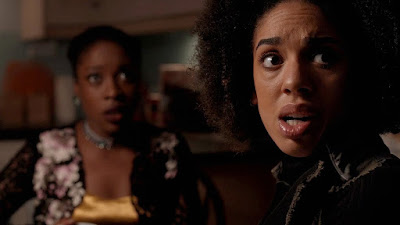
Whithouse didn't even include the most superficial parallels of the
Monks Trilogy in "The Lie of the Land," like a third version of
Bill's date with Ronke Adekoluejo's Penny. It would have been
nicely bleak, as fits the story. But he couldn't even manage that!
As I said in my review of the episode itself, “The Lie of the Land” was a profound screw-up of the highest order. It’s rare when I see a writer so profoundly fail to understand any of the interesting or innovative aspects of a story he’s commissioned for.

The Monks Trilogy was, in my view, the single most ambitious Doctor Who story Steven Moffat ever conceived and actually got on screen. But the messy realities of production meant that the worst writer in his whole stable got stuck having to stick the landing. Whithouse is the only writer in the current stable who’s gotten worse as time went on.

I don’t know that I’ve ever seen a Doctor Who story crash and burn as badly. I think it comes down to the need to have split the entire Monks Trilogy over three different writers. If the whole story could have relied on the one writer who conceived of it being in charge from beginning to end, we would have gotten at least a consistent script from the whole affair.

I count “The Return of Doctor Mysterio” as part of Capaldi’s last season for a few reasons. It’s established Nardole as a companion, foreshadows Bill’s arrival, and most importantly marked the return of Doctor Who since its gap year of 2016.

The show’s absence for an entire year was a strange period – it evoked echoes of the 1986 hiatus, even though the earlier gap was the function of a production and aesthetic catastrophe.

Doctor Who took on the superhero sci-fi genre for the first time with
"The Return of Doctor Mysterio," but couldn't figure out how to
overcome that genre's most ingrained problem, its deep sexism
and refusal to question the ego of the fragile male characters that
make up so many of its traditional protagonists.
Doctor Who was assured a comeback, of course – it was still one of Britain’s most popular television shows domestically, and its leading global export. The contrast was the most jarring aspect of the 2016 gap year.

Two years before, the BBC sent Peter Capaldi and Jenna Coleman did a round-the-world tour in a week to promote the premiere of “Deep Breath.” Now the show was going on break for a year?

So it was wonderful seeing a story as fresh and fun as “The Return of Doctor Mysterio” kick off the return of Doctor Who. And it was a straightforward story of Doctor Who riffing on a classic sci-fi genre it had never tackled before, with a few questionable sexual and romantic threads woven in without question. A fun story that left an icky feeling in me for a few days afterward.

Speaking of icky feelings, “Knock Knock.” Doctor Who goes full Freudian horrorshow with a script that dropped the ball on comprehensive characterization. Despite this, it had some fine camerawork that evoked the classic late 20th century aesthetic of Hammer horror, haunted house films, and a pre-watershed riff on the slasher genre.

Smile” worked out the same way, but Frank Cottrell Boyce crafted a better story overall. The inventiveness of the setting and the nature of the Vardy robots were its best features.

Good work overall in a very creative story. Frank Cottrell Boyce is
becoming Doctor Who's go-to for the trippiest settings and kinds of
existence in the writers' stable.
The visual storytelling was wonderful as well, the contrast of the Vardy surface city and the human spaceship underground overflowing with thematic and conceptual meaning. Boyce seems to be one of the best in the current Doctor Who stable at developing radically different kinds of life.

It was also a great decision to make most of the story a two-hander that gives Pearl Mackie a chance to stretch Bill’s character – a fairly generic approach to the companion lets the actor find her own nuances in the performance. But the very ordinariness of the basic story and plot weighed “Smile” down a little bit.

Speaking of ordinary stories, “The Pyramid at the End of the World” suffered from that a fair bit. Peter Harness’ commission consisted of repeating all the general military action story styles of “The Zygon Inva/ersion” but in a thematic context so different that they’re all kind of empty. He even brought us back to Turmezistan.

That was the main problem of “The Pyramid at the End of the World.” The psychological terror at the heart of the Monks as a concept didn’t fit the story style and setting of the international military thriller. Other than that, Harness understood their core concepts very well.

With “The Empress of Mars,” we really get into the brilliance of this season. Mark Gatiss told a simple fable of the immoral, criminal, petty, chauvinist, cruel, hateful nature of the too-often romanticized British Empire. Not a word or even an image was wasted (even if Friday kind of disappeared from the story in the last act and he just gave up on integrating Nardole into the story).

I'm kind of glad Mark Gatiss will probably never get to play the Doctor
officially, but he's already made a significant historic contribution to
the franchise in so many different ways. His work has only improved
as his time with Doctor Who has gone on.
He did it while expanding the culture of the Ice Warriors in creative and fruitful directions, so future writers have plenty of new places to take these creatures so deeply embedded in Doctor Who. This and “Sleep No More” were his most creative and ambitious stories.

Whether or not he writes for Doctor Who in the future, his best work is probably in front of him, and that’s fantastic.

The Pilot” was of similar quality – Steven Moffat can write tightly-structured, thematically-deep, characterization-rich companion introduction stories in his sleep by now.

Eaters of Light” is the best of the stories of A- rank because it was the story that best-balanced the TARDIS team of the Doctor, Bill, and Nardole in an everyday setting. It was also another stellar contribution to the general theme of this season, Doctor Who’s rejection of Brexit morality.

Like “Empress of Mars,” “Eaters of Light” was fundamentally about the rejection of militarism, imperialism, and nationalism to embrace a plural society whose powers are stronger for their diversity and mutual respect.

Its only real flaw was that the story structure of splitting the main cast up to explore the world efficiently through parallel adventures doesn’t have room to breathe in a single 45 minute episode. It was well-suited to the classic series, where stories were 100-150 minutes long. But now, it’s too rushed.

"Oxygen" was one of the few stories this year to make good use of
the three-person TARDIS team, involving Nardole significantly in
the action as well as Bill. I think a lot of Doctor Who writers don't
have the skill to weave a TARDIS crew of more than two people
into a story effectively, simply because most of the show has
featured only a two-person TARDIS crew. Future writers of a
three-person main case should study this episode, "Eaters of Light,"
this season's finale, and the Pond family era.
Oxygen” is a grade above because its story was perfectly in tune with the possibilities of the 45 minute episode. It was a simple setting – a base under siege – which the Doctor and Bill explored in a clear linear order, where each event revealed more about the central mystery of the story.

It carried another aspect of the anti-Brexit political message of this year’s Doctor Who with an intensely punk fire – a world that opens everything to be bought and sold as a commodity robs all dignity from people’s lives. Their own existences are only as good as their short-term profit margins – we aren’t lives, but assets to be managed or replaced.

Extremis” was the only part of the Monks Trilogy that carried off its core themes and ideas without a hitch, because the person who conceived it is also the one who wrote it. Steven Moffat’s most ambitious story perfectly designed and executed.

Thin Ice” was the clearest and best-executed story that carried Doctor Who’s opposition to Brexit ideology. It firmly punctured the Brexit myth that British isolation was a time of cultural, moral, and political greatness.

Bill visits a world where a petty, self-absorbed racist aristocrat has become an energy industry oligarch by enslaving an alien creature. Here’s a story where poor orphan children, a black lesbian, and an anarchist professor overthrow a repressive business leader and steal his fortune.

Most of the time in "The Doctor Falls," John Simm's Master is part of
the storyline focussing on that character. But it made for a fantastic
moment when he stepped into Bill's storyline to show, univocally,
what a wretched monster the Master is. His taunting her was a
collision that showed the high stakes and radical shift the current
Master was undergoing.
The finale was the pinnacle of this season’s success, however. “World Enough and Time” was a perfectly-made story that assembled a complex script built on a brilliant scientific conceit. Its time dilation narrative hook returned to the 54-year-old mandate of Doctor Who for popular children’s science education.

Meanwhile, that hook was also the lynchpin in a terrifying story of cybernetic body horror – the haunted hospital of living monstrosities, perversions of humanity, and manipulative villains in disguise.

But “The Doctor Falls” was where everything came together with such wonderful perfection.

Its three core stories – Nardole integrating with the Mondasian community, Bill adjusting to her existence as a mutilated Cyberman, and the Master’s ethical redemption – played in parallel with perfect balance. All the performances were at their A-game, perfectly fitting what was necessary for each of their central moments.

Pearl Mackie played her bombast at the epic scale it required – and Rachel Talalay shot it perfectly, cutting between Pearl and Cyber-Bill at just the right moments to maximize her story’s power. But Michelle Gomez gave the best performance of all, because of the subtlety and complexity of her own performance.

In the whole history of the Master's character, from 1971 to today,
46 years later, Michelle Gomez was the most epochal.
Pay close attention to her face and speech in the final confrontation between the Doctor and the two Masters. It tells you all you need to know about how radically the Master has transformed, all in the smallest details of facial expression and voice.

Ultimately, it was a tale of redemption, which is a narrative central to Doctor Who – there can always be a better way forward, even when there isn’t. There’s no better way to have ended the Capaldi years.

So this Xmas is going to have a lot to live up to.
• • •
How does all this stand up to previous Capaldi seasons? His second year was probably the most problematic. Several stories were excellent, particularly “The Zygon Inva/ersion” and “Face the Raven.”

“Heaven Sent” was a revolution for the show, a moment where Steven Moffat brought such talent and concentration to a story that it put an episode of Doctor Who on the same level as the best works of Philip K Dick or Ursula LeGuin.

But Capaldi’s second year suffered from Toby Whithouse’s worst (and now second-worst) script. Plus, there was a lack of thematic unity that led to a kind of scattershot unfolding.

At this point, the arc from "The Doctor Falls" to the Xmas Special is a
serious contender for the best regeneration story in the history of
Doctor Who. If you're going to go out, leave them wanting more.
Even after eight years.
Ashildir’s story was closest to supplying the unity that contemporary Doctor Who seasons need, but it often danced around the potential of her character, staying ultimately at a very superficial level.

The deepest she could explore her isolation was in the joke of naming herself Me, a few scenes of crying in “The Woman Who Lived,” and some bemused indifference in “Hell Bent.” It wasn’t due to Maisie Williams’ performance – she did very well with writing that had trouble grappling with the real existential depth of immortality’s horror.

“Heaven Sent” is where you go for that horror. But the season overall was a grab-bag of mostly disconnected stories with a few ideas – Clara’s recklessness, the experience of immortality – that recurred now and then. Would have been a brilliant construction in the classic era, or even the Davies years. But Moffat has raised the standards on season arcs too high for us to stay with this.

Capaldi’s first year was the tightest story – something of every episode contributed to developing the Clara-Danny love story and the Doctor’s role in it. Its conclusion in “Dark Water” and “Death in Heaven” was beautiful in its power.

But the season itself was so tightly bound to that story, even stories that had little to do with it like “Flatline” found themselves shoehorned in. So there are benefits and problems to that approach.

When it's all over, but not quite yet.
Where does the Capaldi era break down? What was the best season? Well, I can give two answers. One is just with math. Let’s count the number of A-level stories in each season and see what they are as a percentage of the whole.

I’m calculating Capaldi Year One simply as the main Fall run from “Deep Breath” to “Death in Heaven,” counting “Dark Water” and “Death in Heaven” as a single story. Both the Xmas specials “Last Christmas” and “The Husbands of River Song” are part of Capaldi Year Two because they serve as prologue and epilogue to that season’s main run.

Year Three is as I listed above, with a caveat that its score would change depending on the upcoming regeneration story. So the scores.

Year One: 7/11 64%
Year Two: 5/10 50%
Year Three: 8/13 62%

What’s my second answer? It’s about progress. How does each season innovate in what Doctor Who can do? Frankly, I think Capaldi Year Three did the most.

The show developed a strong, principled aesthetic and ethical response to the explosion of Brexit nationalism. In the Monks Trilogy, Moffat crafted his most ambitious piece of writing in a career in which he’s refused to stop pushing himself creatively (even if it did fall flat at the ending).

This season also completely rejuvenated and transformed the character of the Master, so that now the character will be defined by its pre-Gomez and post-Gomez nature. A snarling, cackling villain has now become a nuanced parallel to the Doctor’s own complexity.

That’s what we want Doctor Who (and all our storytelling) to do, right? Spin me a narrative that I haven’t quite heard before.

The Highest Nobility Is Our Virtue, Doctor Who: The Doctor Falls, Reviews, 02/07/2017

How much is going on in “The Doctor Falls,” really? Was I right to save the entire entry on this two-part story for the second week? Honestly, I think I was.

Was this also a scheme to boost a little visibility on Patreon once I start promoting my upcoming book of Capaldi Doctor Who essays? Honestly, I’ll openly tell you that of course it is.

The next few months of 2017, leading up to Peter Capaldi’s actual regeneration in the Xmas Special, will see me actually paying some attention to my Patreon page. I’ll be posting old Doctor Who philosophical reviews a couple of times each week, just to encourage some attention, and driving some social media attention to the page as well.

"The Doctor Falls" provides the narrative gravity of the beginning of a
(21st century Doctor Who style of a) regeneration story by bringing
powerful ideas out of a small setting. The Doctor's greatest nobility is
in the utterly innocuous, a setting without spectacle. Not the whole
Earth at risk, but just a small community of people.
Each of these old posts will be reposted through my Facebook fan page, and through Patreon too. The goal will be attracting a larger audience than my current small set of patrons to fund a larger project – re-editing the old essays, expanding some ideas, and ultimately launching my own book on Capaldi-era Doctor Who.

What more significant place to splash the first step of that promotional campaign than in my review of “World Enough and Time,” and “The Doctor Falls.”

The Weight of the Occasion

“The Doctor Falls,” as an episode of Doctor Who, was written so carefully that almost every line was maximally portentous. Steven Moffat has written eleven season finales or stories with the same symbolic importance.* What do I mean here, when I talk about the symbolic importance of a story.

* I'm counting “A Good Man Goes to War,” “Angels Take Manhattan,” all three “X of the Doctor” stories, and “The Husbands of River Song,” as having the same symbolic importance as a season finale. You’ll see why when I answer the above question.

Let’s start from a common theme that tends to occur in a lot of Doctor Who stories these days. Quite often – but especially so under Moffat’s tenure as creative director and in his stories – 21st century Doctor Who stories tend to include ethics statements for the character.

There's no more epic, intense moment in Doctor Who like a regeneration
story. It's when the entire show literally transforms.
There’ll be some moment in the story where the Doctor or some other character will make a big, powerful statement, highlighted by the narrative and the cinematic emphasis,** about why the Doctor does what he does.

** Big, rousing theme music. An arresting change in camera technique, often focussing more on close-ups to showcase emotionally evocative and powerful performances. Usually occurs at a turning point or a climax in the narrative.

This statement may be in the form of a speech, or an event. Here, it reiterates the point that Moffat made in “Time of the Doctor,” that you take a stand to protect people because the gesture of kindness itself justifies who you are. To be fundamentally kind is to put yourself entirely on the line to protect innocent people under siege.

An Improved Second Draft

Matt Smith’s regeneration story was a wonderfully epic statement of that theme, though the experimental format of “Time of the Doctor” kind of obscured the statement itself.

The extended time frame of that story – an entire community of people growing around the Doctor for centuries as he protected them from an intergalactic siege – kept us from building an emotional connection with any characters.

“The Doctor Falls,” makes, as well as excellent

SPOILERS!!

I loved the madness of the structural complexity that Steven Moffat
achieved in "Time of the Doctor," but I did find that it made the
Doctor into more of a fairy-tale himself than a character. That
fit the imagery Moffat was bringing to the Matt Smith era, but
it also showed a limit of where those images could work.
an excellent contrast. Where “Time of the Doctor” revelled in its jerking, piecemeal, patchwork of a narrative, “The Doctor Falls” keeps things simple. There’s one community, and we’re in it for a mere few weeks. We’re introduced to this community first, a whimsical solar farm under regular siege from the primitive Cyber army.

The cast from “World Enough and Time” breaks into this story and change everything. It’s an excellent example of one type of story – a rural horror story with a few BBC-copyright elements – being smashed into by a crew of sci-fi immortals.

We’re allowed to focus on a few key characters of this rural horror story, the girl Alit and the community matriarch Hazran. We get to know them well enough as an hour-long story can for a couple of supporting characters.

But they carry through to the end of the story, and provide a grace point for Nardole leaving the TARDIS crew. It’s a nice return to the old Doctor Who tradition of companions leaving for a new home, as does Bill.

We follow the same five main characters through the episode. Nardole grows closer to the community. Bill comes to grips with her cybernetic zombification. The Doctor and the Masters battle over whether the villain will ultimately turn.

What I loved best about Michelle Gomez's Master was the stealthy
coldness she kept under her quirky, smirking social personality.
Master of Her Domain

I saw some initial reviews of the episode that called it, “the battle for Missy’s soul.” I mean, that rather missed the point of who Missy actually is. Michelle Gomez and John Simm aren’t playing different characters – they are both the same person.

This is why I think it was a mistake to keep referring to Gomez’s Master as Missy. It implies that she’s actually someone other than the Master. It was brilliant move introduce so casually transgender regeneration.*** It was typical to undercut it with the irreverent playfulness of a Steven Moffat who’s so overjoyed with his own jokes that he’ll throw out exactly the wrong number too many.

*** And tease it in a so-not-really-a-throwaway line.

Understanding the true nature of the Master’s storyline in this episode means knowing all the way through that John Simm is Michelle Gomez for the same reason David Bradley is Peter Capaldi. Gomez and Simm are the Master.

This is a battle, of sorts, between the Doctor and the Master over what kind of person the Master will eventually be. It’s the story of a man seeing his own future and doing everything he can to reject it, and the older one has a few last doubts that this change in life is the right one.

John Simm's Master was – aside from being the only credible one
available – the best contrast for Gomez's most empathetic Master
ever. He was, of all of the major Masters, the one more thoroughly
consumed with hate and rage.
It’s an absolutely beautiful Time Lord story to tell, but one that you could never play with the Doctor. There’s been a constancy to the Doctor pretty much since the Daleks, which prevents you from thinking about the character like this.

For one thing, we see so much of the Doctor as a character – it’s their show, after all – that you don’t really get a big enough gap in our knowledge of him to get such a radical break as Simm to Gomez. Simm’s Master is literally from a totally different era – the Davies era.

Simm’s Master is solidly a Davies creation as well. That frenetic, feverish energy – the sheer giddy delight in the possibilities of the universe.**** Gomez’s Master is speaking of Davies just as much as she is of Simm when she whispers how she so loved the flaming power of being him.*****

**** Contrasting Moffat’s era to Davies’, especially being able to take in the entire Moffat era in memory, truly does show how very rooted in the theatrical gay aesthetic the previous era was.

*****Clearly, Moffat also knows that theatrical aesthetic just as well as Davies. He can see it – he just can’t write it.

This is a fitting end to Gomez's Master. Of course, as soon as two
Masters got together, it could only end with the two betraying
each other at the same moment. Betraying their ostensible allies
is an essential part of the Master's character. But maybe not
anymore.
Gomez’s Master is a cerebral eccentric, a seether. The differences between Gomez and Simm as characters power their story. It’s a story that still, despite the younger man’s intentions, profoundly transformed the Master as a character.

Don’t think that “You won’t regenerate” line is at all sincere. Doctor Who will technobabble its way to a new Master in a few years, whenever Chibnall or some future writer thinks of a good story for her. No, this is the end of Gomez’s Master, and Moffat has given the next writers of Doctor Who a wonderful gift.

What Is a Hero?

Gomez’s Master ended in a moment of genuine goodness – she was at the beginning of an act of kindness, of becoming genuinely heroic. She was already there, and it was utterly justified because she did do it without recognition, as the ethical standard of her season arc said.

To be good without any prospect of recognition or reward is an act of the supreme virtue – kindness. That’s exactly what the Doctor says as the two Masters are leaving the village. Kindness is a good life in itself because of the nobility of kindness – it’s a life without ulterior motive, at its most profound.

You can tell lies, have some hidden motives, because these are petty hypocrisies. It is most profoundly noble to do what you can for others in need with no expectation of your own aggrandizement because you don’t need reputation for the sake of your own self-worth.

The Xmas Special is clearly going to be extremely entertaining, and
the collision of these two Doctors will make for remarkable new
story possibilities. It'll probably be the happiest regeneration
story that we've ever gotten since at least John Hurt's Doctor.
The Doctor has always been this kind of character – pretty much since the second-last episode of “The Daleks.” That’s why such a complex multiple-Doctor story as what the Master went through here ever happen? No matter what can happen with a multiple-Doctor story, the Doctor never stops being a decent person.

The Master has chosen that kind of nobility. From now on, she can no longer be a villain because she has been kind. The Master always had kind of a limited act before now – the same kind of cartoonish villainy Terrance Dicks and Barry Letts thought of. Doctor Who’s very own scenery-chewing Snidely Whiplash.

Overcomplicated evil schemes, the quest for power over the universe, the ruthless embrace of destruction, the gloating obsession with the Doctor. It was as reliable as Daleks shouting “Exterminate!” while they conquer and destroy.

The Master is something different now. An ex-villain in Doctor Who. Someone who has the capacity to commit horrifying acts, who has a history of doing so, but has now turned against it.

The next Master doesn’t have to be a villain. She can be a chaotic, devious sage. A demented and depressed blend of Kali and St. Francis of Assisi. A mad inventor tearing worlds apart in absent-minded enthusiasm. A dedicated revolutionary in too much love with her own violent zealotry.

Michelle Gomez is probably the most significant actor to play the
Master in the character's entire history, simply for incubating so much
more possibility for the character than has ever existed before.
All those are possible directions for the Master’s character that I could think of in a minute’s thinking three hours after seeing where Moffat’s story and Gomez’s performance took her in “The Doctor Falls.” Chris Chibnall is being handed a beautiful present to play with in his era – a Master with more potential than the character’s ever had!

The Weight of the World

Season finales, companion departures, and regenerations are stories that, in the 21st century era of Doctor Who, are moments where the entire ethic of Doctor Who as a show and the Doctor as a character are summed up.

That format gets a slightly different mix every time, depending on what kind of event is the primary reason to maximize symbolic weight. Most sensibly, symbolic power gets its maximum hit from regenerations or companion departures.

The entire show has anchored itself around these characters, so the departure of a lead actor requires a moment of thematic summation. Their story climaxes, giving us the perfect moment to hear what Doctor Who is for this moment, for this companion, for this Doctor.

I could say many wonderful things about Bill. Pearl Mackie is
brilliant when she plays maximum soul-shattering emotional
intensity. Those moments were essential to Bill's story arc
throughout the season. Her transformation into an interstellar
proteus alongside a same-sex life partner already sounds like
the most awesome ending for a companion in the history of
Doctor Who. More about this arc in the book version, I think.
Bill's transformations will be the focus of my "World Enough
and Time" essay.
It wasn’t always this way. But our era of television has viewers that watch it with a special eye toward thematic resonance and meaning. Television literacy understands ideas and symbols with the same ease as plot, performance, and music. We’re pretty much all critics now, in the very good sense of the term.

What does the Doctor say? Not just those words about kindness, but a very existentialist version of them. Where you stand is also where you fall. Stake the possibility of your life or death on one moment.

What kind of person will you be in that moment when you face the possibility of death? That’s the core question of nobility. What is the most impressive and awesome character to embrace at such a critical moment?

Such a character is most inspirational to us ethically – in terms of our virtues – what makes us the best kind of people we can be. What kind of character uses all of humanity’s capacities in their optimal arrangement?

The kind person. That’s the entire ethical message of Doctor Who.
• • •
Read the full set of essays on this year's season of Doctor Who.
The Pilot / The Girl With the Star in Her Eye
Smile
Thin Ice
Knock Knock
Oxygen
Extremis
The Pyramid at the End of the World (1)
The Pyramid at the End of the World (2)
The Lie of the Land
The Monks Trilogy
Empress of Mars
Eaters of Light

A Metaphor That Will Devour Your World, Doctor Who: Eaters of Light, Reviews, 19/06/2017

“Eaters of Light” is a very old-fashioned Doctor Who story, but it’s also perfectly in tune with the rebellious tone and message Doctor Who is expressing in 2017. Several stories this season have staked out what Doctor Who can be in the Britain of Brexit nationalism and cultural delusion. “Eaters of Light” is another one.

The Doctor’s Harsh Words for Brexit Nation

The British nationalism of Brexit is an ideology that’s trying to resurrect the spirit of the British Empire, a time when Britain as a country needed no partners, no friends. Brexit ideology is the image of Britain as the dominant power in the world.

Quite simply, the Doctor does not have time for any of your shit.
That’s why the ideology rejects the European Union – for all that its execution remains flawed, the core promise of the EU is that it’s a confederation of partners who are stronger together than they ever could be separately or at war.

Brexit nationalism remembers an alternative arrangement – when Britain was independent of all such confederations, and wanted war because Britain would conquer.

Nigel Farage’s vision has two elements: domination and racism. Reject the European Union because Britain’s true greatness lies not in becoming one partner among ostensible equals, but in dominating all rivals. Reject a multicultural society because those who aren’t ethnically and culturally traditional British are no equals, but slaves.

The victory of Brexit was a reactionary eruption of this demented vision – a demand to return to the patriotism of the empire, of conquerors.

We’ve seen several reactions Doctor Who has had to this vision of Britain – all variations on “NO!”

Doctor Who could never have embraced this kind of ideology without falling apart. It would be a bigger ethical crisis for the show than the collapse of the Doctor’s character in the metafictional suicide of 1985.

One flaw of the retro nature of Rona Munro's script was that the
supporting cast didn't get much development in their dialogue that
wasn't directly related to the theme of the story. Which was fine,
since the theme was brilliant. But I found Rebecca Benson's Kar
had the best performance in relatively thin material.
Doctor Who was designed as a take on the Victorian character trope of the travelling scientist-adventurer in a post-empire world. The Doctor explores the ethic of the imperial scientist-adventurer who rejects empire. So of course Doctor Who could only ever stand against Brexit ideology.

Thieves and Killers, Eaters of Light

Several stories this season have attacked different expressions of Brexit ideology. “Thin Ice” depicted the Victorian-era version of Nigel Farage for exactly the kind of petty, pathetic, small-minded, racist twit he is.

“Oxygen” shows how the world is perverted into a horror-show of exploitation, where people are treated as disposable machinery in the name of profit. A society whose core values are those of remorseless, pitiless, rapacious libertarian capitalism where everything can be for sale, even the air we breathe. This society is the monster whose death the Doctor sets in motion.

The flawed yet terribly ambitious Monks Trilogy carries among its many dense philosophical themes a running resistance to apparently invincible empire. Each episode features an act of resistance and hope that eventually forces that empire to crumble.

“Empress of Mars” is probably the biggest middle finger to the Faragean romanticizing of brutality and theft. It’s not a subtle story. The Victorian English soldiers that Brexit ideology considers the height of British nobility are petty thieves and chauvinist murderers.

Romans are romanticized as the ultimate warriors, ever since the
original histories of their empire. Livy was as much a propagandist
for his country as its chronicler. But when the chips are seriously
down and your enemy is a hungry killing machine from another
dimension whose very material nature is a destructive cancer on
your own universe, they're a bit in over their heads.
The only one among the major soldier characters with any honour or ethics is the deserter. I mean, naturally. This is Doctor Who – anyone who deserts from a brutal conquering army bent on looting the world is a hero.

Which brings us to “Eaters of Light,” which is simultaneously straightforward in its rejection of Brexit nationalist ideology and a little more complex.

Impotent Empires

This week’s story is straightforward, though a warning of

SPOILERS!! 

is needed. Phil Sandifer’s review already described how the structure of the story was so straightforward, it was straight out of the classic series. Rona Munro, who wrote the last story of the classic series “Survival,” turned in a very simple Doctor Who story. Its narrative wouldn’t have been out of place in the 1970s.

The TARDIS team gets split up and meets the two sides of a terrible conflict. Bill meets the last teenage soldiers of the Roman legion while the Doctor and Nardole meet the child and teenage survivors of the area’s Pictish people. When they reunite, they bring the two sides together to fight a greater evil. The monster receives no greater detail than its monstrousness, its concept as a light-eater.

The episode's ending, with Pict and Roman warriors and shamans
locked together in a time-out-of-joint pocket battling eternally for
the safety of our reality, reminded me a lot of the end of the classic
Star Trek episode "The Alternative Factor," but much more hopeful.
The Romans of 2000 years ago are, along with the British of 150 years ago, the most legendary empires of Europe. Their armies and conquests are remembered fondly in the current age. Mussolini’s nationalism regarded imperial Rome in much the same way Farage’s remembers Victorian Britain.

But Kar herself, the young Pict shaman, describes what they were in their own times. Armies of mass murderers, thieves, looters, not warriors but despoilers. The reason the few teenagers are left in the Roman legion is because the Light Eater monster killed them all. As for the adult Picts, the Romans killed all of them.

The episode itself demonstrates the pathetic nature of this kind of imperialist killing. You wouldn’t think that we’d have to demonstrate how horrible imperialist killing is, but that’s Brexit ideology for you, and it’s a serious danger.

Peace Conquers All

Simply demonstrating the inherent wrongness of invading a country, massacring its people, and looting its wealth isn’t enough, however. The problem is one of intuitions, the kind of ethical thinking to which you’re accustomed.

I can very easily say that invading a country, massacring its people, and looting their wealth is a terrible thing, because that is what I believe. And I can argue for its rightness using appeals to historical evidence and philosophical principle. History provides my cases to analyze, and philosophy provides my principles and the means to justify them.

The last scene (whether written by Munro herself or Steven Moffat,
credit to them both anyway) is a vast improvement on Toby
Whithouse's brick-headed attempt to show the Master's ethical
transformation. "Eaters of Light" is bold and sophisticated
enough to show us the deeply erotic aspects of this season's arc
of the Master's relationship with the Doctor as the means to her
ethical change. It's territory that Doctor Who has never really
explored (officially, anyway). Like I said last time, I'm
disappointed that it turned out to be a straight pairing, as is
everyone else who wrote a little Davison Doctor / Ainley
Master slash-fic in our day. But that's especially so for this
episode, which made such a touching moment of queer
conversation when Bill got to know her Roman friends.
The problem is that a rabid imperialist nationalist can do the same. They believe that the glory of a people is in dominating, conquering, brutalizing, and looting them. They use cases from history and philosophical analysis to determine and justify their principles too. What can break the deadlock?

“Eaters of Light” provides an answer, one similar in a fashion to that of “Empress of Mars” last week. They prove that domination through violence is ultimately a fool’s game, because you can never win those contests forever. You might believe that you can, as Catchlove did last week and the most deranged Farageans do most every day.

But if the British Empire had lasted long enough (or made it to Mars), they’d have eventually discovered some alien civilization with far superior technology who would have made short work of their glory. The same goes for Rome – the all-consuming army is destroyed by a locust from another dimension.

What can actually ensure the continuity of your civilization and culture through such a challenge is peace. Last week, we saw a human who’d rejected empire making peace with Martians. This weekend, we saw the remnants of conquerors joining with the remnants of the conquered to defeat a force that threatened their whole world.

That's the message of Doctor Who for those who worship empire. Not only are our values of peace and friendship better ethically, they’re better for our very survival.
• • •
My reviews on this season of Doctor Who so far. Unranked, at least for now.
The Pilot / The Girl with The Star in Her Eye
Smile
Thin Ice
Knock Knock
Oxygen
Extremis
The Pyramid at the End of the World (1)
The Pyramid at the End of the World (2)
The Lie of the Land
The Monks Trilogy
Empress of Mars