Showing posts with label Music. Show all posts

Sites of Actualizing Freedom Out to the Goulds, Jamming, 23/08/2016

This break turned out to be longer than I thought. While I was in St John’s, I ended up getting virtually no time to write. I squeezed out some remarks for the Syria Film Festival Coordinator AtoZ’s speech at a TIFF event. But it was literally a list of lines and jokes barely a page long that I burned off before going to my cousin’s wedding.

It was a fantastic wedding too. Not only do I think my cousin Cornbread has finally found someone able to tolerate his artistic ego and comically savant-like inability to do basic practical household chores, the Jammer is a generally cool, extremely chill, well-accomplished artist in her own right. 

It’s taken him a while to find a good balance in his life this way. The west coast has been good to him. I just hope Victoria isn’t destroyed by a massive tectonic displacement in the next few decades. 

My only regret is that I was an idiot and forgot to sign his guestbook. But I promise I was there – there is photographic evidence of it. And you can screencap the last few paragraphs, print the image, and paste it in your guestbook. The fact that this is essentially a public apology has taken care of enough public shaming.

Lunaza's DJs largely had a good sense of variety. St John's
is, frankly, too detached from the continent's major techno
culture hubs to get caught up in fresh trends. So the scene
seems to be a collection of young music historians who
plug decades of different styles into the same sets. They
don't chase trends, they absorb them.
Philosophically, though, I was most excited by the techno party I attended with GF earlier that weekend. Lunaza has yet to gain a large-scale profile beyond the St John’s electronica scene, which is good in some ways, but dangerous in others.

Being a latecomer to Ontario and Quebec’s festival rave circuit, I think what I see has a lot of potential. There are political limitations, of course. Hippie culture on the whole has been thoroughly corrupted, healthy rebellions becoming self-destructive paranoias.

Mistrust of pharmaceutical companies’ motives has become a dedication to Falun Dafa and anti-vaxx activism – opposition to global violence has become conspiracist anti-Americanism easily manipulated by Putinist propaganda. A liberating drug regimen of pot and occasional acid has become the self-destructive addiction of nitrous and way too fucking much acid.

But at its heart, the techno festival is a free space of a temporary respite from the hustle and madness of contemporary life. Precarious existence in an unstable economy gives way to a communion with a more natural ecosystem, as well as a community of like-minded cultural rebels. 

Our socio-economic guarantees may have collapsed, but these parties can create a space where a low-consumption lifestyle at least feels plausible. It's a space of social and intellectual freedom.

Lunaza offers one such space that hasn’t yet grown to such a size that its financial investment turns it into an elite zone. You have to pay for a ticket, and there are logistics to subsidize with that admission fee. Port-a-potties, deco, the stage and sound system. Paying the musicians, organizers, and workers. But the atmosphere was sociable, relaxing. 

Most importantly, Newfoundland hasn’t been a serious victim of global climate change – it’s still cool enough there to avoid heatstroke during a day of camping, which wasn’t something I could say for rural Quebec. Or Toronto.

Ideally, these parties should be music and arts festivals where people from all over the world can meet and learn from each other. They’re places where you can discover new identities, personalities, and styles of life. You can conceive of greater possibilities for humanity than you have before.

These are the summits that can really build peace, because ordinary people from all walks of life can meet – our social and moral minds expand. Combine this with aesthetic stimulation from being surrounded by music and art for days, as well as mental relaxation from an intense country experience. It can literally strengthen and expand the mind.

I don’t need drugs to have fun.

Checking Out for a Long Weekend, A History Boy, 27/07/2016

Today, I'm vanishing from the internet for five days. GF and I are going to Eclipse Festival to enjoy the woods, dance to ridiculously intense and funky music, and read under our makeshift gazebo for the holiday long weekend.

I’m bringing a few books in the same backpack as my clothes, because I’m kind of mad. There’s For Marx, the collection of Louis Althusser essays that I haven’t quite finished reading. 

There’s Etienne Balibar’s We the People of Europe, an appropriate book for these post-Brexit times. I also plan on using it for Utopias, as I’m interested in exploring Balibar’s approach to pragmatism as a political philosophy. And depending on how much useful material I find there, I’ll track down his 2010s work on the concepts of citizenship and culture.

I've already read his book on Spinoza, which had a lot of fascinating ideas from a perspective I hadn’t quite worked through before. My route to Spinoza was through Gilles Deleuze and Antonio Negri, so Balibar’s take was another wonderful angle.

There’s Let the Great World Spin, a curious book by Colum McCann. It’s the first time in a while that I’ve returned to Irish literature, a tradition that has always been important to me. That’s true for several reasons. 

Growing up in Newfoundland and having a close family member born and raised in Belfast, Ireland is one of the two European countries (along with Italy, of course) that I have strong patriotic feelings about. I read a wonderfully cheeky article in the Irish Times that imagined a fascinating future for the islands. 

Fintan O’Toole called it SCINI, but on the walk home from work yesterday afternoon, I imagined a bright future for (official name) The Federated Celtic Republics of Ireland, Scotland, and Ulster. Along with a BBC shared between the Celtic Republics and Britain, enriched with the contribution of Irish money and talent. 

Talent like the novelist Colum McCann, who I’m still reading after that odd tangent. It’s one of those bewitching polyphonic narratives that I love reading (and writing), twisting through different perspectives on the same story. Exploring the world through many monads at once, if you’ll let me get a little Leibnizian.

The musicality of his prose is something I’ve always enjoyed in Irish literature, and which I think Irish-inflected voices inject best into the English language. It’s what I love most about James Joyce. A trilling dance that can suddenly flick a spray of acid into your gaily laughing mouth.

Black American authors can inject a similar musicality into English prose, as well as the few African authors I’ve read in English. 

I’m looking forward to immersion in the artistic and social atmosphere of Eclipse Festival  as well. I love the idealism and joy of hippie culture, even though their political values have become corrupted and misdirected by a complex collision of forces and corporate deceptions. But I still see potential in that community to harness the power they used to wield.

But there’s a lot I’m skipping out on this weekend. And I don’t just mean work. 

I won’t be writing the blog for one. But I hope to have plenty of ideas after this weekend from reading in the gazebo, listening to music, absorbing plenty of utopian, fantastical art to fill its space. 

I won’t see Hillary Clinton’s acceptance speech (though I’ve seen enough of the Democratic National Convention to know that they’re bringing out enough living expressions of hope and optimism that I have no doubt they’ll win by a landslide). 

But I’ll watch it on youtube after I get home, to see if she can pull together the campaign of her life to stop Donald Trump from destroying American democracy with his spectacular dictatorship. And if her coalition continues to contain the multitudes of liberatory forces – Black Lives, Occupy values, the resurgence of social democracy in America – that will win her the election and curb her worst impulses. 

And I want to see the United States take the subversive attacks from Russia seriously, and fight by living up to the ideals of their nation. As well as funding and supporting democrats in Europe, Asia, and the Middle East. 

Polyphonous voices. Each perspective singular, a unique value. That’s the concept of democracy, and it’s what drives my own work in art and politics. 

See you next week.

A Poetry Machine Man, A History Boy, 25/05/2016

I was originally going to continue my reflections on the Bush Administration, then I heard that Gord Downie was dying,* so I put that on hold. 


Yeah, Gord is dying. But very slowly. More like dying, but on hold. Probably not going to see 60, which is a horribly young age to die. But he’s 52 right now. Still likely a few more years. And he's going on tour again soon, in a concert series that fucking everyone will want to see.

In the context of this strange year that’s already seen the premature deaths of two musical legends already – Bowie and Prince – hearing the news of Downie’s imminent mortality still made me reflect on his place in my life. 

The Tragically Hip and Gord Downie particularly have such a legendary place in contemporary Canadian culture that every person’s memories of them becomes a small part of the country’s entire tapestry. So a few strands for the occasion.

A friend of mine tweeted that, like a lot of Canadians, his first big rock show was a Tragically Hip concert. I can’t lay claim to that myself. My first big rock concert was Bob Dylan on the Time Out of Mind tour, watching him in a 2000-seat venue with festival seating so I could get right to the front of the stage. So fuck you.

But a few years later came my first Hip show, on the Music at Work tour in the 6000-seat venue the city built to replace the old 2000-seat place so they could attract bigger bands. Then the Tragically Hip finally came to St John’s. Gord’s laid-back, unpretentious pose in his striking music videos – Canada’s great television surrealist Bruce McCulloch behind the camera – always made me feel like this was a kindred voice.

I was a teenager still figuring out that I wanted to write for a living, to spend some of my time in life producing art that would bring people some pleasure, happiness, and make them think. I didn’t know anything else about what my voice would be. And maybe in Gord’s eerie lyricism, there was something I could start with.

They were cinematic in how often and profoundly Gord’s lyrics were poems of imagery than they were narratives. Images that were more like the filmmakers I admired most deeply at the time and as I grew older – Kubrick, Herzog, Murnau, Iñarritu, Burton. 

And I think all of us in Canada knew that too. It was why the more ambitious, smarter MuchMusic hosts – George in his prime, Sook-Yin, Bradford, even Bill Welychka, who I always thought was kind of a dick – loved interviewing him. Gord was more than just a typically empty-headed pale CanCon imitation of some American musical archetype.

Yet I had a sneaky suspicion for years that this is all most people thought of the Tragically Hip and Gord Downie. It first developed when I read through reviews of the band’s albums on AllMusic. They’ve since been rewritten with some actual critical knowledge of the band, but when I first found them, they were weirdly ignorant.

The reviewer loved early Hip albums, with their unapologetic middle-of-the-road riff rock musical style. Then the songs started sounding a little artier around the mid-1990s. Trouble at the Henhouse started giving the AllMusic reviewers some trouble. It was as if they never heard Gord’s poetry in the early records, as if the band’s ordinary-sounding bar rock obscured the artistry of the verse.

The intellect was always there, underneath the party rock and too-frequent Leafs references.** Could so many not see it?

** This is the 21st century, so new Canadian songs about sports legends need to include at least the Jays and the Raptors. This isn’t a white country anymore.

I really don’t think many could. At least, there were many who didn’t, even if many others could. Gord could release brilliantly abrasive solo records, they could make poetic, evocative videos like “Music @ Work,” “Bobcaygeon,” and “It’s a Good Life If You Don’t Weaken,” tour with more obviously smart artists like Sarah Harmer, bring their names to environmentalist politics. The Hip were a party band.

I suspect that Hip fandom, once you take samples from across the country, includes quite a few who are also enthusiastic Nickelback fans. They like simple songs with chugging, poppy, bar rock riffs. They also probably don’t bother with Gord’s solo albums or listen to that many songs the band made after 1998.

Or maybe all those other fans come home from the Nickelback concert and throw on Coke Machine Glow to chill with a joint, thinking to themselves, “I can’t ever let my friends know that I’m into this intellectual shit. The guys’ll never let me hear the end of it.”

I wonder if Canada will ever see a band like the Tragically Hip or a lyricist like Gord Downie after he dies. They seemed to articulate a kind of cross-Canadian identity that everyone could agree on. But maybe the times aren’t right for that kind of band right now.

Yeah, there are still a lot of people in this country who like Nickelback, which in the words of another famous Canadian, is both bogus and sad. But Canadian music has blossomed more than anyone three decades ago could have expected. Back when the Tragically Hip was the only popular band in the country that didn’t sound like some American band.

But there seems to be no one band now, in our embarrassment of musical riches, that can stand for all of Canada the way the Hip can in our culture. The huge number of bands and side projects around Vancouver’s New Pornographers, Toronto’s Broken Social Scene, or Montreal’s Wolf Parade, and all the social networks of awesome musicians that flow from those scenes. Our most popular rock exports Arcade Fire. 

But Canada is so much more than its rock music. Drake and the scene around him, like The Weeknd and everyone else with a vaguely defined contractual relationship with OVO or the Toronto Raptors, is a powerful statement of Canada and 21st century Canadiana globally. 

The triumphant rise of indigenous musicians and artists – and the political, social, and ethical messages they bring with them – likewise can’t be ignored. Indigenous musicians across the country have been catapulted to international visibility through the Idle No More movement. 

There is no sound on Earth like the joyous polar rage that screams from Tanya Tagaq. Buffy St Marie descends before them all like the resurrection of some Yoda of Saskatchewan. 

There’s never been anything quite like The Tragically Hip and Gordon Downie. When he’s gone, he will be missed. But the music of Canada is so much richer and bolder now than when he and his band began.

And I saw the constellations reveal themselves one star at a time.

He Embodies Creativity (The Bowie Post), Composing, 12/01/2016

His death shook the world with grief and celebration. When he released the brilliant Blackstar on his 69th birthday, I thought it was a cheeky birthday present. It was his own eulogy for himself.

I can’t help but wonder at his physical state as the end came, especially after I heard that the Blackstar recording sessions wrapped just over six months ago, and the videos were filmed around the same time. I imagine an emaciated, skeletal Bowie, wracked with an imploding, catastrophic physicality. Inescapable.

Some of the tweets I read were about how impossible it is to write a simple summation of Bowie's career. Yes, there was the music, but there was also the films he made and performed in, the innovations in theatre, and the visual arts. He was forever changeable.

David Bowie was a living embodiment of the vibrancy and value of process, mutation, hybridity, strangeness, restlessness, and change. He's the West's greatest icon of the reality of flux.

This, when I think about it, is how Bowie has influenced my own creative work, and my entire intellectual approach to life. 

In the world of marketing and branding, consistency is prized. This is true for a lot of Western philosophy too. Each of us has an essence, the content of our identity that never changes, that makes a thing who and what it is.

This is what it typically means to "stay on message,” or at least maintain the brand. You continue forward, satisfying and staying true to what your audience expects of you. Any changes to your brand are accomplished slowly, so as not to disturb or irritate your audience. 

And in most cases, that underlying essence remains the same. Brand X retains the core set of values that it embodies in the public eye. Your brand is the one part of any person or company that remains certain and eternal in the face of all the constant activity that flows around you in the world.

Ever since Parmenides, one of the mystical metaphysical seers of ancient Greece who began the Western tradition of philosophy, truth and even existence itself is only real when it does not change. To be changeable is not even to be real.

Change, whether in the radical form of death or just everyday alteration, is the negation of existence itself. What is, is – if it is, then it can’t not be. If there’s no true you that's immune to change throughout all the flux of your life, then your own life has no foundation, no ground, no identity.

Bowie didn't change that concept. In a lot of ways, that concept still exists, and permeates the Western mind-set, if not the human one. But through the worldwide success of his art and his personality, he did more than any other person more quickly to kick that concept to pieces.

Bowie is a process thinker’s musician. He foregrounded flux and embraced it as reality. To change was the nature of his identity. Continuity and identity emerges from motion, not stability. 

What if what’s expected of you, is shock and surprise? Reality is flux and transformation, the creativity to make the new. The eternal is worse than the dead, because the eternal was never really alive. 

No life lasts forever, but the affects you generate persist, because they integrate with the world around them to change it. Your immortality isn't about preserving some essence of yourself in the eternal. It’s to proliferate your influence on the world so that the universe is different from how it would have been if you never existed.

Everything ends, but death is not the end.

That was a fantastic last album, and a very kind man.


The Intense Political Power of Art, Research Time, 21/07/2015

The content of Italian Futurism’s political philosophy is abhorrent and terrifying. Many people today would consider it obscene. I don’t know how well the average contemporary Western person could understand a style of patriotism that’s so dedicated to freedom while also being so nakedly and proudly militarist and imperialist. Today, we at least lie so well to ourselves that we aren’t our own brand of conquerors.

My greatest hope for the Trump campaign is that it's
actually a brilliant, long-game piece of performance art
that would put Stephen Colbert and Joaquin Phoenix to
shame.
Yet the spirit of Marinetti’s philosophy is the same spirit central to the most inspiring progressive movements throughout the last hundred or so years. I snuck back yesterday afternoon to After the Future, the slim book by Bifo that first drew me to Futurism for philosophical inspiration, and read again his description of their vision.

Futurism is the purest expression of the Modernist era, the faith that the development of human culture, knowledge, and technology brings liberation and freedom, that development was inherently progress. Utopia was coming, and we would build it ourselves.

The particulars change, but the movement remains the same. Bifo wrote that the end of Modernity* came in 1977, when the last breath of a political movement that imagined the future as a brighter place was finally crushed. He saw it simultaneously as the violent government crackdown on the autonomist movement and the cry of England’s punks. A fetish store advertisement in disguise as a rock band screams “No Future!!!!”

* With a capital M, so as not to confuse Modernity the cultural era for modernity the contemporary cultural era of the moment.

This reveals a curious convergence that I see in Bifo and many other cultural theorists, with Marinetti and his noxiously seductive ideology and aesthetic of techno-violence. They all, and increasingly myself, understand art as an inherently political phenomenon.

Now, it’s generally accepted that you can make art with an explicitly political message. In its most sedate form, it can be the simple graphic design of a campaign for state office, or the shining expressiveness of an image like Shepard Fairey’s Barack Obama portrait. Or it can be a more pointed, critical form. Consider Picasso’s Guernica, which depicts the visceral and empathic terror of arial bombardment. Think about the protest song, whether it emerges from Woody Guthrie, Bob Dylan, Reagan Youth, Rage Against the Machine, Run the Jewels, or Buffy Sainte Marie.

For a moment, he was the voice of an entire
continent's culture. But I still prefer the PiL albums.
Or consider what I hope the Donald Trump 2016 Presidential campaign will turn out to be in the United States. A months-long work of performance art that systematically attacks and destroys forever the credibility and collective sanity of the Republican Party, forcing entirely different social forces to come to dominate the American state. 

Art can have a more profound power than this, because of its expressive power. An artist creates a work, whether in collaboration with others (as in film and theatre) or on her own (as in painting, sculpture, or fiction writing) as an expression of will through technical means. The content of this expression comes from the ideas and occupations of the artist, what thoughts and problems she wants her artwork to explore.

An artist who pays attention to the political and social conflicts of her time will express those conflicts in the content of her work. This is true even for oblique forms of art like music or more explicit, conscious forms of art like drama. 

The mood, form, or motivating concepts of an artwork will express a political mood of the entire country, a cultural shift. The nihilism of “No Future” was the culture of Europe itself crashing into dystopia. The aggression of the art that emerged from Italian Futurism was the will to technological power demanding its domination over the Earth. 

Dreaming of a Better World, Call It a Utopia, or a Music Festival, Jamming, 31/07/2014

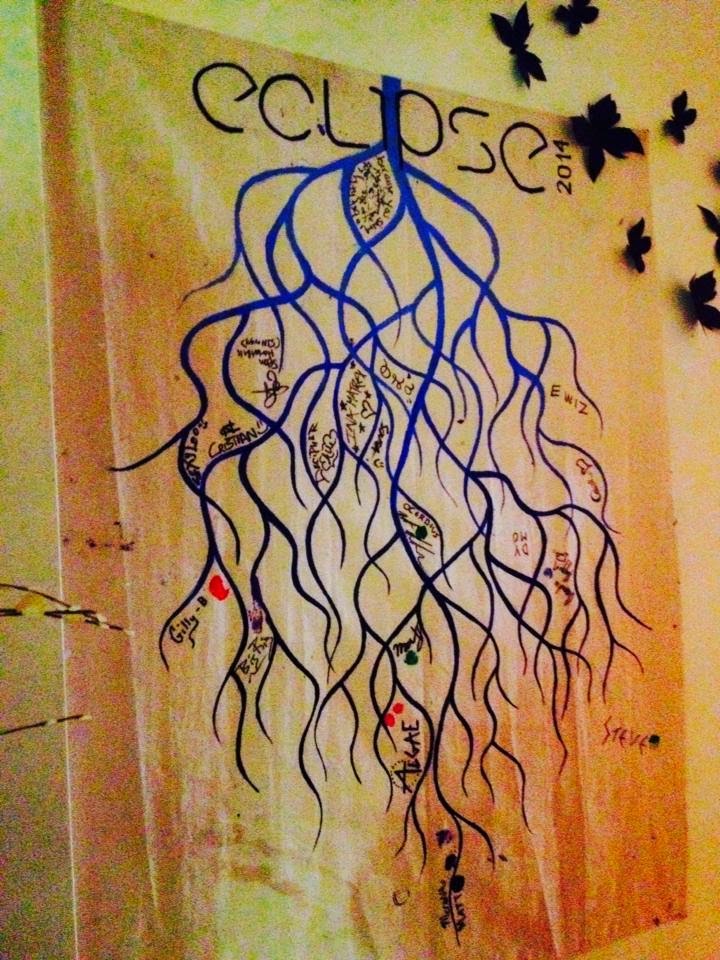
A rhizome of memory. Thanks for the image,
Syn.
My girlfriend and I went to our first giant electronic music festival as part of our one year anniversary. Eclipse was quite possibly the largest, most entertaining, utterly epic shit-show that I’ve ever experienced, and I’d love to return to the next one in 2016. But I was also very philosophically stimulated by the entire affair, so while this post won’t discuss the personal aspects of the long weekend (because they’re personal), the political and metaphysical will get their due consideration. 

When the hippie movement began, it was intensely political and deeply politically informed. They were the social revolution in the class of white intelligentsia in North America, a group of young people rejecting their parents’ ideals, at least for a while, large enough that they couldn’t be written off or swept under the rug. Yet the culture was always driven not only by socialist political ideals and opposition to international war, but also drugs. At first, psychedelics were pharmaceutical routes to personal and communal spiritual enlightenment. Now, the rhetoric survives, but psychedelics are now one part of a wider cornucopia of substances that exist mostly just to get you pleasantly fucked up.

I’ve noticed a recent trend in drug use that could actually put people’s health at considerable risk. MAOIs are chemicals that were originally developed as anti-depressants, but which are now pitched as a ‘high enhancer’ for people who are already having a really rather pleasant trip on LSD or mushrooms. But these drugs chemically contraindicate each other, resulting in extreme toxicity (which induces vomiting if you’re lucky) and can raise your blood pressure to disastrously high levels. 

I’ve long had something of an ethical problem with using hallucinogens as party drugs, once again because of their original purpose in hippie culture as pathways, in conjunction with meditation and philosophical and scientific learning, to enlightenment. Under the guidance of a shaman, DMT, the active ingredient in ayahuasca, can bring a person into a trance that displays their entire past existence before them for contemplation and analysis in experience. The goal is to understand one’s entire past narrative as a foundation for ethical progress. That purpose of enlightenment has become largely forgotten as hippie culture has slowly changed its focus to dropping out of society’s rat races and getting pleasantly fucked up.

A reasonable skepticism of government chicanery about such deceptions as the Gulf of Tonkin incident and of hiding the full truth about the Kennedy assassination has developed today into a belief that the September 11 attacks were the work of government conspiracy (including anti-Semitic notions that Jewish businessmen were secretly in league with the CIA to destroy the WTC to foster conflict between the USA and Arab nations), and a healthy distrust of pharmaceutical companies has snowballed into widespread anti-vaxxerism. 

The modern hippie community has no longer dropped out of the mainstream to inspire political revolution. They have dropped out merely for the sake of a misfit existence. Even the community’s political radicalism, where it exists, is misdirected. I overheard one attendee last weekend talking about his desire to move to a commune where everything would be shared. But he said that as soon as anyone attempted to barter or trade, he would leave. He called such behaviour, “economics.” 

That seriously saddened me because it confused the mere act of asking for something in return for a product you worked hard to produce with the large-scale economic exploitations of the modern industrial era. A successful commune returns its residents to a lifestyle where power arises from the community’s own productive labour. It is not a place like a music festival, where the escapism and partying of the many attendees rest on the intense labour of a small technical crew working to the bone. 

As I watched a field full of people dancing wildly on more speed than a fighter pilot usually takes while the enormous bass of hour-long psy-trance mixes blasts them with more powerful forces than a riot control sound cannon, it reminded me of Marinetti’s comments on the mechanization of man. Human industry creates a force so powerful that it dwarfs humanity itself, crushing it under its waves. 

The psy-trance was exploding across the central field of Eclipse Festival for 90 of 96 total hours. Its rhythm constant, its beat continuous, its pulse shattering, its force unrelenting. As the music overtook our entire environment, dominating every aspect of our experience, I felt myself become psy-trance. In a wonderful, adventurous weekend that brought me romantic joy and happy encounters with old friends and new ones, I experienced philosophical disappointments that re-energized me for future creativity. 

I realized that a book like Utopias, with its goal to help resurrect a livable ideal for a better world, is more necessary than ever when the former vanguards and prophets of that world have sunk into ignorance and self-absorption. Perhaps with a little charismatic writing, they can be woken up again. 

Friedrich Nietzsche's Casual Greatness; A History Boy, 23/06/2014

This weekend, I read Nietzsche’s essay “The Case of Wagner,” largely because I felt like it. Nietzsche has been a major philosophical influence on me, to the point where I can say that if I hadn’t read him, I would be a completely different author and person. Nietzsche is another figure in the history of philosophy that I’ve never been taught in class in any great detail. I started reading his work on my own, without any detailed direction from any other professors or similar authority figures. 

The egotistical, German nationalist, anti-Semitic
Richard Wagner. History has come down on
Nietzsche's side in this dispute, I think.
The Wagner essay is a little minor, not exactly a home of Nietzsche’s most profound or influential ideas, but it’s a beautiful piece that demonstrates his skill as a writer and thinker. But it uses those central ideas in an essay with a specific purpose, a critique of the enormous cultural power of Richard Wagner’s aesthetics in the Germany of his day. Wagner’s art, goes the essay, is an assemblage of pathos. His character arcs are reactive and rather unoriginal (every one of his women, says Nietzsche, has essentially the same narrative arc as Flaubert’s Madame Bovary). His art exists to impress you, to overwhelm you with emotion.

And that’s basically fine, but holding this set of aesthetic goals, as Wagner’s works were, as the pinnacle of a culture’s artistic achievement, speaks terribly for the culture. For me, at least, this gets at the heart of what Nietzsche means when he calls Wagner’s art an expression of cultural decadence. To call an art that revolves entirely around cookie-cutter narratives whose presentation is solely to evoke strong emotion the pinnacle of the form, ignores the multifaceted power of art. To say that this is all you want out of your art reveals how shallow you are.

Because art can encourage philosophical and moral thinking, fiercely radical ideas on personal, moral, political, and even cosmological scales. My girlfriend and I were watching Slavoj Zizek’s new documentary The Pervert’s Guide to Ideology,* which included a discussion of Beethoven’s Ninth. Zizek discusses how the climactic choral movement switches from a bombastic explosion of instrumental and vocal power to a carnivalesque jaunt (in other words, it switches from the famous enormity we’re familiar with from the Ninth to the music that was playing in the record shop where Alex DeLarge picked up those chicks in A Clockwork Orange).** Beethoven here lets his own art critique the bombast of symphonic music; the music moves you and simultaneously carries out a dense task of philosophical aesthetic criticism.

* That’s how cool my girlfriend is; we watch Zizek documentaries together.

** Another aspect of A Clockwork Orange which makes it infinitely superior to the novel, a book remarkable in itself, in that its own author ruined it. It took a fearless filmmaker to bring it to its true greatness.

Fitzcarraldo was sublime in its imagery and fascinating in
its philosophical density.
My own rant about A Clockwork Orange is a Composing post for another time, which will focus on the importance of thematic multiplicity as a necessary condition for a truly great work of art. Werner Herzog is actually a counterpoint to Wagner, as far as explaining the power of the operatic. Arguing against Wagner makes Nietzsche in this essay rather hostile to the operatic form of art itself, which I can understand. So much of opera truly is about the evocation of enormous feeling above all else, an emotional sublime. This is a power to be reckoned with, but Herzog’s art is a creative answer to Nietzsche’s criticism of opera as able to be little more than this.

In his quest for the most remarkable images in the world, Herzog was creating a cinema of opera. Only during the production of Fitzcarraldo did he realize that much of what he had done in his own art was an operatic mode: searching for incredible intensity to capture and put before an audience. One reason he made fewer films in the 1980s was because he was in Germany making operas. 

But Herzog’s films were not only acts of emotional intensity; his images evoked concepts and sparked chains of thought that encompassed so many philosophically vital aspects of life. Here are just three examples. An ecologically philosophical meditation on the weakness of simplistic human imperial drives in the face of an implacably complex nature: Fata Morgana, Aguirre, Grizzly Man, Lessons of Darkness. The alien nature of human madness: Stroszek, Woyzeck, Heart of Glass, My Son My Son What Have Ye Done. An exploration of the pinnacle of human virtue and the creation of new moral paradigms through implacable situations: Signs of Life, Fitzcarraldo, Rescue Dawn, Invincible, Bad Lieutenant. This is operatic cinema with the philosophical power of which Nietzsche thought opera was incapable.
• • •
I doubt my own thoughts on “The Case of Wagner” are all that original, however. Werner Herzog has long been associated with existentialism in cinema. The relationship of Nietzsche with Wagner, both the man and his art, have been the focus of works by many philosophers and historians of art and culture. Nietzsche’s concept of decadence as it applies to culture and art is the subject of countless articles across several specialties of modern academic philosophy. Since I’ve been locked out of university libraries for the last year, I’ve had no access to any of the databases whose journals could corroborate my ideas, or indicate just how unoriginal they are.

Friedrich Nietzsche anticipated not
only many ideas of 20th century
philosophy, but also hipster fashion.
This is part of why, when I was more firmly inside the academic system, I was always hesitant to focus my research on the history of philosophy. The major and minor figures of the philosophical tradition have been the object of so much scholarship already that it’s difficult to find your own place. You almost have to contort yourself in a ridiculous shape to find anything original to say at all. I was most interested in producing philosophically original work, and still am, which is why I focussed my research on problems from which I could draw upon a wide range of scholarship across debates, disciplines, and fields of knowledge. 

Another problem regarded relevance. Nietzsche himself wrote a wonderful character in Zarathustra, the man who was the foremost expert on the brain of the leech. He was brilliant and knowledgable, but his knowledge was so intensely specialized that it was practically useless, and he couldn’t even coordinate his knowledge of the leech’s brain with other biological, neurological, or ecological studies. He knew his narrow corner intimately, but the rest of the world was darkness.

This is how I felt when I learned what kind of scholarship would be necessary to become an expert in a specific figure in the history of philosophy. Reading the primary material of the thinker in question was no problem — these were the philosophically dense and interesting works that started the firestorm of the self-named sub-discipline in the first place. 

The ancillary material was a different matter. One would not only have to become an expert in philosopher X, but an expert in all the other experts of philosopher X. This, especially for a central figure in the tradition like Nietzsche or Wittgenstein, would essentially make you into the leech brain expert. Brilliant and knowledgable, but unable to connect any of his work to outside applications. You lived in a brightly illuminated bubble which could light nothing of the darkness around it. 

I chose a disciplinary specialty outside of the history of philosophy or the production of secondary material on a historical figure because I wanted my works to contribute to the tradition of which those primary texts were a part: a tradition of philosophical writing and thinking that sought to understand and change the world. Even, perhaps especially, now that I'm outside the formal academic system of the modern university, they still can.

Thoughts Travel on Good Vibrations, Research Time, 16/07/2013

The problem with having a really long work-day on a Sunday when your friends J and K have their DJ nights at the bar a block away is that when this combines with an extremely hot and humid Monday, very little creative work actually gets done. I’ve found that when I need to focus my mind on a difficult day, my musical soundtrack helps.

I’ve never been able to read in perfect silence. I need something trying to distract me from my reading so I don’t distract myself with my own chains of thought. So I play music. And I play all kinds of music, usually just according to my mood, my general sense of enjoyment, whatever I’m listening to at the time, whatever new record I’ve just discovered. But on days when my brain needs a solid stimulation to get its machinery working at a reasonable efficiency again, I play Dilla.

It isn’t just the powerful sense of rhythm that comes from Dilla’s instrumentals, or the artistry with which he renders a sound collage from samples that takes the original sonic texts into a different realm. It isn’t just that Dilla’s work is the only music that genuinely follows through on the promise of Paul’s Boutique, a promise that was largely destroyed by the litigations of music publishing corporations. I’ll let ?uestlove make the point, in a passage from Mo’ Meta Blues.
“There’s a radical rethinking of the relationship between artist and work: the album’s credited to Dilla, but what does that even really mean, given how he builds his house from other people’s bricks while at the same time decoupling the snippets of song, the bits of music, the loops, from their original source? . . . Where are these sounds coming from? Where are they going? . . . They go back to the beginning of recorded music, where the first break was made between performer and performed.”
I’m a writer. One of the reasons I’m a writer is because I have a deep need to control my product, to create without the need to rely on others who would make me waste my time and effort when they drop the ball. When I fail, I have no one to blame but myself. When I succeed, no one can take that victory away from me. Yet here are these assemblies of sounds gathered from all of history to create what has never been heard before. Dilla the artist relies on others for the very material of his art. His method of creation needs history to work, and so can only function embedded within the material of history. Yet his inspiration begins a whole new history. 

The artist as a conduit for the transformation of history into the present. A fruitful idea.


A logistical note. I think in the future, I’ll only make this a weekdays-updating blog. I’ll try weekend updates for a few more weeks, but I get declining numbers. I may be the only person I know who has the same morning internet browsing routine no matter what day of the week it is. I’ll decide for sure in the next month or so.