Showing posts with label Drugs. Show all posts

Scattered Thoughts on Cultural Paranoia, Jamming, 30/08/2017

Call this the epilogue to “Hey! Cultural Marxism!” Just a few reflections on how we got into this mess as a society. No claim to completeness or even an escape from my partiality.

I do suspect that there may have been a little systematic causation between the old moral panic movies of the 1930s and the hysteric paranoia of anti-communism from McCarthy to John Birch to Goldwater to Breitbart. But since this is an idea that literally came to me over the last few days, I don’t exactly have a huge pile of pre-existing scholarship backing me up.

The paranoia of modern American culture is one of the strangest
social phenomena I've ever thought about. Such fear of all aliens is
only possible through profound and thorough solipsism.
My thanks to the source.
That said, there is a common tone – a paranoid fear bordering on ecstasy, expressed in the aesthetics of a live-action cartoon.

Anyway, this one is for fun. A set of reflections.

Thought One. The dominant mode of Cold War anti-communism was paranoia. This was the engine of Joseph McCarthy’s hearings of the House Un-American Activities Committee. HUAC had existed for decades, but McCarthy’s leadership brought it into legend.

Those hearings and the cultural atmosphere they created basically burned the socialist left out of American consciousness as a society.

Thought Two. That paranoia was a reactive fear. Obviously – its name is ‘anti-communism.’ But the wildest delusions of the anti-communist paranoid was precisely that of McCarthy. They could be anywhere; It’s possible they’ve infiltrated everywhere; Won converts who keep their actions secret; A demoniacal cabal.

I never saw this in action in my own lifetime until it became about Islamist terrorists, not communists. Terrorism paranoia differed quite a bit from anti-communist paranoia. Mostly, the paranoia I experienced in 21st century Canada (watching America on TV) had an extra racializing flavour.

Invasion of the Body Snatchers was the expression of McCarthy's
paranoia in techno-horror cinema.
The Arabs and South/Central Asians who faced that stigma had distinct ethnic differences that were pretty quickly racialized into a vector to marginalize them. It’s sad, because Salafists would have a lot in common with radical American Evangelicals.

Thought Three. Lots of Americans were anti-communist in the 1930s, the same time those moral panic films first exploded. But that was actually the United States catching up with Europe’s anti-communism – it was oligarchical and right-wing opposition to the trade union movement.

This first American anti-communism strikes me as very much like the European version. Communism at the time was the farthest left wing of the trade union movement. Radical communists as fellow travellers with Eugene Debs, Woody Guthrie, and Jimmy Hoffa. Mostly, it was a vehicle for America’s money’s WASP class to remix their traditional anti-Semitism.

Thought Four. The hysterical lunacy of it all. That’s the only way I can think to describe the tone of that paranoia. I’m talking about McCarthyism, but it shared the same tone, the same deranged outlook on the world as those moral panic films.

Reefer Madness and all those others. It could be weed, cocaine, sex. Eventually, it was motorcycle gangs. Above all, those films were about fear. Fear that ordinary looking people could turn their whole lives upside-down – one act of deviancy was all it took to send your life to hell.

The Puritan bides his time through eras of liberalism until at last, the
more moderate among them reaches a breaking point of even their
disgust. Public acceptance of homosexuality is too much for them.
A group of Evangelical extremists published The Nashville Statement
standing against LGBTQ rights yesterday, and I saw one social media
exchange. "How could you condemn Christians praying for gays
when Muslims kill gays all the time?" Well, Christians kill and
persecute LGBTQ people all the time. The American money goes
to Africa
so their sensitive domestic audience doesn't see the blood.
The 1930s wasn’t just the era of the Great Depression – it was also Prohibition, the greatest triumph of the temperance movement. Temperance was the most powerful expression of Puritan Christian popular asceticism since the foundation of the United States.

The Puritan was the most extreme ascetic ideology. Beyond the traditional asceticism of an elite, powerful holy one’s path. No, Puritanism and the temperance movement was devoted to mass asceticism. The denial of all deviancy was necessary to save the soul.

Electric fear of total destruction – death, murder, the surrender of your own identity to a deterritorializing desire. “Play faster! Faster!

They were education-exploitation films. Reefer Madness was itself first financed by a church organization. Did that Puritan energy somehow mutate through McCarthy and John Birch to become hysteric anti-communism?

Thought Five. I don’t actually know. But the possibility intrigues me.

Dreaming of a Better World, Call It a Utopia, or a Music Festival, Jamming, 31/07/2014

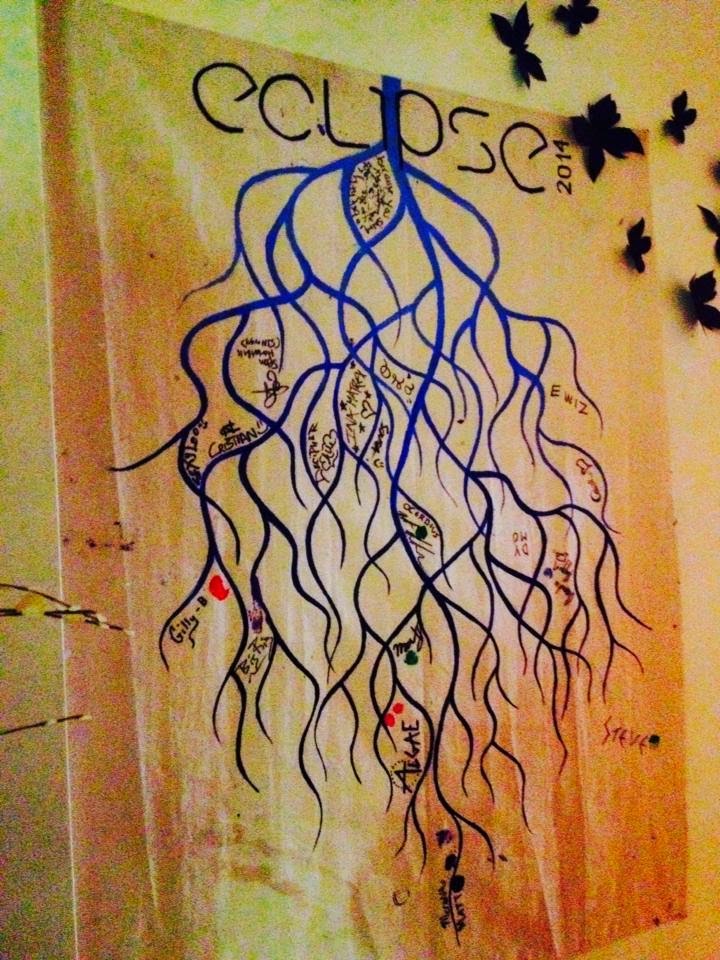
A rhizome of memory. Thanks for the image,
Syn.
My girlfriend and I went to our first giant electronic music festival as part of our one year anniversary. Eclipse was quite possibly the largest, most entertaining, utterly epic shit-show that I’ve ever experienced, and I’d love to return to the next one in 2016. But I was also very philosophically stimulated by the entire affair, so while this post won’t discuss the personal aspects of the long weekend (because they’re personal), the political and metaphysical will get their due consideration. 

When the hippie movement began, it was intensely political and deeply politically informed. They were the social revolution in the class of white intelligentsia in North America, a group of young people rejecting their parents’ ideals, at least for a while, large enough that they couldn’t be written off or swept under the rug. Yet the culture was always driven not only by socialist political ideals and opposition to international war, but also drugs. At first, psychedelics were pharmaceutical routes to personal and communal spiritual enlightenment. Now, the rhetoric survives, but psychedelics are now one part of a wider cornucopia of substances that exist mostly just to get you pleasantly fucked up.

I’ve noticed a recent trend in drug use that could actually put people’s health at considerable risk. MAOIs are chemicals that were originally developed as anti-depressants, but which are now pitched as a ‘high enhancer’ for people who are already having a really rather pleasant trip on LSD or mushrooms. But these drugs chemically contraindicate each other, resulting in extreme toxicity (which induces vomiting if you’re lucky) and can raise your blood pressure to disastrously high levels. 

I’ve long had something of an ethical problem with using hallucinogens as party drugs, once again because of their original purpose in hippie culture as pathways, in conjunction with meditation and philosophical and scientific learning, to enlightenment. Under the guidance of a shaman, DMT, the active ingredient in ayahuasca, can bring a person into a trance that displays their entire past existence before them for contemplation and analysis in experience. The goal is to understand one’s entire past narrative as a foundation for ethical progress. That purpose of enlightenment has become largely forgotten as hippie culture has slowly changed its focus to dropping out of society’s rat races and getting pleasantly fucked up.

A reasonable skepticism of government chicanery about such deceptions as the Gulf of Tonkin incident and of hiding the full truth about the Kennedy assassination has developed today into a belief that the September 11 attacks were the work of government conspiracy (including anti-Semitic notions that Jewish businessmen were secretly in league with the CIA to destroy the WTC to foster conflict between the USA and Arab nations), and a healthy distrust of pharmaceutical companies has snowballed into widespread anti-vaxxerism. 

The modern hippie community has no longer dropped out of the mainstream to inspire political revolution. They have dropped out merely for the sake of a misfit existence. Even the community’s political radicalism, where it exists, is misdirected. I overheard one attendee last weekend talking about his desire to move to a commune where everything would be shared. But he said that as soon as anyone attempted to barter or trade, he would leave. He called such behaviour, “economics.” 

That seriously saddened me because it confused the mere act of asking for something in return for a product you worked hard to produce with the large-scale economic exploitations of the modern industrial era. A successful commune returns its residents to a lifestyle where power arises from the community’s own productive labour. It is not a place like a music festival, where the escapism and partying of the many attendees rest on the intense labour of a small technical crew working to the bone. 

As I watched a field full of people dancing wildly on more speed than a fighter pilot usually takes while the enormous bass of hour-long psy-trance mixes blasts them with more powerful forces than a riot control sound cannon, it reminded me of Marinetti’s comments on the mechanization of man. Human industry creates a force so powerful that it dwarfs humanity itself, crushing it under its waves. 

The psy-trance was exploding across the central field of Eclipse Festival for 90 of 96 total hours. Its rhythm constant, its beat continuous, its pulse shattering, its force unrelenting. As the music overtook our entire environment, dominating every aspect of our experience, I felt myself become psy-trance. In a wonderful, adventurous weekend that brought me romantic joy and happy encounters with old friends and new ones, I experienced philosophical disappointments that re-energized me for future creativity. 

I realized that a book like Utopias, with its goal to help resurrect a livable ideal for a better world, is more necessary than ever when the former vanguards and prophets of that world have sunk into ignorance and self-absorption. Perhaps with a little charismatic writing, they can be woken up again.