Showing posts with label Theatre. Show all posts

The Inevitability of Nightmares, Research Time, 10/06/2018

I was too busy with the last few days of the provincial election in Ontario to produce any blog posts. I was working on a campaign, and it took up so much of my time and energy in that last push.

Then in the days after the election, I was recovering. A Conservative majority government in Ontario led by Doug Ford will turn a significant chunk of the machinery of the state against vulnerable people. Within the Ontario Conservative party, a key part of Ford’s support base are social conservatives, and outside the official party many bigots and racist extremists are quite happy for his victory.

I’ll be the first to admit that many edgelords across all demographics drank my liberal tears that night.*
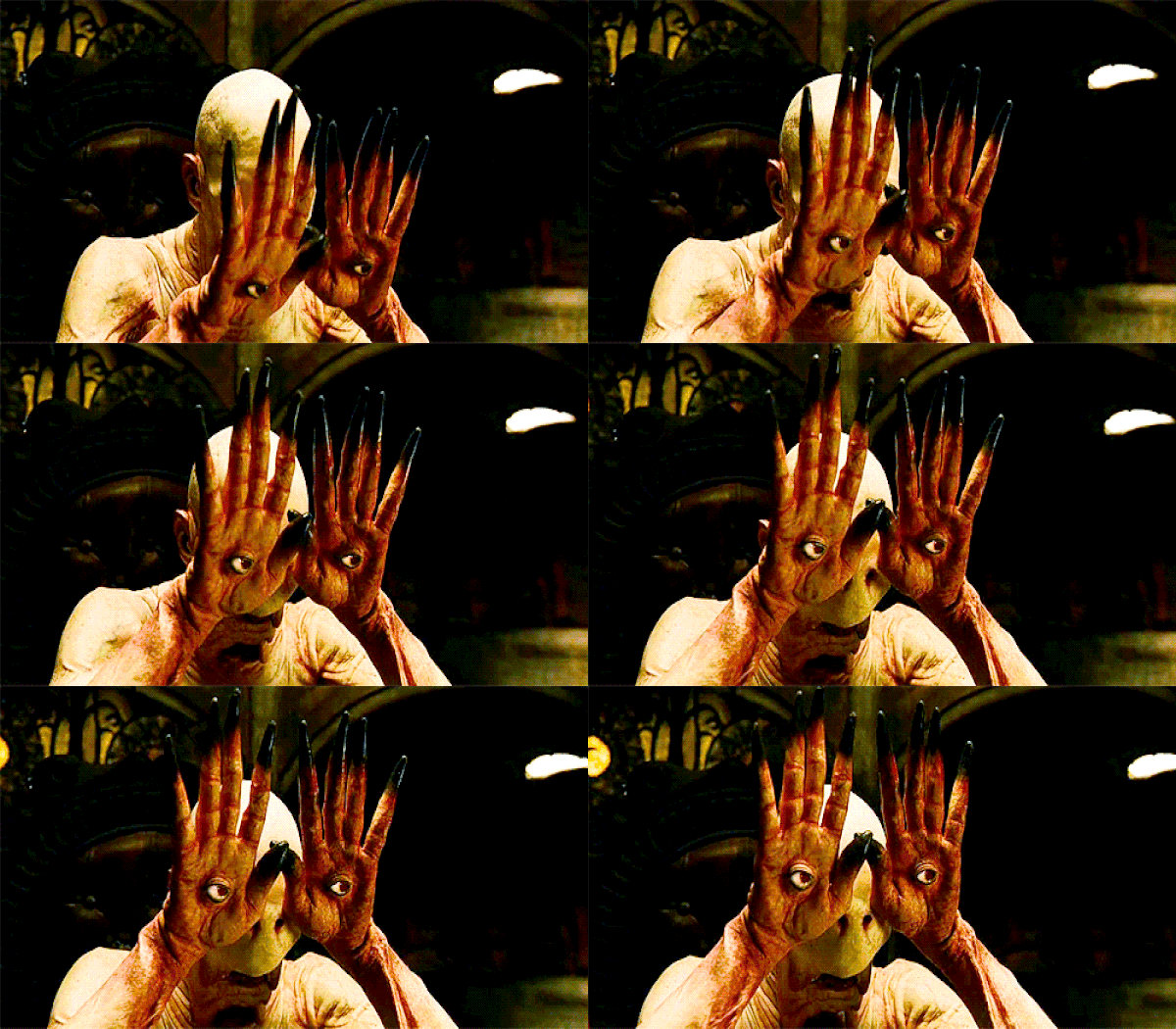
The stuff of nightmares. Hidden in the deepest crevices of our homes,
our lands, where the most destructive and cruel tendencies of our
natures are cultivated and so flower. They will eat us alive.
* Even though I’m totally not a liberal. To them, everyone on the left is a liberal. It’s part of the widespread complete misunderstanding among most of the modern conservative scene of how progressive thought actually works.

It’s easy to feel discouraged by elections like Doug Ford’s, Donald Trump’s, Binyamin Netanyahu’s, or Theresa May’s. There are plenty of profound philosophical sources that justify and explore that pessimism about real social and political progress.

As well as the Frankfurt School figures of Theodor Adorno, Herbert Marcuse, and Walter Benjamin, there’s the Situationist project. I’m thinking in particular of the project as laid out in Guy Debord’s Society of the Spectacle.

He developed a union of political demonstration and theatrical exhibition that influenced techniques of protest around the world. But much of the Situationist perspective remained limited by its own pessimism. Protest created a space for the imagination to roam free – it was a space where, for a few moments, a different kind of life was possible.

But that possibility could never become reality. It was always an act of imagination, a performance, an act of refusal to acquiesce facing the inevitability of its own defeat. Protest, on the Situationist model, is a demonstration of a dream from material, but which will always be a dream, a performance, an image. Not a real system of economic, cultural, and ecological activity.

There is no one more fearful than the richest of men. That fear is why
they hate and destroy. And also why they become grotesque neurotics.
Maybe they're absurd germaphobes. Maybe they subsidize an insane
scientist's quack research on human urine as an aid to rejuvenating
us into near-immortality.
It is so difficult to find guides for philosophical creativity that also considers material success possible. Recovering and maintaining optimism is the most difficult task of progressive politics.

The secret to overcoming pessimism is to identify the real material relationships and dynamics that maintain an unjust system and people’s support for it. It’s an inherently empirical act, but it needs the precision of a philosophically-trained mind to identify the keystones – the relationships of a social-moral-economic system without which it will fall to chaos.

Here’s a key idea that Jeremy Gilbert – along with an old influence of mine, Manuel DeLanda – has identified. You can have markets without capitalism. What turns a market system into an exploitive capitalist system is crossing a threshold of accumulation. When your markets have produced oligarchs – the absurdly rich – those central power figures are able to turn the entire system to serve their personal goals.

Markets are places where people experiment with new ideas for economic activity, moral thinking, and ecological development. People have the social and economic space to adapt to changing circumstances. People in markets on fairly equal terms have the power to take risks, knowing that a risk gone sour won’t be a disaster because they can fall back into the community.

An oligarch operates by a selfish fear. They’ve accumulated so much that their kingdom is more important than the prosperity that produced it in the first place. They become risk-averse and greedy. It’s the irony of massive accumulation – the weight of wealth perverts you with paranoia.

When you’ve been taken out of a community, you’re no longer capable of trust, because your wealth has alienated you from those who are different from you in the most important way.

You’ve become an alien to the non-wealthy. You imagine that they hate you, and so you fear them. Your actions from that fear makes them hate you. You’ve fulfilled your own nightmare.

Third Format’s a Charm, Composing, 25/02/2018

I’ve had a super-stressful week, and I’ve dealt with it as best I can in a few ways. Most of those involve writing about Félix Guattari, getting some research work done where I can, and lots of coffee.

I’ve also taken another artistic decision. I’ve laid my project of Doctor Who essays to the side – I still want to write philosophical reviews of the new series on the blog as episodes come out later this year, but I don’t think my energies will work best on major statements about the show.

Reasonably accurate depiction of myself. Once I get into a groove
anyway.
On Saturday, I outlined how the novel version of You Were My Friend will go. And I made a symbolic gesture for myself – I wrote its first sentence.
She wasn't doing much of anything at all when the knocking came from the door.
I’ve been trying to do justice to this story since I first developed it – it’s been about four years since I first pitched the idea. I hoped that You Were My Friend could be the ground of work as a theatre writer.

But we had virtually no box office – we were swamped by audiences flocking to see Billy Bishop Goes to War at the higher-budget theatre down the road from our production in Hamilton. They had a higher promotional budget – and more experience marketing theatre. Hamilton was consumed by mournful patriotism after Nathan Cirillo’s murder – which happened less than two weeks before our debut.

The director and crew I worked with on the play You Were My Friend returned to the more sure bets of bigger-budget productions of established content. It suited them well – I approached Mel and Jeannette because I’d seen their brilliant production of Harold Pinter’s Betrayal the year before, and she was already a friend.

Beyond the poor luck of our debut, I also think the story was still incomplete. Its presentation was powerful, but having to stick to one set and two actors may have been too much constraint. When I adapted You Were My Friend into a film script, I expanded its world.

You saw key background events that were only described in the theatre. You met other characters at the supporting or bit level who I could flesh out in more detail than I could when their only existence was as a name in someone else’s dialogue.

You can only do so much on a stage. I mean, you can do so much on
a stage, but not all stories are suited to it – at least not without some
serious changes in expression. Could you do a stage adaptation of,
for example, War and Peace on minimal budget and with only four
or five actors? Maybe. But a lot would have to change.
I hoped to ground the abstract quality of the play in the material reality of Toronto as a city. You Were My Friend began with a single set that became surreal nightclubs and Albertan mountains.

But I wanted to shoot in Trinity-Bellwoods, the streets of Kensington Market and Chinatown, surreptitiously in the back of city buses. It never worked out, though.

In nearly three years, I could never get the damn thing shot. Shooting a film takes equipment, crew, and actors. Acquiring all those takes money and time. I didn’t have the money, so I didn’t have the time as I was too busy trying to make sure I had enough money.

I first started working on the project with Sam, the lead actress from the first version in the theatre. We had a few conversations, but eventually we decided to part ways on the project. I think it was largely down to me – Looking back, I think I appeared dismissive and argumentative when we would critique each other’s work and ideas. I didn’t mean to, but I did.

Oddly, it's the lowest-investment and most isolating form of art that I think lets me create the most expansive world. You Were My Friend the novel can let me fill out the characters’ minds and memories as well as the world they move in. The labyrinths of the narrative can wind deeper into time, space, and thought.

All thanks to being able to string the whole world together with words alone. As for publishing, I’ll soon start reaching out to small publishers in Toronto, but may ultimately publish and promote independently.

This story began as an artistic inspiration from some of the struggles the GF went through earlier in her life, when she was underemployed and had little to no family support – just like my lead character Vicki.

I want You Were My Friend to be reasonably successful not just to honour her in this powerful figurative way, but also to share that struggle with other people who’ve experienced it in my society. It's a work of artistic and ethical solidarity. I want it to breathe and live beyond those nine forgotten performances in a Hamilton indie theatre.

Let the pages fly.

It's Not Finished – It's Finished, Composing, 27/04/2016

Today was a day with a lot of writing. I finished the script for the promotional video to go on my Patreon page this morning, though I think tomorrow or Thursday morning will be a better time to film it. Most notably, I finished the script of You Were My Friend

I feel a combination of relief and excitement. Relief because I’d been falling behind on this project – at least I felt like I was, which in a way is even worse than actually being behind on a project that’s important to you. Excitement because I know that this is just the first phase in a very exciting production process. 

It's interesting to have finished the script for You Were My Friend after having written the script for You Were My Friend two years ago and produced it at the Pearl Company Theatre. It was actually my most successful creative project yet, simply because it actually got produced and we made a little bit of money.

One reason I wanted to do this film project is that I thought that a lot of circumstances conspired against us in the original theatrical run. For the sake of logistics, we were producing the play in Hamilton, when it took place in Toronto, and was very much a Toronto story. But I lived in Hamilton at the time, and my director Mel already know the owner of a theatre there. 

Also, I think there were a lot of ways in which the theatre script couldn’t tell the story as well as film ultimately could. I only fully realized this in the course of writing the script. The theatrical version only had my two lead actresses on the stage and a single set. The story was told only through their words. 

That resulted in some very intense emotional scenes and displays, and some moments that cut to the essence of the ideas I wanted the story to explore about the desperation that underemployment and poverty pressure creates.

But it also resulted in a lot of ambiguity over where the story ultimately ended, and ambiguity over the meaning of some of the film’s events. For a lot of their backstory, we could only tell it through the conflicting, and sometimes self-contradictory accounts that the leads told each other in their long, twisting scenes of conversation.

This is a realistic dramatic play. Most of the sequences consisted of the leads talking to each other. The two of them talking to each other established the drama of the story. It had to. All I had was two actresses, one set, and a director and crew who knew how to make the most of a cheap lighting grid.

While we may not be able to achieve the most ambitious shots I wrote in this script (not sure if we can fly a second unit crew to get establishing shots of the Rocky Mountains for the first 20 seconds of the story’s one scene in Alberta), this is going to be a story with more characters, more locations, and more of the story on the actual screen than the theatre version could ever manage.

I mean, there are still long sequences of Vicki and Madison just talking to each other. But they work differently than in the theatre. In the theatrical version, all I had to suggest the existence of a world outside their apartment was for them to talk about it. 

In the film, the dynamic is very different, simply because we can film stuff outside the apartment. So we’ll see the characters out in the world doing things, sometimes together, sometimes on their own. Then they’ll come back to the apartment and talk about it with each other. 

And the drama in their friendship comes not only from what they themselves do together and in their own lives. It’s also a matter of contrasting what we see happening to them with what they tell each other happened. Depending on how well which order works for a given event, the script shows the event, then the conversation about it, or intercuts them both.

Now, the drama comes not only from what happens to them, or only from what they say happens to them. It comes from how much of the truth the audience can see them hiding from each other.

Will Neil Patrick Harris Dance for Me? Composing, 01/04/2016

I’ve been working on the You Were My Friend film script again for the past week or so. It’s taken me about three months to get to this current almost-done point because I’ve had to work on it in fits and starts. 

This is the peril of having a ton of work and activism commitments that barely make me any money in the first place. 

And we're changing the poster too.
But I’ve started adapting the last sequence, what I call the stab to the heart sequence. This is basically the fallout of a single, desperate, stupid act of betrayal that leaves the main character in an even bigger poverty trap than she was already. It’s a very simple scene – a search through an apartment and a series of frantic phone calls for help.

But the sequence unfolds very differently from theatre to film. I mean, it has to. It’s a question of literal physical material. The original version of You Were My Friend consisted of two people acting out lines live on a messy set in front of an audience of people sitting a few feet away from them. 

This new version will be a series of images projected on a theatre wall or playing through a television or computer screen with a soundtrack. 

It sounds silly to write out the actual physical form of the different media, theatre and cinema. But it actually helps foreground the challenges of adapting a story from one medium to another.

Some of the most frustrating conversations I’ve had with people about writing have talked about adaptation. How it must be so easy to adapt, say, a book into a movie. All the story is already there, you might say. You just cut bits and turn it into a script.

It’s even easier with a play! you might say before I slap you in the mouth. It’s even already a script. 

Yes, the narrative stays the same. In some cases, I’ll admit it: I literally copied and pasted lines of dialogue from the theatre script to the cinema script. There’s an entire Groucho-Chico conversation between the two leads Vicki and Madison that unfolds in exactly the same way.

But the differences between the media change a lot about the presentation. Here's an example that shows how radical the changes really are, from a composition perspective. 

Adaptation is a lot harder than people think.
The Room.

No, not that one. I mean the apartment my Vicki and Madison share. On the stage, it’s literally the only set. There’s a sequence late in the play where they go clubbing together – I depict the change by a disorienting sudden change in lighting from a bright apartment to a dance floor and they just start dancing to trance music. The transition back to the apartment the next morning is done by bringing the stage lights up extra-bright to show how hung over they are. 

It’s all one smoothly flowing sequence. The cinema version is going to be more disjointed. In fact, it’s getting purposely, extremely disjointed.

For one thing, being a realist film, I have to have the actors in an actual club. But I’ve also been playing with the order of events a lot more in the film version. It’s not going to be disorienting – there are enough visual and narrative cues in the script to show how the different events connect to each other. 

All the sequences in the theatre version unfolded chronologically – the drama and suspense comes from how their conversations about their past unfold. Peeling back one layer of truth and history at a time until you reach the raw nerve underneath all the smiles and laughter.

I'm talking Samantha into lifting ideas from Martin
Scorsese movies. Either we do it and it still looks
awesome, or we think of something even better. But
you have to start from lifting someone else's really
awesome idea.
In the film version, each sequence is about discovering hidden facts that change a situation radically – sometimes both characters know. Sometimes only one of them. The drama comes from the different effects their different knowledge of each other has on their friendship and their situations. 

So the clubbing sequence in the film version – narratively speaking – plays out just as it does in the play. Vicki’s unfolding monologue about the frustration and hopelessness of her underemployment, punctuated with comic interruptions from Madison.

But in the film version, it’ll play out in an entirely different order. Some lines of the monologue in a club bathroom, some in the apartment as they take MDMA, some of Vicki talking to herself as she staggers peaking through the crowd, and a few shots of her dry heaving alone in an alley. 

Sometimes you rock the party, and sometimes the party rocks you.

The heart of the scene now shifts seriously from the theatrical version because one line doesn’t follow another in straightforward order. Whole different parts of her speech are now next to each other. It emphasizes different themes and ideas, shows you Vicki’s state of mind in a much more visceral way. 

And it breaks the last stability for the audience by shattering the stability of all this happening on the same set. It’s a whole different set of narrative ideas to think about. 

An adaptation is more than just cutting and pasting into a different script format. It’s retelling the story entirely differently, with totally different tools and affordances. Frankly, I’m a little impressed with myself.

My First Theatre Production Was Probably My Last, Composing, 21/03/2016

Just under a month ago, I read a review of a piece of theatre that I’d quite like to see. It’s in London, so I really hope they record it and make a version available online eventually. It’s called Cleansed by Sarah Kane, and directed by Katie Mitchell.

It is an apparently very disturbing piece of art – deeply symbolic and filled with visceral violence and torture. Actors masturbate on stage. There are graphic murders and horrifying violence throughout the story. Anal violations, mechanical tortures, brutal stabbings. Nudity is a constant, and this nudity is disturbing and unsettling – as far from erotic as you can get. 

A scene from Cleansed, some seriously weird shit.
Yet compared to what I’ve learned of the most remarkable theatre of the last century, Cleansed actually fits in quite well with its history of provocation and the tradition’s recent desires to push the boundaries of art forward. Despite this, there seems to be a limit to the artistic innovation theatre can achieve. 

You can see this in the descriptions of the audience at the Cleansed preview. Its political content is challenging, but its on-stage violence amounts to nothing more unusual than a live theatre Hostel. It’s violent, but no more bloody than a typical horror or action film of the 21st century.

But audience members were hissing and walking out in disgust. The audience was composed entirely of refined, upper-crust, and frankly ignorant theatre buffs. The folks who, as far as the VICE reporter could tell, still tittered nervously at the double entendres of a farce like The Importance of Being Earnest

It seems to be the same conundrum that I hit two years ago when I produced my first play, You Were My Friend. I still thought about the theatre as a place for challenging, powerful art. That’s why I wrote an uncompromising story about two women struggling against the financial erosion of under- and unemployment in modern Toronto.

My whole crew and I thought the story was wonderful, and that (it’s my blog, so I’ll blow my own horn) the script itself was pretty damn good. What audiences were got were appreciative, and many people approached me after performances to say how affected and touched they were. It hit people in the souls and the guts. 

When I first thought of the story of You Were My Friend, I wanted to make a visceral, powerful theatre experience that depicted the struggles of so many people in this rough economy, and showed how low we could fall – financially and ethically – if we didn’t support each other.

English theatre director Sarah Kane
And we succeeded. Me, the director, the designer, our technician, and our two actors, we all succeeded. But the audiences were all at Theatre Aquarius down the road watching the feel-good Canadian patriotism play Billy Bishop Goes to War

Of course, a serious factor in Billy Bishop’s success was the terrible and tragic timing of our theatrical run. Barley two weeks before we opened in Hamilton were the Parliament Hill shootings, whose only fatality (other than the shooter himself) was Nathan Cirillo, a Hamilton-born soldier who was only in his mid-20s. 

The entire city went into a period of collective mourning. A city in that mood wouldn’t be drawn to a story like You Were My Friend, but would sit in the collective cushion of happy patriotism. But thinking about the reaction to Cleansed helped me understand that there was more to it.

The art of playwrights like Antonin Artaud, Henrik Ibsen, Dario Fo, Eugene Ionesco, Samuel Beckett, Tennessee Williams, and Harold Pinter could shock a popular audience because they had a popular audience. But theatre today is priced largely beyond the reach of ordinary people.

Most young people in my generation and with my cultural tastes – fairly intelligent hipsters raised on Quentin Tarantino, basically – love to watch these kinds of emotionally powerful and sometimes viscerally violent stories. We’re the generation who loves series on Netflix like Jessica Jones, television shows like Breaking Bad, and I hope movies like the film version of You Were My Friend

I’m finishing the script over the next couple of weeks, and then we’re searching for enough funding to get this thing produced. My lead actress Samantha from the theatre version is keeping her role and will direct as well.

Because people like Samantha and me (and our collaborators on the play version, Mel, Jeannette, and Hannah) are drawn to stories like this. They’re the kind of stories people love from artists like Greta Gerwig and Lena Dunham. But you put them on the theatre and they go nowhere. 

Theatre audiences largely aren’t young people anymore. The tickets are just inaccessible to them, especially in the most prestigious venues. So the biggest theatres in my current home city of Toronto – despite having a major large theatre district – play mainstream musicals and mainstream adaptations like Spamalot. Anything more experimental – even the classics – ends up on the margins.

So I’m probably not going to produce theatre again, unless it’s a trial run or some related part of a project that will be recorded and distributed more cheaply than live performance. There just aren’t the same possible returns. And I want to aim big.

Looking Up In Arts and Politics, Composing, 04/12/2015

Today, I want to leave philosophy and the more intense creative conceptual play aside. Today is just going to be a diary entry. Because things are finally starting to pick up in my career, and I want to share that with my readers.

Samantha would be on top.
I hope I don’t jinx it. 

Artistic news first. I’ve had a really good film development meeting to put together a passion project that I’ve been nursing for a year. When You Were My Friend the play was a box office bomb, I was pretty depressed.

It was a story that meant a lot to me, about social issues close to my heart – the stress and anxiety of life scraping by through underemployment, the hypocritical double standards that women face in our society. 

These issues have only become more important to me since I’ve moved to Toronto and experienced that economic wringer first-hand, with incredible intensity. And we only really got a reasonable house on our first and last nights of a nine-performance run.

I mean, I understand why. We were an independent production, a fresh script, and no big names. All the major principals were in different stages of the beginnings of their arts careers. It was a story whose particulars were very rooted in Toronto, but played in Hamilton. 

More than all that, the timing was just terrible. We were playing opposite a high-budget run of the patriotic classic Billy Bishop Goes to War at Theatre Aquarius, just down the street. Just two weeks before we both debuted, Nathan Cirillo died in the 2014 Parliament Hill shooting. 

His regiment was based on James Street North in Hamilton. His city-long funeral procession passed by my apartment building. The city convulsed in collective mourning. Love of Canada engulfed the city. My little story about two women sharing a shitty apartment never stood a chance.

So I finally met with Samantha, my lead actress, and we’re going to make a film version. Once I get something like a regular work schedule together, I’ll be able to sit down and knock out the treatments and the scripts that we need to get this financed. If everything comes together like Voltron, we’ll have this thing in the can by the end of next year.

Politics news next. I’m now Vice-President of the New Democrats’ Etobicoke-Lakeshore riding association. Technically, I’m two Vice-Presidents, for the federal and provincial party. This means I go to association meetings, come up with policy proposals, and network with local social movement activists around Toronto.

T-Knuckles, the volunteer coordinator for the Phil Trotter campaign this year, is the association President. He’s also my boss, as I’m taking on some duties with his business writing company at the start of next year. So we get to trade insults in two different professional contexts. 

Professional news. I’ve started some part-time consulting work on retainer, and part of my duties involves promoting a business called Hekaia. You’ll hear more from this on my social media in the next week or so. 

This is a business in Turkey, a factory that produces hand-made clothing and children’s toys. The factory is staffed entirely by Syrian refugee women, and it’s one of the few places in Turkey where otherwise marginalized refugees from the Third World War can earn a dignified living.

Learn more at the website at the link, and I’ll be talking a little more over the next while about the promotional event we’ve planned for next weekend.

And that’s all. Just a diary tonight. Sometime Sunday, my review of the Doctor Who season finale should be up.

Sexuality, Death, and Happiness in the Theatre, Composing, 11/02/2015

Getting back to my theatre work, almost as soon as I came up with the basic storyline of It’s The Best I Can Do!, I realized that the ending, and really the entire character of Cordelia, could easily be seen as expressing a bigoted, conservative point of view about non-straight people. She is, in a very simple way of putting it, a seductress who draws Amy away from her stable, heterosexual marriage. 

Well, you could certainly read it that way if you wanted. At least from the treatment that I posted on Monday. But I should say that I rather like politically ambiguous art, art that can carry a conservative or a progressive or a radical message depending on what you bring to it yourself. And it isn’t just a matter of conservatives viewing an ambiguous work as being conservative, and so on down the line, although that’s often what happens.

The Hurt Locker examined what kind of man could
only feel happy in the horrifying violence of mid-2000s
Iraq, his virtues as well as how he was broken. That's
the most powerful narrative.
One of my favourite war movies of the century so far is The Hurt Locker.* I saw it in the theatres with my friend J-Mac, who’s also a very left-leaning person, more than me in some ways, less than me in others. He saw a very conservative, patriotic movie. I saw a movie that was radically critical of what the Iraq War did to the psyches of its American veterans. That was horrible enough, but even worse now that we know what it did to the psyches of its Iraqi veterans.

* No, I won’t be talking about American Sniper because I haven’t seen it yet. Reading some of the reviews by critics I respect, I’m actually not that interested. Clint Eastwood’s films actually are getting kind of lazy, especially the rubber baby. I’m much more interested in filmmakers in their prime like Paul Thomas Anderson, or brilliant new figures like Miranda July and J. C. Chandor.

I like the way politically ambiguous art can mess around with its audience. So as I develop It’s The Best I Can Do!, Cordelia is going to be its most slippery figure. I'm really quite afraid that people will look at this story and see it as hostile to gay people because a gay person does the most morally reprehensible thing in the story, breaking up Amy and Jamie’s marriage. The very basic description (and even her unusual, Shakespearean name) could imply that Cordelia seduces a virtuous and innocent Amy away from her devotion to her husband. 

That story, however, would be not only offensive and bigoted, but also just plain terrible. It would be a story without drama, the kind of pablum that Kirk Cameron would produce. Amy and Jamie would not exist as personalities, but as perfect victims sacrificed to a devil figure. 

Human stories with a clear villain and a clear hero are dull now. There’s more drama to be wrung through characters who are in conflict between their better and worse natures. Adrian is a man who has literally tried his best to succeed in life, but his best just isn’t good enough. He fell on hard times, ended up having to depend on undependable people through no fault of his own, and his life is falling apart. Jamie is torn because he wants to do best by his brother and his wife, but doesn’t have the energy to manage both at once.

Amy herself is at the end of her rope from the strain of being head of a household that is too big, even for her own successful career. Two people were supposed to support this household, and one opted out from stress. Resentment is inevitable: with every mortgage payment stretching her credit, she looks at her husband and wonders, “Why would dealing with his stress be worth heaping more of it on me?”

What influences on my art is . . . diverse.
When she sees Jamie spending more and more of his time trying to help his brother, who is slipping away from any place where he can even be helped, strain reaches a breaking point. 

Cordelia will appear as a relief, and a way out of a situation where Amy no longer feels respected or fully human. And she has remorse. I’m planning a rather weird scene where she talks to the audience, almost like Dame Edna, engaging them about their own lives. She tries to justify her actions to them, the way only someone whose remorse is tearing at them inside would. 

Because the audience is dynamically involved, what can happen during that scene will be unpredictable. Someone may even call her out on it. The actress would have to improvise her way through the conversation to hit the right thematic marks. But then, I know actors like a challenge. 

Planning Intense and Hilarious Theatricality, Composing, 09/02/2015

I don’t think I’ve ever worked on as tight a deadline as on Ecology, Ethics, and the Future of Humanity. It is, after all, the highest profile publication I’ve ever had, a major book from a major professional publisher of philosophy in a focal series. After three years of so little interest in the project, it still hasn’t fully sunk in how enthusiastic my contacts at Palgrave are about it.

But that doesn’t mean I’m not also cooking up ideas for other projects as well. My Alice script is still on pause while I work through my communications program, and Lee my collaborator on that project is in no hurry.

This post, I’d like to float an idea to my readers about some theatre ideas I’ve been thinking about since late last year. For one thing, I’m going to make some changes to the script for You Were My Friend, particularly changing a scene midway through the story where we’re first introduced to Madison’s job security anxieties. Instead, I’ll focus on getting to know their family backgrounds a bit better, perhaps Madison and Vicki’s relationships with their fathers.

Like the earlier scene (which still plays damn near perfectly) about their major romantic partners at the time, it’ll subvert the usual tropes of women talking about men. That scene about their ex or on/off boyfriends started with a funny story from Madison about the sort-of hipster douche she keeps seeing despite her better judgment, and ended with a harrowing story of how Vicki’s whirlwind secret romance with a man ten years older than she was ended up getting her thrown onto the street. 

I think the new version of the third sequence will start the same way. Vicki will come home from a long shift to find Madison exasperated after another terrible quality sexual encounter with her not-boyfriend. As Vicki leaves and returns a few times to change out of uniform, Madison’s father calls her for an awkward conversation, and afterward, she ends up unloading a story of a piece with American Beauty or Revolutionary Road

Vicki responds with a story about her parents’ divorce that, when described in the abstract, is just as horrible, but she plays it for laughs. And the audience will laugh along with her. Nonetheless, when Vicki needs to turn to her parents for help at the end of the play, the audience will have already had their unresponsiveness set up, even though they were laughing about it originally.

But I had an idea for a totally new play. Here’s the pitch: Like Death of a Salesman, but it’s funny and there are lesbians.

It’s title is It’s The Best I Can Do!. I think this will end up being a common idea in my theatre work, that my titles will be phrases that my characters could conceivably say at a key moment in the story, but don’t because that would be ridiculously corny.

There are four characters, all with about equal focal time. It’s easiest to start with James (but most people call him Jamie), a part-time accountant who works by freelance contracts from a home office after he left his old firm due to workplace stress. His role is to become increasingly confused, frazzled, and desperate as the story goes on.

Jamie’s wife Amy is a top executive for a chain of coffee shops (maybe they’ll be analogous to Second Cup). Jamie’s brother Adrian, recently divorced, was downsized out of his managerial job a little while ago (maybe he worked at Tim Horton’s in administration). Because Adrian is so desperate for something to keep him from going stir-crazy in his one-bedroom apartment, he talks Amy into getting him a job as a barista at a Third Mug location. I think this would work as the first scene of the play.

Then, due to a comically complicated situation involving when direct deposits actually make it into his bank accounts, Adrian’s rent check bounces, and his landlord visits his job at Third Mug trying to track him down for the money (he’s not living in a very pleasant building), but he isn’t even working that day. As a result of this humiliation, Adrian’s boss fires him, and he spends the rest of the play on an increasingly ridiculous bender. 

While Jamie is chasing down his brother, Amy is having a breakdown of her own from the pressures of her executive job where she has to act harder than her own personality can handle in a patriarchal environment. She also has to deal with their mortgage and payments on two cars, among other household expenses that were set when she and Jamie were both working high-powered jobs. Jamie’s part-time income is a little less than it used to be, and the strain is wearing on her, as is resentment at having had to shoulder so much extra financial and emotional burden on the household. 

Using the name Cordelia makes some
King Lear images float around this
story as well.
This is where Amy and Jamie’s old college friend Cordelia appears, having spent years working in America developing a Gawker-like media network and now in a relaxed, but high-paying, job arranging finance capital for tech firms (which mostly amounts to networking startups with the larger companies that buy them out). Cordelia is at first a sympathetic ear to Amy, but eventually her comments betray a sense of contempt for Jamie and Adrian.

So as one man who barely held onto his sanity chases after another man who has thrown his away, two women look on this mess and eventually decide to cut their losses. Essentially, and by the end of the play literally, Cordelia is seducing Amy to leave her husband for her. 

Cordelia is Amy’s way out of the binds in her life, through which she can embrace happiness and fulfillment. 

Perhaps tomorrow, I’ll go into some of the philosophical ideas that underlie this story as I think about the narrative. About happiness, life, and death.

Our Morality Determines Our Art, Composing, 22/11/2014

Or at least our morals and central ethical concepts have significant foundational influence on how we engage them in art. Let me start with a brief memory from high school, when a crotchety old Newfoundlander Literature teacher named Mr Matthews taught us Sophocles’ Antigone. It was my first exposure to Greek tragedy, a dramatic tradition that has been revived in occasional forms and influences since the Renaissance, but never really had the impact that it originally did.

Read Nietzsche’s The Birth of Tragedy if you want the details. In a basic sense, Greek tragedy doesn’t really have the same impact on us today as it did in its original setting because in ancient Greece, the theatre was more than thoughtful entertainment. It was deeply integrated with the religious rituals of the Greek people, particularly the worship of Dionysus, and invested with an ontological meaning that was integral to the worldview of that culture.

A lot of the humour in You Were My
Friend
 comes from Samantha (right)
reacting to Hannah (left) rant, the straight
man to her comic. Part of what the play's
structure does is slowly expose Hannah's
shattering soul under all that sarcasm.
That ontology was about fate. The widespread belief, the predominant tendency of thinking about the world, was that humanity was powerless before the forces of nature, including the chains of events that united us. The plots of Greek tragedies all revolved around the same general movement: the central characters attempt to exercise control over their world, make it bend to their will and desires, but a series of events and coincidences over which they have no control ends up utterly ruining them. 

The tragedy, so goes the major theme that, in this case, I take from Nietzsche’s interpretation, offers its audience the opportunity to meditate on our powerlessness before nature. Greek culture at this time had an ethical sensibility based around how miniscule we were compared to the gods, so their whims in shaping our lives were inescapable powers. Tragedy in its original, ancient Greek sense, was about terrible things happening to admirable people because there could have been no other way.

Modern sensibilities are a little different. I don’t really have the time, space, or desire to write about what makes contemporary humanity different from the perspective of the ancient Greeks, despite our important cultural heritage from this epoch. Going into every aspect of that history is, shall we say, a bit of a big topic.

But the central idea of the modern sensibility is that we as individuals and as societies do have some control over our destinies. Maybe we’re not totally in control, maybe some forces do still dwarf us. They don’t determine us, though.

I say this as a convoluted means of advertising the last show of You Were My Friend at the Pearl Company later today at 8.00 pm. The show didn’t do quite as well as I’d hoped in terms of sales and audience. My provisional assessment is that, in the most immediate sense, Theatre Aquarius down the road kicked our ass. They were selling out the house damn near every night with a production of Billy Bishop Goes to War whose performance schedule revolved around Remembrance Day weekend. And their show opened a week after Nathan Cirillo was killed.

So there was no way a dramedy about cycles of underemployment and skirting poverty in downtown Toronto was going to beat that jingoistic celebration of Canadian military pluck.* But everyone who did see You Were My Friend loved it. We’re planning a run in Toronto itself this summer, hopefully at that city’s Fringe. 

* You can see where my feelings fall on the subject of Billy Bishop Goes to War.

Toronto has a lot more younger theatre-goers than Hamilton. Although a lot of the older folks in our audiences have loved it — I had one older fellow opening night tell me that the play very accurately articulated the perspective of his grandchildren struggling with underemployment — I wrote You Were My Friend to articulate the struggles and pain of my own generation. These are the people I want it to speak to.

Many of Nietzsche's ideas have
turned out to be centrally important
to my art.
Getting back, however, to the question of tragedy, that cultural shift regarding our control over our lives has completely rewritten our conception of tragedy. A modern tragedy is that there could have been another way. We see a terrible destructive event, and the entire story that has come to us has presented countless opportunities to improve the fates of the characters. Instead, because of the characters’ own failures to see these moments for the pivotal events that they are, and act accordingly, everything falls apart. 

That’s modern tragedy. That there could have been another, better, way.

In the case of You Were My Friend, the entire set is trashed in our final destructive event. Samantha Nemeth’s award winning moment is an emotionally excruciating 10-minute sequence where her life has fallen apart and she, person by person, discovers that there is no one left in her life she can turn to for help. And if Samantha’s character had been there to help her friend through her emotional breakdown, or if Hannah Ziss’ character had brought herself to share a little more of her emotions with her friend, it never would have gone down like this.

You Were My Friend’s director, Mel Aravena, told me one day that he found the play very nihilistic. I understand where he’s coming from, but there’s ultimately a hopefulness to the play as well. If you come by the play tonight, watch how we turn up the house lights for Hannah’s central monologue. You’re involved in this play. The hope is that you’ll see the terrible things that can happen when we stop listening to the people we care about, and listen a little bit more.

We have power over the world, and if we know how best to act, we can make it better.

This November Is My Most Ambitious Month, You Were My Friend, 29/10/2014

In a week, I officially become a playwright. I’ve written scripts, stories, blog posts, and ideas about a lot of things. But for the past month, I’ve been working with two brilliant actresses speaking the words that I’ve written. I’ve been working with an insightful and skilled director, and a dedicated and creative crew. You Were My Friend debuts in eight days. Shameless plug: Advance tickets are available.

So on November 7, we’ll see whether this career as a playwright really has any legs. I thought that today, I’d run through some of my major themes in a spoiler-free manner, to provide an easy reference point as I convince influential figures in the arts communities of Hamilton, Toronto, and the cities around and in between, to come support what is a socially, politically, and ethically valuable work of theatre. 

Hannah Ziss plays Madison, Samantha Nemeth plays
Vicki, and Mel Aravena the director took the photo. I'm
the writer. None of them would be here without me.
Probably the most important theme in the play is, and I know I’ll sound corny writing this but it’s true, the power of friendship. Vicki and Madison are two roommates in a dingy apartment in Kensington, a neighbourhood that attracts tourists from all over the world to see an authentic part of traditional Toronto life. But it’s also a neighbourhood with a lot of poverty, even as it sits among some of the most expensive property in one of Canada’s most expensive cities. 

They’re both working jobs that barely let them live with a reasonable level of dignity and self-respect for a human being. Madison is an underpaid office monkey in her mid-20s, facing the creeping anxiety that she’ll soon be made redundant. The type of work she’s done for years is being squeezed out of relevance from the contemporary business world, and a stagnating economy at the level of working people prevents her from feeling secure in her career and her income.

Vicki is in an even worse situation. The play starts as she meets and moves into Madison’s spare room. Even this mediocre futon in a room little bigger than a closet is a better deal than she was in before. She was barely old enough to drink legally, but she was homeless, kicked out of her mother’s house over crap decisions she made in her sex life. She spends the rest of the play working waitressing jobs where the customers (and occasionally the bosses) degrade and proposition her. But these are the only jobs she can find, and she’s unable even to get a loan to go to school until she’s eventually able to qualify as a mature student. 

The only bulwark against a world that’s continually wearing them down is their friendship, and their ability to talk through each other’s problems. But even this is tested eventually, as poor decisions and flashes of anger keep them from listening to each other at pivotal moments.

Vicki and Madison are stronger together than they are apart, as are we all. We’re stronger when we help each other, when we communicate well enough to build a strategy to overcome our obstacles, or at least better withstand the more powerful shocks and economic currents that would otherwise capsize us monetarily and psychologically. This is a message that people in an age of the valorization of pure individualism need to hear, and not didactically but demonstratively.

We are not alone. Or at least we need not be alone as we face currents that can swamp us, and we should not be alone. But it’s our own responsibility to reach out and end our self-destructive isolation. That itself requires strength.

It’s easier to walk away from anything than to maintain it in the face of difficulty. Here’s where what I consider the Nietzschean themes enter the dynamic of You Were My Friend. The most destructive force in the play isn’t the economy that’s ruining Madison’s career before it can even really get started, and it isn’t the morality of female purity that put Vicki out on the street. 

The narrative's most destructive force is the personal weakness that makes running away from problems and leaving our friendships, commitments, and promises behind easier than building the relationships that can overcome material adversity. You Were My Friend isn’t just a comedy of poverty (even though it’s hilarious), an actors' showcase (even though our cast is brilliant) or a tragedy of failure (even though I dare you not to cry by the end). It’s a challenge to my whole generation not to fall for the mug’s game that says it’s better to be an individual free from constraint than a person who’s empowered by what they give to others (call this the Spinozist theme).

If you want your work to make an impact, you have to think big about it. I’m talking Tunguska big; talking “I want an Ibsen Prize in the 2040s” big. Write with ambition.

I Hear Voices Across My Desk, Composing, 18/09/2014

Wednesday was so ridiculously busy that I couldn’t really sit down and blog an entry for today, but I got some things done on the way home from my campus in Oakville. So I was able to load this up to post this evening. The schedule goes, I’ll probably promote this as Friday’s post as well, write a conclusion to my thoughts on my coming battle with Robert Nozick for Saturday, then post my review of Doctor Who: Time Heist for either Sunday afternoon or Monday morning.

It’s not so much that Adam Writes Everything is scattershot. Posts are regular, with few unscheduled skips. But there are always variations to the plan that pop up at the last minute. 

One quite pleasant such variation was the first read-through of You Were My Friend, as the cast and crew sat around a desk at the Pearl Company in Hamilton. It was the first time that anything I wrote was performed by professional actors in a professional context. The play’s director Mel told me beforehand how wonderful it felt to hear your words being spoken, and it really is a beautiful feeling. It helps that my dialogue wasn’t terrible. In fact, it was generally pretty good.

I designed You Were My Friend as a social realist play, a simple story about people under pressure from the current economy. Hearing Samantha and Hannah, our actors, read through the script in real time also gave me a good sense of how the narrative unfolds over time. Samantha’s character comes from a working class background and a hostile home environment, but begins with an optimistic, hopeful attitude about her fellow humans and her new life in the rough neighbourhoods of Toronto. But as the grind of the everlasting recession goes on, that hope gets pushed under her anger and frustration at continuing exploitation by customers, bosses, and co-workers.

Hannah’s character is already jaded from working in mediocre office jobs for a few years, and funnels that bitterness into rage at the idiocy of the human race. She hates people to distract her from hating herself. Samantha is the centre of gravity around which Hannah flies fuelled by rage until she crashes. Substance use (but not really abuse, as that would be too cheesy in my context) is how they deal with their frustrations.

Another pleasant aspect of the play’s production is that I now have a promotional team working for me. Well, I shouldn’t be quite so hierarchical about it. I’m retraining right now in the Corporate Communications program at Sheridan College, and our working teams each have to promote a not-for-profit event this Fall as a credit for one of our courses. 

Our professor for this course was cool with our promoting You Were My Friend, which plays over this November. So we have a publicity team working at the training program for the best public relations practitioners in Canada. And they’re cool with my paying them in complementary tickets. 

A Character’s Conceptual Reality, Composing, 29/08/2014

A break from the anarchism, which has been simply depressing, as you could probably tell from my last post, which indicated how little we’ve progressed (and how much we’ve probably backslid, given the bleak, Thatcherian individualism that has permeated our society) in the last hundred years.

I spent a good chunk of today taking care of the bureaucracy for my new retraining plan in Sheridan College’s Corporate Communications program, an opportunity to land a solid, well-paying job with an environmentalist group, or a publisher, or a film company, or a lobby group on behalf of affordable housing in Ontario. I want to use a career that’s typically called public relations to help people and make the world a better place. I think that’s a reasonable request of the universe.

Of course, that career path won’t stop my creative pursuits in philosophy, fiction, and scriptwriting. Basically, it will allow me a virtuous way out of the relative poverty I’ve been stuck in for the past two years while my creative work can continue. I spent this afternoon in a meeting with my director, Mel, about our upcoming play, You Were My Friend.

As I polish the script over the next few days, we’re preparing for the auditions for the two parts, which will take place in a couple of Sundays. I designed the parts so that the actresses will not only have fun doing them, but be challenged and impress their audience. I wanted the characters to be crafted such that they follow an idea which I think is essential to most quality literature and drama.

One of my favourite eras of cinema is the social realist era of
the 1970s, and Five Easy Pieces was one of the best of those
films, easily the most influential on my own work.
First, they have to be neither particularly heroic nor villainous. Both of these women have virtues and flaws. One has a powerful sense of optimism and hope, a basic faith in people to be decent, despite having been kicked around by several people who were very close to her. Yet this is also her flaw, as it leaves her still vulnerable to being manipulated by others, and vulnerable to the harms that the world has in store for us all generally. One is an insightful pragmatist, able to see reality for what it truly is. But she doesn’t have the sense of hope to fight against the foregone conclusion of defeat. If they can combine their virtues properly, they’d be practically unstoppable, friends for life fighting together against a world full of petty micro-injustices. Because I’m a terrible person and I like to make people feel depressed, it doesn’t quite work out that way. They’re both the protagonists, each of their stories illuminating and colliding with the other. In that sense, they’re people.

That’s the essence of what I think of as social realism, art that articulates the singularity of human personalities and the essences of how we live today. The play itself isn’t purely realist in that I never strive for verisimilitude. There are scenes where telephone conversations that happen across town merge into the same apartment, where characters make revealing remarks in Shakespearean (or Underwoodian) asides to the audience. But the people and the world they live in are real, because they’re ours.

The characters also embody so much of the experience of my own generation in the modern world. We work hard and intelligently in difficult circumstances, but too often remain trapped in the bad situations we were in before. And all too often, we don’t really understand how it could be anything but our own fault, unable to perceive the aggregate association of individuals interacting so that so much is ruined, but it’s impossible to apportion intentional blame to anyone, even sometimes when someone actually does commit a terrible act.

But that would be spoilers. You’ll just have to see the play in November. Or audition for it – write me at the Twitter account along the side here, and you’ll get a pm back with the address to apply. I promise you’ll love it.

Say It to My Face She Said and So She Did, Composing, 13/08/2014

Although not everything in my working life is entirely in my control, my creative life certainly is. As a career, it’s still in the early phases when being able to make a living at it is still a long shot, but just about any career is turning into a long shot these days. 

I found it very hard, when searching for images of Frank
Cottrell Boyce, to find shots of him when he isn't smiling.
I’ve also looked back at the career of Frank Cottrell Boyce, who has a PhD in English literature and a 30-year career as a television, film, and novel writer, had a long creative partnership with the director Michael Winterbottom (Butterfly Kiss, Welcome to Sarajevo, The Claim, 24 Hour Party People, Code 46, and A Cock and Bull Story, the madly meta-fictional adaptation of Laurence Sterne’s The Life and Opinions of Tristram Shandy, Gentleman, one of my favourite novels), adapted his own novel into Danny Boyle’s Millions, and this Fall will feature his debut script for Doctor Who. There are worse career role models to have. 

Earlier this month, I finished some radical revisions to You Were My Friend, the play I’m developing with Mel Aravena and Jeannette Hicks to produce at the Pearl Company Theatre in Hamilton this November. I had originally designed the script with an experimental structure, whose purpose was to attract the best possible stage actors in the greater Toronto area to audition for the roles of these two women. I wanted these characters to be so attractive to actors that they'd start physical fights in the audition hall. 

So I developed the play almost entirely through monologues. There were dialogue scenes, but these were conversations during which the characters would mask their real feelings, revealing them only to the audience in scenes that are lit only by a single spotlight in the centre of the stage. But the divisions between the dialogue and monologue sequences eventually become slippery over the course of the original script. Characters would poke their heads into the monologue, or the spotlight would slowly fade out into the fully lit apartment set and the speaker would be surprised and embarrassed to find themselves back in their reality instead of talking to the audience.

Writing these monologues had a couple of clear benefits. One, it gave me a deep sense of each character’s inner life, so I could better understand their thoughts behind their dialogue, what motivates them to reveal what they reveal, hide what they hide, and let slip what they let slip. But their original purpose was more crass, or at least more opportunistic.

I first saw Mel and Jeannette’s theatre work in a production of Harold Pinter’s Betrayal that they produced for Hamilton Fringe in 2012. Remembering the quality of their work on that project made me approach them to work with me on this. However, I’m not Harold Pinter. As far as the theatre community of southern Ontario is concerned, I’m still nobody. So I thought I needed a gimmick to convince really talented actresses to play these roles, because the play will live or die by the skill of our actresses. And because actors are egomaniacs at heart, what would they like better than a bunch of giant monologues?

I ended up with six monologues apiece for the characters. Mel wisely advised me that this was simply too much; there weren’t enough scenes of the two women being together. So the monologues themselves were transformed into dialogues, conversations where, as a function of the natural intimacy that grows between two people when they live together and are each a pair of motormouths, they actually learn about each other’s lives and anxieties. 

The result was a series of long scenes that I think a lot of us will recognize as the conversations that form the basis of a lot of our most intimate friendships. A scene begins with one character explaining her casual relationship with a boring computer programmer who is so bad at sex that she suspects he might be a closeted homosexual. This is played for laughs, of course. That scene ends with another character describing the illicit sexual relationship with an older family friend, whose revelation got her tossed out of her parent’s house and into a homeless shelter. So it ends a bit more seriously.

The transition? An impish expression crosses a woman’s face as she says, “Well, there was this one guy . . .”

Yellow Wallpaper: Centuries Collide in Joyous Explosions, 22/07/2014

Last week, I wrote a post that was a philosophical analysis of Yellow Wallpaper, an original play that my friend Kristi Boulton adapted from a short story by Charlottle Perkins Gilman. I discussed many of the meta-fictional and feminist aspects of the play in the first post, based on a couple of conversations between Kristi and I. Now I’ve seen the play, and there’s even more roiling within it. The play is still running until July 27, and it's a good idea to go.

Yellow Wallpaper depicts a woman in
a multifaceted prison: a locked room,
a morality that reduces her to an
incubator, politics and economics that
make her entirely servile. Forces from
beyond her walls offer liberation.
“Yellow Wallpaper” the short story is a product of the late Victorian era, an expression of the feminist culture and the female voices that were rebelling against the period’s cultural oppression. And the trappings of the era are well on display. The costumes evoke the physical constraints of the time’s upper-class fashions and stiff pretensions. The characters themselves speak in mannered Victorianisms, which slowly strain and crack under the emotional pressures that the protagonist’s mental illness forces on them. 

This growing pressure constitutes the narrative thrust of the play. As the play begins, the protagonist just looks as though she needs a vacation in the country after a stressful period. Her husband, a Victorian doctor, is concerned for his wife, but confident that he and his brother, a fellow doctor whose Victorian coldness and status-consciousness is played for laughs, can restore her to mental health. Her sister-in-law Rachel is similarly confident and optimistic. The family maid is a non-entity. 

As the lead actress becomes more unhinged and obsessed with her visions and nervousness, her husband becomes similarly uncertain in his abilities and wracked with self-doubt. His collaborating brother becomes openly cruel to her. As Rachel sees the protagonist’s behaviour and statements sensibly questioning the Victorian morality in which the purpose of a woman is to bear and raise children, she snaps and begins losing her temper. The maid begins a scheme of her own to rise in this wealthy family at the expense of the doctor’s marginalized wife.

Yet Yellow Wallpaper is not only a story of oppression, but of liberation.

The first sign of this is in the use of names. The only use of the protagonist’s own name throughout the entire play was at the very end, spoken by the yellow spectres. She has been referred to as a patient, a wife, a mother, a threat, and as darling, but never by her own name.* The spectres call her Charlotte in the only moment where any character acknowledges her humanity. It is to the detriment of the human characters that only the spectres of the house, whose very ontological nature is obscured among many possibilities, accept Charlotte’s singularity.

* Names have a curious power in Boulton’s script.** One subtle assault on the protagonist’s security is an otherwise unremarkable character breaking her place in the social hierarchy when she calls the lead actor John.

** And I’ve just used our common naming convention to accord my friend an extra layer of respect. After all this analysis, it would be improper for me to refer to her by the familiar Kristi, trivializing her contribution to her own production. So here I call her Boulton.

Hanah Itner's masterful performance as
manic intensity itself straining against
its constraints anchors and elevates an
already fascinating play.
Charlotte is not simply mad, not simply unhinged. She is a creative figure, diegetically a nationally famous author of children’s literature, a genre that the play explicitly associates with fantasy and escape from reality. A symptom of the typical Victorian (and generally patriarchal, whether Western, global, past, or present) repression of women, her husband does not allow her to write, to express her creative drives, until she is cured. The doctors frame this cure in terms of self-discipline, self-control. Her presumptive healers see imagination, the creative act itself, as a threat.

The other female characters join with the doctors to supply the content and purpose for this discipline. She will have considered herself cured when she can hold her baby without anxiety, when she is able to be a mother, joyously happy in the care of her infant. Rachel herself articulates this ideology most clearly: she turns from Charlotte’s only apparently sympathetic ear to a dedicated enemy when she hears her express seriously the idea that not all women are cut out to be mothers. 

As a character, there is a psychological reason for this, because Rachel herself is barren. So psychologically, this is a simple expression of jealousy. However, Rachel never appeared in Gilman’s story. She is entirely Boulton’s creation, and Boulton herself plays her well. Her performance goes beyond this petty psychological motivation so that Rachel expresses one of our culture’s most oppressive ideologies: that the only purpose of a woman is as a vehicle for procreation.

It’s fitting that the day before I went to see Boulton’s play, I wrote some light reflections about how one can be happy in life without having children. I framed my own take on this in reaction to Lee Edelman’s notion that a life without children signifies a joyous embrace of death and the annihilation of the self and all others. Edelman’s Lacanian influence leads him to think this way, interpreting Lacan’s concept of jouissance as the annihilation of identity, the joy of becoming thanatos, the death drive.

Boulton told me that the more overtly sexual
elements of Granger's dance came from
collaboration with the Fringe version's lead
actress, Itner, and was absent in the original
McMaster production. A great improvement.
Because I have no loyalty to Lacan, I need not argue against this, only state my opposition, and instead argue that my own ideological perspective offers a better existence. Charlotte, in betraying her husband to the spectre women of her wallpaper, does not embrace death. Much of this is down to the physical interaction of Hanah Itner as Charlotte and Sarah Granger as The Wallpaper Woman. They relate through a sensual dance that is clearly sexual in nature, which supplies Charlotte’s positive identity: as woman, as writer, and as homosexual, a triple threat to the oppressive morality of the Victorian era and so many other oppressive cultural currents that still exist today. Granger’s dancing is explicitly a product of the twentieth century: she is a modern dancer breaking into this militarized Victorian setting. Their dances are the only times in the play when Charlotte’s body language changes from the shaking nerves of constricted energy to the smooth bodily flows of free motion. 

The Yellow Wallpaper charts many attempts to constrain Charlotte, whether through a reproductive futurist morality, the rhetoric of self-control, economic dependence, medical institutions, or anaesthetic drugs. Joining with the Wallpaper Woman is a physical and ontological transformation, setting Charlotte free. She doesn’t trade one morality from another, but articulates an ethical transformation, a complete metamorphosis of who she truly is. A new genuine identity is created, and the regimentation of Victorian identity, ideology, and political morality is impotent before the power of a woman who has finally freed herself.

Editor's note: In case you were wondering, Kristi: Yes, I thought it was good. And I hope you don't mind that I used a couple of photos from your Facebook page.