Showing posts with label Stephen Harper. Show all posts

The Sad Essence of Harperism, Jamming, 07/02/2016

A lot of ink has spilled and data has streamed asking questions about what the hell Canada experienced in the last decade with Stephen Harper as Prime Minister. His priorities, methods, and ideals determined what the Canadian government did, for better according to some, and for much much worse according to others.

Understanding just what kind of a monster Stephen Harper was has been a major task for my country’s professional writers, journalists, and artists. We know that we were upset, we know the object of our anger, but I’m not sure that we could quite yet say in a single keen statement precisely what upset us.

We could go on and on, of course. Logically speaking, the most precise statements are actually the longest. The more detail you put into your statement and the more attention you pay to your words as you write them all down, the less room there is for misinterpretation.

And nothing will stand in his way.
I’ve read and produced plenty of this ink and data so far. Daniel Gutstein’s Harperism got a multi-post appearance on the blog, but I’ve tried wrapping my head around him plenty of times. 

I think I’ll actually make the Harper years a subject in the Utopias manuscript. It’ll have two purposes: 1) to reflect its position as a Canadian work, and 2) as a prominent example of the hypocritical conservatism that animates the contemporary Western right wing. 

A couple of Facebook friends posted an article by Michael Harris that I found remarkably insightful for two reasons. Harris described the essential priority of Harper’s government very clearly, so that it foregrounded its transformative power and its pettiness.

Harper was an epochal Prime Minister for Canada. There’s a before and after line in Canadian history, and Harper’s leadership is the transition inside that line. So writers can get pretentious as all fuck trying to define the Harper period of Canadian history. But as Harris describes, there’s a very simple idea animating it all.


Harper’s government did everything they could to develop the oil sands and its pipelines as fast as they physically could. The Conservative provincial government in Alberta had their backs the entire way. 

Harper hobbled or outright demolished every institution in the Canadian government that could slow down the pipeline approval and construction process. Harper government omnibus bills frequently included legislation that removed environmental protections for almost all of Canada. 

Compromise is for the weak. The strong crush their
opposition.
Harper’s silencing of any voice that could conflict with the interests of the Alberta oil industry even included restrictions on scientific research and freedom to speak and publish. Government-employed or funded ecological scientists couldn’t engage the public without direct, micro-managerial approval from the Prime Minister’s office. 

They also pulped huge chunks of government scientific archives and cut funding to all but those scientific projects that would aid oil development. 

More than just removing roadblocks, the Harper government sought to demonize and marginalize even democratic agencies like environmental organizations and citizens’ groups. This was behind their hostile tax audits of environmental charities, and why their public relations on the subject frequently lumped environmentalists with extreme violent terror groups. 

As Harris says, this hardball strategy backfired, as informal protests of Harper’s policies grew and grew. Indigenous people took their concerns over ecological destruction to the courts, and frequently won. The Canadian public, broadly speaking, grew tired of Harper’s own hostility to any criticism.

Admittedly Harper never had the opportunity to stack Canada’s courts fully in his favour. And his communication office demonized critics of the Conservatives to such an intensity that right-wing partisanship in Canada has become insane. 

Justin Trudeau, Prime Minister under the right-wing (but socially progressive) Liberal banner, still makes boosting the Alberta oil industry a priority. And it’s a higher priority in this time of political instability in many oil producing regions and cratering global crude prices. 

True victory is not about overcoming your opponents
through brute force. It's about making peace with them,
and so changing them, until you achieve what you
always wanted as easily as a dolphin swims through
a calm, placid sea.
It’s just that Trudeau recognizes that Harper’s polarizing support of the oil industry was a failure. And it failed because it alienated any possible public support from anyone who wasn’t already an enthusiastic petroleum partisan.

Justin Trudeau is the PR Prime Minister. It’s his greatest skill. And he’s going to use it to rebuild the public support for oil industry expansion and export that Harper’s uncompromising support of the oil industry destroyed.

A lot of Harper supporters hate Justin Trudeau precisely because he takes a soft, conciliatory approach to opponents of the oil industry. They hate him because they think softness is a sign of weakness. Trudeau haters don’t understand that softness and conciliation is actually how you win allies and change minds.

Ruthless oil industry partisanship was the practical engine of Stephen Harper’s politics. It backfired because your opponent will respond in kind to a blackened eye. Justin Trudeau will probably achieve all the same economic and oil industry ascendence that Harper wanted. Kind words make opponents into friends. Friends of Big Oil across Canada.

The Relentless Ruthlessness of Existential Threats, A History Boy, 31/01/2016

I was originally going to shift my running posts about my aesthetic impressions of Doctor Who production leaders over the years to Sundays. But an idea dawned on me a few days ago that I wanted to get out in the form of a post. 

Here’s what it comes down to. Modern politics are polarized, fearful, demonizing, and violent because it’s now standard to understand your opponents as existential threats.

Millions have died in the last 12 years of fighting the
wars that began with the American invasion of Iraq.
Don't forget that, for all we rightfully attack Daesh,
the leaders and founders of Islamic State were members
of Al Qaeda and other anti-occupation rebels who
met in an American prison camp.
Grounded in Collective Trauma

I'm not the first one to comment that something’s shifted in the way we think about politics in our society. And I’m talking about just straight-up electoral politics,* the political parties who jockey for public support in voting processes to control state legislatures and bureaucracies.

* In contrast to where real politics, the radical transformations of societies, happen – in social movements, uprisings, mass migrations, and cultural revolutions.

I remember the tone of things beginning to change with September 11, the slack-jawed incomprehension at the fawning, worshipful tone so much of the mainstream media took with the Bush Administration and the invasion of Iraq.

We saw a terrible mistake happening, one we knew would have horrifying results – instability across the region, massive violence, the killings of millions with horrible weaponry and the crunching terror of neighbours going house to house, murdering. 

We knew it in 2002 when the marches against the Iraq invasion began. We knew it as we watched all the most nightmarish visions of the anti-war movement come true. The Iraq invasion was a blunt instrument wielded with blatant disregard for even such ordinary tasks as contingency planning. 

Something rotten and horribly destructive took control of the American government. Even the worst interventions of the Cold War – the overthrow of Mohammed Mossadegh, the murder of Patrice Lumumba, Augusto Pinochet’s coup and Operation Condor, the invasion of Grenada, stoking civil wars and paramilitary terrorism across Latin America – weren’t as horrifying as the invasion of Iraq.

Even the Vietnam War had a logic underlying its justification. The “It’s all about oil!” protesters of 2003 were desperate that there be some sensible reason for Bush’s war. But the worst really was true. 

Bush, Cheney, Wolfowitz, Rumsfeld, Ashcroft and the rest of them all thought you could invade and occupy a country, and they’d be grateful to you for unleashing a society of unrestrained violent mercenaries and stationing a massive military presence in their communities. Then it got worse.

Carl Schmitt, the German philosopher who
first developed the concept of the existential
threat, a social conception of an enemy
whose mere existence is an act of violence
toward you.
Bush League

The reason so many people supported the Iraq war was because they were all so freaked and collectively traumatized over the theatrical terror of the September 11 attacks. The majority of Americans – maybe 200 million people – felt the burning presence of existential threat.

Bush did one respectable thing in this instance – he distinguished terror from Islam and Muslim people. Despite the anti-Muslim racism that grew prevalent in America, he didn’t encourage it. But the existential threat of nameless Islamist terrorism galvanized millions.

And we got used to it. Existential threat became an ordinary part of political thinking for most people. That made it get even worse.

The election of Barack Obama constituted an existential threat to just about everyone in America who still had enough anti-black racism in their personality to consider his Presidency illegitimate. The racial roots of the Tea Party lie in the refusal to accept that a black person legitimately gained and holds the authority of the President’s office.

But the politics of existential threats had settled into the left as well. Bush, if anything was the left’s first existential threat. Bush seemed unstoppable, a demon more than a man. He committed terrible acts that we thought would invalidate him from office, then he won re-election by a bigger margin than he got in the first place!

When Bush left office, he was at his lowest low of popularity. His policies had caused a worldwide economic recession, the Iraq war was a univocal disaster, and the response he oversaw to Hurricane Katrina was so incompetent as to leave hundreds dead and many thousands internally displaced.

I cried when Obama won his first Presidential election, because I thought the nightmare was finally over.

No, there's certainly no racism in populist American
opposition to Barack Obama. Just policy disagreements,
I'm sure.
The Nightmare Truly Begins

I seriously thought it would end. I thought politics would become more rational. But the Tea Party amped it up. The snowballing social collapse among the American white working class – permanent unemployment, economic stagnation, ubiquitous opiate addiction, a suicide epidemic – amped it up even more.

Hopelessness made millions feel as if their lifestyle really was under threat. Because it literally was under threat, thanks to all those social problems exploding from economic stagnation in white America crossing a threshold to become total collapse.

Yet these people didn’t realize that the threat to their culture’s existence was rooted in complex macroeconomic forces that had been unleashed decades ago and culminating in today’s mass social wreckage. Such hopeless people are the natural patrons of scapegoat politics and demagoguery. Hence the rise of Donald Trump.

Everything is an existential threat in America’s Trumpist movement. Refugees, immigrants, Muslims, Jews, gay and trans people, terrorists. All of these are threats to the American way of life for their very existence. 

More than that, even just ordinary political opponents: people who support Hillary Clinton or Bernie Sanders, or even people who support Rubio or Jeb Bush for President. To the Trumpist, all of these people are complicit in YOUR destruction. Opponents are not people to work with to someone who takes all opposition as an existential threats.

Existential threats can only be destroyed, because their existence imperils your own. That’s what an existential threat is.

In the words of one group of anti-Harper activists, he
encouraged his supporters to believe that Canadian
democracy was fragile enough that the entire state
institution could be destroyed by a mere change in
government. The heirs of this message in Canadian
culture now talk as if an anti-Trudeau coup is brewing.
Canada Is No Exception

It’s not like my own country hasn’t done this. The opposition to Stephen Harper, from its earliest days, was based in the notion that he was fundamentally un-Canadian. 

The notion that his goal was to undo all the work of social program, human rights advancement, and international peace-building. From the first days of his majority government, radical gestures of opposition followed him. We opponents of Stephen Harper saw his leadership as a fundamental threat to the social fabric of Canada itself.

The weird thing is, we were actually right. He did fundamentally change the nature of the Canadian government and state, and its relationship with its people. 

Harper’s Canada would be in thrall to the globe’s oil companies. Government science institutions would receive their marching orders from resource extraction companies, both oil and metals mining. No dissent allowed.

Canada’s government would be neutered and bankrupted through gutting its statistical data gathering powers and bleeding its public institutions through comprehensive tax cuts and inflated police, prison, and military spending. 

The F-35 boondoggle and other wasteful, misdirected military expansions, would have cost so much government money that no social program, even the health care system, would have been able to continue. 

Total privatization would have been the main theme of a second Harper majority. It may still be, since Justin Trudeau’s Liberals have no plans to restore the government revenue that Harper slashed.

Sierra Club activists plant trees in a San Francisco
neighbourhood. Stephen Harper considered these types
of people radical violent saboteurs and agitators.
Harper was an existential threat to the Canada that its progressive social movements and politicians built. And he made good on that threat. But he also based his own electoral strategy on the same hysteria that has reintroduced racist fascism to mainstream American politics.

Harper had always demonized political opponents. This was particularly true of environmentalist groups, which his government frequently lumped in with terrorist organizations. 

But leading up to the 2015 election, his communications vilified opponents as dangerous radical leftists – you know, Justin Trudeau and Tom Mulcair – whose policies would destroy Canada. He and others in his party also vilified observant Muslims and war refugees as radical, violent killers whose danger was so constant that they needed a special police tipline to inform on our neighbours’ barbaric cultural practices.

This Is Madness

Dealing with all your opponents as threats to the fabric of your society and your ability to live as you wish (or at all) can be very effective in stopping them. But it also causes a lot of horrifying collateral damage.

For one thing, conceiving of people as existential threats encourages actual mass slaughter. It what Hutus thought of Tutsis thanks to that class’ dominance of a colonially-structured state in Rwanda. It was what Germans thought of Jews as Hitler’s racial Darwinist dogma dominated the country’s politics. 

Will this be the face of America's future?
But it also animates politics to the intensity of constant hysteria. Political activity is the daily grind of working through issues among different people to live together peacefully. Seeing any group or type of people with which you live – an ethnic or religious minority, people with political differences – as existential threats destroys the ability to live peacefully at all.

When a person is an existential threat to you, there’s no negotiation. You sincerely and deeply believe that the existence of this person in your community is a fatal threat to you. When you believe that, the different person can’t stay in your community. They’ve got to go.

By any means necessary. We must not become our nightmares.

Success in Growth, or The Ones Who Call Him Zoolander Will Never Listen Anyway, Jamming, 13/12/2015

I'm a member of the New Democratic Party. My campaigning in southern Etobicoke this summer and fall was all over Twitter. Sometimes, older members of my family will tell me I shouldn't mention this on the internet, because employers would discriminate against me for my political beliefs.

But seriously, as much as the 100-year-old people who joined up back when it was the CCF rant about socialism, the NDP isn’t a hard left-wing party anymore. At least not in the old communist sense. 

Justin Trudeau having a great time at Pride Vancouver.
He is epochal now. Deal with it.
I was damn disappointed in this election, though. I genuinely think the NDP would have made the best government for Canada, or at least, we should have held the balance of power in a Liberal minority to make sure their policies remained in line with what was best for the people.

Instead, I found myself in conversations – in real life and online – with people who had been lifelong supporters of the NDP. These people accused Tom Mulcair of being a hardcore, right-wing, pro-austerity conservative. They thought the NDP had betrayed all its basic values, and were voting Liberal.

I've written about the party’s failures to communicate before, both here and at Rabble. That’s not what I'm talking about today.

Instead, I want to talk about successful communication. That's why I want to talk about Justin Trudeau.

We all know the narrative now. Trudeau thrived on being underestimated. While everyone thought of him as an empty-headed pretty-boy who was coasting into parliament on his father’s name and legacy, he was networking with leadership circles all over Canada to build an enormously diverse team of politicians.

People who may never necessarily have thought about running for parliament, especially for a decimated Liberal Party that looked to be dying off, were inspired to join the Trudeau banner. They worked their communities, their neighbourhoods, and peddled the message of hope that was at the centre of Trudeau’s campaign.

Justin Trudeau combines his father's intelligence and
Machiavellian deviousness with a genuine love of
interacting with everyday people.
And they won. It was the same with everyone who voted for them.

A few years ago, I read a book by John Ibbitson called The Big Shift. It was about Harper’s plan to remake the Canadian state so that its services would no longer supply the progressive social programs that a century of Liberal dominance built. And the people would love their new, more cruel, more harsh country.

But they didn’t, even as Harper kept winning larger parliamentary shares until his majority in 2011. Once Harper had a majority government and no longer had to wheedle and downplay how radical his changes to the Canadian state institution were, Canadian people came to hate it. 

Harper’s strategy to stay in point in the 2015 election smacked of obvious desperation. Double down on demonization of everyone opposed to you, or even a little critical of you. The opposition parties, the media, social movements. They were all mocked and insulted in Conservative party communications. 

Hate and resentment are the last acts of desperate people. It stirs up a paranoid, spiteful base, but it doesn't appeal to anyone who isn’t already filled with the hatred you’re encouraging.

I probably won't make it to the NDP leadership
convention in Edmonton due to work commitments, but
I will support Tom Mulcair stepping down. I think he's
a good leader, but his public image has been completely
ruined by the conservative messaging of the 2015
campaign. He has no more credibility to lead the NDP
against a Liberal government that's already positioned
itself in the public eye as more progressive than he is.
Mulcair may talk about being "the progressive
opposition," but Canadians don't believe him anymore.
The NDP were softer in tone, but ultimately no better. Worse, since our campaign made two mistakes instead of Harper's one. NDP campaign communication staff tried to rile up our base with messages about the evil and destructiveness of Harper and his cronies. And at least they targeted those properly.

Yet the mass media messages turned the NDP base away at the same time. We were trying to appeal to conservative-leaning people, especially with balanced budget messaging. 

But conservative people will never support the NDP, even the modern social democratic version. Many of them still believe all the hype about New Democrats being communists. 

So the NDP played it super-safe, aiming to sound like reassuring, conservative voices when the people were desperate for genuine radical breaks from the Harper years. 

The NDP communications and campaign leadership painted us as compassionate conservatives because they thought the key to victory was winning over people who were already regular voters, but simply voted Conservative last time. 

The result? Our vote collapsed in absolute quantity and in share of the total. Frankly, I’m amazed we pulled through to the degree we did.

Trudeau is the victor. Hands down. It’s impossible to ignore. And he will dominate Canadian politics for the next 20 years. At least. I hope the Liberal Party is able to control the corruption that will reappear once they become Canada’s “natural governing party" again.

To all the conservative supporters who hate his smooth media image, or who think they can rile up hatred for him because his childcare workers are government employees:* you dismiss him at your peril and you do not understand.

* And not the real reason you should be upset, which is because their pay is still shit.

Because Trudeau did more than simply win an election. Voter turnout this October was 68%, the highest turnout percentage since 1993. There were 17-million ballots cast. More ballots than any other election in Canadian history. His victory was built on inspiring people who had never voted before to cast ballots.

My conservative friends would be horrified at the prospect,
but I seriously think that Trudeau's potential impact on
Canadian society can be even greater than his father's.
That means more people were inspired to vote, to take part in choosing the leader of the Canadian state, than ever before. They voted Trudeau and Liberal. Many of those were young people, who will carry their party preferences forward for most of their lives. 

The campaign galvanized them. All those media appearances that conservatives think are a sign of Trudeau’s empty-headed vapidity? These mass media images lock down the loyalty of an entire generation of politically engaged Canadians.

Until we realize the magnitude of all this, the opposition to Trudeau and the Liberals, whether from social democrats or conservatives, will fail.

Justin Trudeau set entirely new terms of politics in Canada. He made a whole new epoch. We now have to learn it and get used to it.

Democratic Spirit's Strength, Advocate, 18/10/2015

I finished Fukuyama’s The End of History yesterday. It was an interesting read. As a book with such a major (and horrifying) real-world influence, what’s most striking is the incredible tone of optimism almost to the end. 

Even those final chapters about what could cause a liberal democratic regime to collapse aren’t pessimistic about problems of democracy or capitalism. He wonders if the human urge to dominate through violence will become strong enough again to overthrow the peaceful, sedate society of democracies. 

Something else that you've probably figured out from my
social media is that I support the New Democrats this
election. And even though I may criticize them on some
things, they fit my political beliefs about what a state
should do.
But the way Fukuyama discussed that peaceful, sedate society that democratic institutions forge started me steaming a little. He spoke so naïvely about democracy, as if its ideal was something that just happened once we had the right institutions and basic liberties. Like we didn’t have to work for it, or that our democracy and prosperity wasn’t so fragile.

I’ve lived in Canada over the last decade of Stephen Harper’s leadership. I can’t be naïve about this. 

You can tell from my Twitter feed and some of my posts over the last year that I’m not exactly a Harper fan. This post will clearly explain why. 

If Harper loses, which is likely, this will be my political obituary for him. If he wins, this will be a scream of rage to help give us enough energy to keep fighting him for another four years if need be.

The legacy of the Harper decade in Canada, and Harperism generally, will be given in the history books. But telling the story event by event won’t be enough to tell the whole story. 

What’s He Done?

The events are easy enough. Tax slashing that strains public services to the breaking point. Hobbling the government’s power to learn about its population, so we won’t even know where and how to provide services or what service is necessary. 

I actually supported Nathan Cullen for the NDP's
leadership, because his political history comes from
work with the environmentalist and indigenous justice
movements of northern BC. Social movements are the
real expression of democratic civilization. The people
organize themselves for action to change society.
A view of the law that’s all about punishing criminals, but no justice. The refusal to perceive how our institutions and cultural attitudes make indigenous people suffer.

Cronyist favouritism to the oil industry far beyond its overall importance to the economy. Equally cronyist concessions to Chinese companies in our resource sector. Trade, immigration, and labour policies that force working people into increasing desperation, newcomer and old stock alike.

Treating the population as suckers to be tricked and manipulated with the harshest message and communication controls in the country. The corruption. The concentration of power. The lies.

Master and Servant

A frequent term for a politician is “public servant.” It sounds quaint, but it actually means something. The essential idea of democracy is that leaders are accountable to the people they lead, first, foremost, and finally. 

That the people are the masters of the state is the slow-burning revolution of democracy as it developed in the modern West. Our principles of government revolve around transparency and accountability. 

If you want control of a machine as powerful as the Canadian (or any) state, you have to ask for it. And if you want to maintain it legitimately, you have to keep that deferent attitude toward the people.

States that suppress social movements, as Harper did with
Bill C51, are tamping down the democratic impulse.
Democracy's purest expression is people organizing
themselves to demand a better world. They call
attention to injustices that have been invisible, and
teach people the new ways of perceiving and
understanding the world that will show them how
to repair that injustice.
Harper, the Harper Government™, the whole political philosophy of Harperism is about leaving that deferent attitude behind. The government for Harperism isn’t about serving the people. 

Harperism’s main priority, when taking control of such a government, is doing everything circumstances allow to hobble, shrink, and maim the powers of government to serve almost any need of the people.

At the same time, the Harper government justified what it was doing to the Canadian people. But it used such comprehensive message control that its justifications became propaganda for its own ideology. 

Victorious Ideas

The mainstream media – our television and print/online news media – were, for the most part, allies in this process. 

Not by any direct control of the media from the government. But because the culture of the media’s management class and the culture of the mainstream political class (in both the Conservative and Liberal parties) was shaped by our right-wing think tank networks. 

If you want to know the philosophical reasons why the Harper Government™ does what it does, and so many large media outlets are pretty much okay with it, look to the Fraser and MacDonald-Laurier Institutes. And the National Citizens’ Coalition, of which Harper was president before becoming an electoral politician.

They’re the Canadian leaders among the network of think tanks that spread from Friedrich Hayek and Milton Friedman’s Mt. Pelerin Society. These anti-socialist advocacy and research groups have spread throughout Europe and North America since the 1950s.

When you understand the world only as disconnected
individuals, you blind yourself to many indirect and
systemic ways to understand the world and how our
responsibilities break down. Friedrich Hayek, co-founder
of the Mt Pelerin Society, meets Ronald Reagan.
They’re the intellectual vanguard of the current mainstream in Western politics, liberalism taken to its most terrifying extreme.

How Freedom Becomes Cruelty

You might find my choice of words strange, since liberal values are at the heart of our democratic freedoms. That’s true. The liberal philosophy that’s the conceptual framework of our democratic institutions and values is fundamentally about freedom.

Individual freedom is when each of us can live our life as we choose, within our physical circumstances. Liberal thinking makes this securing this freedom the essential value and purpose of politics. This idea was genuinely revolutionary.

But that individualism must always be tempered by other concerns: care and respect for others, and virtues like the humility of openness to change your views and attitudes. Otherwise, protecting your individual freedoms and their expressions can sanction terrible cruelty.

It’s the cruelty of the social media bully who refuses to stop harassing women in his interest community (gamers, sci-fi fans, whatever) who want to exercise their freedoms to support art from minority perspectives. His freedom means the freedom to shout you into silence.

It’s the cruelty of the man in Robert Nozick’s radio show story, who refuses to do for everyone else what everyone else in his community has done for him, simply because he chooses not to. His freedom means the freedom to turn his back on everyone else.

It’s the cruelty of a man who hates paying taxes for public health care or housing projects because he doesn’t consider it his problem if someone else is too poor to afford to buy a home or a medical test. His freedom means the freedom to let another rot because he’s indifferent to whether they live or die.

Harper's political philosophy is fundamentally cruel: the
core principle expressed whatever the scale on which
the state acts, is that our freedom means that we have no
obligations to each other.
The core principle of liberal politics is protecting each individual’s freedom. Freedom from tyranny is a constructive position: it clears the social space for people to determine their lives as best they can. But that isn’t enough to build a just society. It’s the bare minimum for a society of devils to live peacefully (and maybe not even that much).

Justice must combine individual freedoms with moral obligations. We must all strive for the strength of character to give of ourselves so that we can live in peace and security. Democratic justice doesn’t only require the bare minimum of restraint to keep devils in peace. It requires us to work toward being better than humanity.

Why I Fight Harper

The core principle of Stephen Harper, the Harper Government™, and Harperism is that cruelty: the cruelty of such indifference to the concerns and needs of others that it becomes hostility.

I don’t want to live in a world that runs on those principles, even though in so many parts of our economy, our politics, and our societies, they’re more and more powerful. In my weakest moments, I think that way myself. But only when I’m at my weakest.

They are the values of weak people. People like Stephen Harper and Doug Ford will tell you that they’re the values of strength: strength to assert myself, to force my freedom on the world, to build a society where only people who have the power to take from others can have anything at all.

Don’t let anyone tell you this is a strong society. It’s the character of a starving jackal killing whatever other desperate creature it can find to last another day.

I want to help build a society of people who have the strength of character to recognize others as their friends and family. People who have the strength of mind to understand the systematic nature of so many of the causes and conditions that bind us together. People who have the strength of will to care for more than just themselves.

That’s real strength.

Why Futurism Matters Today III: Power From the People, Jamming, 30/07/2015

So that was an inflammatory way to end the last post. Understanding exactly what this means takes a few minutes of pretty deep philosophy, but the idea is actually pretty easy to understand. It’s about following individualism in all contexts to its farthest possible conclusions.

If you’re a pure individualist, as the general libertarian perspective is, you believe that all human processes are entirely a matter of individual thinking. All group, national, social, institutional activities reduce without remainder to the thoughts and actions of the individuals that compose all these things. 

We shouldn't raise our children to trust the state or the
police uncritically because they're institutions that use
the threat of lethal force (whether through guns or
prison) to control a population. The proper role of the
police is as our servants; the people's servants.
One implication of this reductive individualism is that there are no social phenomena aside from the sum total of individuals’ beliefs and actions. So the constant mutual antagonism and hostility of black people and police officers across the United States doesn’t have anything to do with some cause that exists at a social level of analysis. There is no social to analyze, so you’ll just chase a bunch of fictions.

The problem of police violence against blacks and other minorities in the United States (or anywhere), for a reductive individualist, is in the individual beliefs of each black civilian and each police officer in each confrontation in isolation. You have to consider each singular confrontation in isolation because generalizing across confrontations for common trends and causes is nonsense, because it refers to social causes and social causes don’t exist.

Reductive individualist thinking is the fundamental reason behind, for one example close to my patriotic heart, Canadian Prime Minister Stephen Harper’s gutting of our national census’ ability to gather workable information about the population, and his wider ideological hostility to sociology as a science. 

Sociology is the science of social causes. Reductive individualism says these causes don’t exist because there are no social causes beyond individuals’ actions and beliefs. So a reductive individualist believes that sociology is a junk science, a con job, a waste of money chasing after non-existent entities. Like society.

There’s also a political motivation to the refusal to believe in social causes. It has to do with the politics of the 19th and early 20th centuries, where progressives saw the state as the means to achieve a perfect society as fast as possible. This is why the libertarian right equates communism and socialism with Nazism. 

Before the Second World War, both communist and conservative fascist political movements advanced a vision of the perfect society, and wanted to use the state to achieve it. The state was the means by which a higher consciousness came to exist: the nation, as a unified whole. This concept of the nation overwrote individual identity* with a collective.

* An idea that finds its roots in Georg Hegel’s political philosophy, which saw the development of the European nation-state as a progressive evolution in humanity’s consciousness, an evolution grounded in the universal structure of rationality itself. I don’t think a lot of people fully understand just how weird the 19th century was.

The individualists are right that these collectives don’t exist. Every decision made in the name of a collective’s progress results in terror or fatal sacrifice for too many individuals to be a just path for politics. Physically, the concept of the social collective simply doesn’t fly. 

The morality of a genuinely collective creature would
be terrifying to humans, though I do explore some of
its implications in my sci-fi work.
Consciousness of yourself as a self at the individual level of action is too integral a part of human cognition, psychologically, neurologically, and biologically speaking, that it’s genuinely impossible for us to subsume our desires and personalities into a collective entity. That kind of self-consciousness is for ants. In humans, it takes so much authoritarian discipline that we essentially become broken organisms. 

Yet society does exist. It’s not a collective, but an aggregate. A social movement is the combined physical force of individuals communicating with each other to act together as communities. A social movement is an enormous community, a lobby group organized from person to person in a huge network. 

A social movement works to achieve systematic changes in society, because institutions and social systems are aggregates of individual actions and histories. Statist and collective politics take the power of individuals to flow from an origin in states and institutions, higher unities. Social movement politics is literally a flow from the ground, from networks. 

Solidarity comes from material relationships between people who mutually understand that they share interests and desires, or that some material condition will benefit them all. Hayek never conceived of this kind of solidarity, even though he used these very techniques to build the international community of think tanks that promote his vision of economics and politics. 

The solidarity of aggregates is much more volatile than the solidarity of a true collective would be, though. You don’t see ants striking for higher wages in the fungus farm. Treating humans as a collective breeds resistance and rebellion, but organizing humans as a united aggregate takes constant negotiation and alliance building. 

Scratch that last – friendship building.

But there’s an inherent optimism, or at least hope, to the politics of social movements – solidarity, friendship, and the dedication to achieving justice for all from each of us. That optimism isn’t present in collective or statist politics because authoritarian control is always the default method to move people.

And that optimism is, ironically it might seem at first, nowhere in the libertarian right. It’s because of, no matter what a modern liberal will tell you, libertarianism’s thick roots in the liberal philosophy of politics. . . To be continued.

Don’t Feed the Algorithm II: Brand Death by Attrition, Research Time, 10/07/2015

I originally wasn’t going to write about public relations again today, but an idea came to me yesterday morning as I was thinking about a few conversations I had Wednesday. I want to push yesterday's conclusion a little farther – that the best way to counter messaging that’s hostile to your organization on social media isn’t to engage and overcome each message, but to ignore them and implicitly respond through future messages to your supporters.

The example I used yesterday was Uber. It’s been very successful in promoting its message that the company is a free market challenger to a taxi cartel. It’s been less successful in suppressing a competing message that the labour conditions of its drivers are horribly exploitive. 

One thing I respect about Harper's communications
machine is that they figured out how to turn the
impossibility that he could ever be cool into a
strength for his public image.
Today, I want to talk about Stephen Harper’s Conservative Party in Canada, which has become a gold standard in comprehensive audience research, as well as steel-fisted media relations and message control. 

What we can learn: what’s worked brilliantly for a long time can quickly turn into a massive liability.

For the last decade or so, Harper’s Conservative party has built a winning strategy. They research the voting public of the country in such detail that they can build a precise and highly detailed demographic portrait of Canada. 

They’ve identified what demographics will definitely vote for them, what demographics are likely to vote for them, and what demographics are unreachable. They’ve identified the precise issues mostly likely to move people’s minds depending on their personalities, communities, neighbourhoods, and economic status. 

They tailor their ads and other communications accordingly. Young female apartment-dwelling professionals: no chance, so no focus in communications or policy. Middle aged married suburban families; crotchety seniors: leaning to them with messages and policies focussing on their concerns. 

It's hypersegmentation, slicing and dicing a population and targeting communications to appeal to their self-interests. The government targets this base in messages and policy, and effectively ignores the rest of the population’s concerns.

The Prime Minister’s office also tightly controls media access and messaging from all government agencies. A key communications tool of the government is the Message Event Proposal, an outline for all government public events, no matter what their purpose and content, that mandates the inclusion of particular messages about government policy, no matter what the event is actually about.*

* When I was training in public relations, I was a little disturbed that some of my classmates thought Message Event Proposals were a great idea because they were so effective at propagating and controlling messages. They considered them without any thought of the ethical limits of public message control. We had this discussion in our Ethics of PR class.

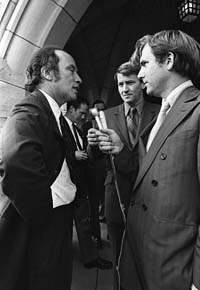
That a Prime Minister would chat
casually with reporters has become
a mind-blowing idea, but it used
to be an everyday event.
Journalists’ access to government offices, employees, and ministers is extremely restricted as well. We’ve long known about the muzzle on state-employed scientists, that they’re unable to publish or publicize any findings that don’t agree with policy messaging decided in Cabinet. 

One problem is that casual media literacy is growing in Western culture. People know when they're hearing a prepared message, and will evaluate it on its own. Little by little, natural human skepticism leads people to seek out critical voices on their own. Even people in prime Conservative support demographics will leak away from the base. Humanity is a race of contrarians.

All support bases fray over time. So communicating to the base and its borderline alone will eventually erode support, as recent polls suggest is happening. Social media’s structures tend to accelerate this erosion because an attempt to engage a critic’s thread only promotes the initial criticism.

Conservative messaging has been so tightly controlled for so long that innovation can only come from the top, the insiders' cabal where it’s difficult to understand why thinking differently would even be sensible. They’ve been targeting the base exclusively for so long that they’re losing the ability to appeal to skeptics and undecided thinkers. 

Communication strategies of tight message control to reach hyper-targeted supporter demographics was a brilliant innovation ten years ago. But the strategy itself enforces the inability to adapt because contrarianism and difference is necessary for creative thinking.

Professional communicators must never lose their contrarian character if they want to avoid becoming a living fossil. I don't yet have enough experience working in the field to know how prevalent such an attitude is, but I’m experienced enough to know how important it is.

A Change Must Come II: Why Is There Government If Not For Us?, Advocate, 08/05/2015

Continued from last post . . . Here is the radical opposition to governments dominated by Stephen Harper or his network of Conservative Party cronies. There will be some kind of social safety net, we’ll try as hard as we can gesture at preserving our country’s ecosystems, ask major industries to give a few percentage points more of their multi-billion dollar revenues to the public infrastructure of your host society, stay out of meddling in horrifying foreign wars, and not give police the power to arrest you on suspicion alone. 

To hear that these inoffensive policies would cause the world’s major petroleum companies to abandon the second-largest oil supplies in the world repeated as serious concern is insane and ridiculous. But this is the world that Fraser Institute policies helped build. The political movement of the new liberal think tank, the legacy of Friedrich Hayek more than anyone else. Philosophy’s greatest victory in the last generation. Ideas changed the world. 

Now that we know their power, it makes sense for new liberalism’s opposition to use the same method. The left has not won thanks to the dominance of Marxists in some culturally marginalized humanities departments in universities. The university is no longer the site where the intellectual has the greatest influence. 

I said yesterday that Chrétien was a
footnote to the rise of Harper. Hell,
maybe the ultimate legacy of Harper
will be so enormous that he'll be as
epochal as John A. MacDonald: a
whole new country rises from what
he did. But it needn't be his own
vision that emerges from his era.
University-based intellectuals are, if anything, completely marginalized by administrations that run public education institutions on the principles of private businesses. When they do work against the new liberal consensus that cutthroat markets are the only proper model for society to operate, they conveniently lose their funding and their jobs. The true intellectual engine of change is the think tank, and that is what progressives need.

Canada has some of these think tanks already, and I think the world needs more of them. The Canadian Centre for Policy Alternatives is the oldest and most well-known of the progressive think tanks, and Canada 2020 is another.* But the one I’ve made personal contact with before is the Broadbent Institute, having spoken to its representatives at the NDP federal leadership convention in 2012.

* Although, like the anti-poverty association Campaign 2000, they face the PR problem of having a clear future date in their name. I’m still disappointed that we still aren’t travelling to Jupiter or colonizing other worlds in our star system, and that hover-vehicles aren’t ubiquitous.

I don’t think I was ever going to be absolutely happy with the Broadbent Institute. It’s too closely linked to a political party to take its politics to a place that can truly overcome the new liberal model of politics. Being concerned with maintaining a single party’s victory in state elections will restrict an institution’s focus to shaping a single party. 

The victory of a single party all the time (or at least often enough to be considered a country’s “natural governing party”) eventually erodes democracy through the corruption of constant control of the state. The Broadbent Institute will always limit itself as long as it is so clearly the philosophical wing of the New Democratic Party.

It will limit its powers to bring about true change. The victory of the Canadian descendants of Hayek wasn’t only in electing Stephen Harper and his followers to government, though they were certainly happy about it. The think tanks and associated thinkers led by the Fraser Institute had their true victory in shifting the entire political conversation of the country to terms more favourable to their philosophy. 

A think tank (or network of them, affiliated through co-members, conference connections, and professional friendships among people allied in the business of political philosophy) will only achieve its greatest goal when all political parties think along their lines. Philosophical victory in politics is when all parties are variations on your principles, variations in the intensity and focus of the same political program.

The Fraser Institute was at the spearhead of this movement in Canada. They laid the groundwork for the new liberal political movement in my country by galvanizing the libertarian-leaning socially conservative population of rural Alberta as a partisan base. But the position papers they released and the connections they made throughout the government and business sector helped spread their ideas all over the mainstream.

This is why, even though the NDP has itself drifted away from its founding vision of true social democracy through good government, its breakthrough in Alberta is significant. In the heartland of Canada’s new liberal political movement, the party whose heart still opposes those politics conquered the old guard.

The 21st century's political revolution in
the West will be Nietzschean: all of us
talking with each other to create new
values. Ecce Homo.
A 21st century left can’t return to the old left politics of a strong state that holds public corporations and services in trust and manages them on behalf of the people. That kind of big-state socialism can’t exist anymore precisely because Friedrich Hayek and the think tanks that followed him were so successful. Socialism is dead, and we should all accept that it’ll never come back. 

Instead, a new left has to emerge from the confrontation with new liberalism. It’s already bubbling out of the protest movements that first flowered in Seattle and have reached their more mature form in Occupy, Internet-mobilized feminism, and #BlackLivesMatter. As I said in my photo caption replies to Steve Fuller this week, the politics of the new left are leaderless movements for liberations that were born through networks of protestors. 

This is how the new left overcomes libertarianism, its fear expressed in Hayek’s conception of left-wing statism as totalitarian in its will to micromanage the economy through institutionalized coercion. People empower themselves to confront corruption and provoke epochal change in social values simply through expressing, as many times as possible, the truth of their experiences of the injustices of oligarchy, gender, and racialization. 

It’s a utopia organized through a global conversation through which we create new values to live by.

A Change Must Come I: True Victory Changes Possibilities, Jamming, 07/05/2015

Knowing the history of governments in Alberta, no one
in Canadian Twitter is actually kidding with those, "We'll
miss them come 2067" jokes.
I was impressed by what happened last night in Alberta. How could I not be? 

As Jeet Heer explained on his Twitter, to any Canadian the Rachel Notley victory in Alberta is absolutely inconceivable. This, I think, is especially true for people younger than about 35. It’s not just that Alberta has a history of changing its party of government very rarely, although VICE did a fine job yesterday of explaining such a history and the political culture it reflects. 

I was ten years old when Canadian politics changed completely from the reasonable model it had been to a venue of growing right-wing radicalism. It was a radicalism whose home was in Alberta. 

I’m referring to the 1993 federal election, which saw the Liberal Jean Chrétien become Prime Minister. That’s not the change I’m talking about, because the Liberal Party in Canada was then still our “natural governing party,” the traditional holders of the Canadian centre, which still held the record of having every party leader serve as PM, at least for a little while. 

The radical change was the destruction of the Progressive Conservative Party. It isn’t that the federal PCs never expressed neoliberal ideas. Brian Mulroney introduced NAFTA, after all. Until 1993, there was still a small-town folksiness to Canadian conservatism. These were the gruff old men that we’d see mentally torturing a protagonist in a Margaret Atwood novel, the patriarchal morality of a blinkered fart without the English sense of irony to at least make him a figure of bearable parody. Like a P. G. Wodehouse villain with Jeeves or Wooster nowhere in sight. 

A Canadian talks to Americans about how fucking weird
Canada can get.
I’m glad to be rid of their political influence. But the social conservatism that emerged from Alberta to destroy them slowly ushered the process by which Canada became a boot-licker of the petroleum industry, a military aggressor in intractable West Asian conflicts whose true ends won’t come for 50 years, where the national police can soon arrest you on suspicion of disliking your government’s policy, and a land whose lakes are now garbage dumps.

Chrétien will be forgotten compared to Stephen Harper, who truly succeeded in his original famous ambition that Canada will be a fundamentally different country than when he began.

Because no matter how much I may be impressed by Rachel Notley as probably Canada’s most successful and brilliant political strategist in the venue of the state, her New Democratic Party is not exactly peddling the radical statist socialism that made Friedrich Hayek quiver with fear and rage at the sight of a union organizer. 

Notley’s leftist principles include spending a greater share of government revenue on funding public health care and education, simplifying and increasing the overall rate of royalties on the production of oil in the province for more revenue for health and education, being more stringent about environmental protections in the oil industry, and liking bitumen pipelines that send oil to refineries in eastern Canada, but not the United States or docks so deep in fjord systems that every third supertanker splits in half trying to dock.

This is the overall result of the change Stephen Harper culminated. The mainstream left shifts so far right that the clearest contrast, the purest principle of opposition to the current order of economic enslavement to the most corrupt energy oligarchs and the mercenary class of finance multi-millionaires is governance by the most minimal basic decency. . . . To Be Continued.