Showing posts with label Donna Haraway. Show all posts

The Defining Idea of Modernity Is That Someone Runs the World, Research Time, 14/03/2014

I wasn’t kidding about Donna Haraway being a fellow traveller in my own philosophical work that I regret I never delved into before now (better late than never, but still should have been earlier). But there’s still one little element of what I consider the obstructively postmodern in her thinking. It has to do with the way we’ve transformed how we conceive of nature in science and philosophy more generally.

She describes that shift as beginning after the Second World War, locating its first element in E. O. Wilson’s theory of sociobiology. But the same trend has developed throughout the biological sciences, into all the major physical sciences, and is now slowly creeping into the social sciences as computer modelling of complex systems have become increasingly prevalent there. I think the only reason this hasn’t caught on fully is because the core concepts are so strange to the way we normally think about the world. Before this era, the era in which the mathematics of chaos and probability have developed and were found to be ubiquitous in natural systems, we thought of the world as directed by minds, intentional, purposive. The prime movers. The gods, goddesses, and directors of activity.

Haraway defines this kind of thinking as the essence of modernity, but I see it as actually much older, really the last harbinger of old-fashioned religious points of view: that the development of reality is directed by a figure with a mind something like ours. That figure may be a god, a God, or gods. The scientifically modern folk at the vanguard of modernity may have stopped believing in Churches, but there remained this stamp of a belief in a personal, anthropomorphic god in their behaviour and thought. Instead of a God, there was now a principle of unity, simple enough that the human mind could understand it analogously with itself. What Haraway calls the postmodern era, and what I call something entirely different, is when the vanguard of new thought understood that reality was far more complex, and that its movements were largely beyond the powers of human thought and mathematics to model without technological assistance.

The closest I’ve ever had to a philosophical epiphany was about this subject, the inadequacy of human standards of thought and beauty to the complexity of the world. I was visiting Edinburgh for a conference, and because I was staying with an old friend, I took a few extra days to explore the city. One of my walks through Edinburgh took me to a public park. It was a pretty large urban park, but its layout unnerved and disgusted me. The whole park was a fenced-in meadow. Gravel paths ran along its north and south edges, and three paths extended from the centre of the south path to the east corner, west corner, and centre of the north path. All the paths were lines by trees on each side, spaced equidistantly. 
I find few things uglier than straight lines where they do not belong.
This felt criminal to me. A park is supposed be a place of relatively tamed nature for people of all ages to play in, so they can develop a positive feeling for the non-urban world through brief, pleasurable exposures on weekend afternoons. A park laid out on a grid? An insult to the chaotic orders of the world. Grids are the natural structures of human cityscapes, human homes. Plants and fungi have their own orders, which an open-minded human should explore. I felt like it was a travesty to line trees up with such an offensively modern, Euclidean (the word feels gross on my hands as I write it) geometry.

The era of scientific thought that kicked off with the development of the chaotic mathematics and the vision of the world as the continual collision of dynamic fields of energy is as alien to this Euclidean subject-centric mind-set as you can get. Haraway calls it technological because the analogues she uses to describe it are all drawn from communication systems, information theory, and the science of immunology. This is a vision of a nature that is neither subjective nor objective. A universe of intensive differences renders all talk of subject and object obsolete. Same with the notion of truth as accuracy in representation.* But I don’t consider this knowledge so inherently technological as she does. There is a technological aspect to this knowledge, because we wouldn’t have been able to carry out the mathematical calculations which describe the actual assembly of the universe without computers. But chaotic geometry and the dynamics of intensive differences is the first time our scientific knowledge has approached adequacy to nature itself. 

* Reading Haraway also reminded me why I left work in philosophy of mind. Far too much of this sub-discipline of philosophy remains caught in models of thought as representation which reify the positions of subject/mind and object/world. I would try to discuss how thinking and perception works by structural coupling and dynamic embodiment, and was usually dismissed. Now, the professor in charge of philosophy of mind at my doctoral university at the time was particularly conservative, but new papers and books throughout philosophy of mind still harp on problems of representation and bridging the subject-object divide. It’s as if they’ve become so obsessed with solving their problems that they can no longer comprehend that they’re working on false problems.

Instead, truth is a matter of adequacy in understanding and adapting to a situation. Representation has nothing to do with it. Our world can’t be divided into subjects and objects; reality is all fields that constitute bodies as they smash, collide, dissipate, engender, and very occasionally even love each other. Such a world is nature, and our thinking is finally starting to understand it.

The Immense Power of Unrestrained Philosophy, Research Time, 13/03/2014

I’ve taken a couple of slow days as I’ve been sluggish from getting a tetanus vaccination the other day. But even though my mind feels a little heavy, I can still think. One thing I’ve been thinking about as I look through my notes on these Donna Haraway essays is my relationship with the naturalistic fallacy, the idea, pretty universally accepted in philosophy, that you can’t derive a moral statement (about what you ought to do) from an ontological statement (about what there is, or how it is). 

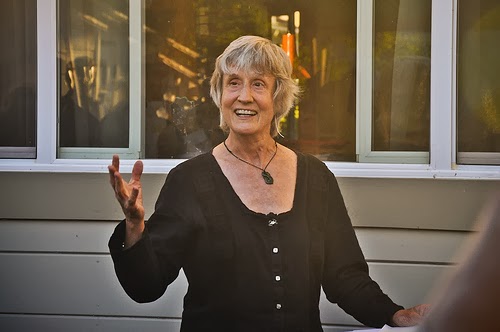
Though Haraway has definitely encouraged people to think
very differently over the years, I'm just not sure how much
potential universities ever had for fostering genuine
change in society.
I see this functioning in terms of the separation of philosophical domains. Ontological, epistemic, moral, and aesthetic problems are rarely treated as if they have anything to do with each other. But I think some of the most remarkable and powerful philosophical ideas come from thought processes that blur and mutate the shapes of those boundaries. Take, for example, the situational feminist epistemology that Haraway develops. 

Writing in the early 1990s, she’s concerned to overcome accusations of relativism of which feminist and other philosophies critical of standard accounts of science have been accused. I feel that so much progress has been made since then.* But she probably explains situational epistemology better than most writers I’ve come across. It’s an epistemological thesis advanced for ethical reasons, with what I see as some wonderfully strange ontological implications. 

* Not that much progress has been made since then. I sometimes feel as if philosophical conservatives continue to make the same old accusations against streams of thought influenced by Haraway, Bruno Latour, Gilles Deleuze, Edward Said, or other critics of the possibility of pure objectivity. No matter how much folks with whom I sympathize may develop nuanced ways to have our criticism and our objectivity too, I’ve come to doubt whether the people we’re trying to convince even bother to read such work. 

Knowledge is perspectival. There can be no knowledge that is literally, in Thomas Nagel’s words, a view from nowhere. Pure objectivity is impartial, but we can compare, contrast, and combine the partial perspectives of people. There is no dichotomous separation of the purely subjective, variable, and unreliable, from the purely objective, consistent, and true. All partial perspectives are themselves objective, and can be understood and mapped.

Leibniz's hair was even bigger than that of the
greatest rock musicians of the 1970s. The 1600s
was a strange time.
Every subjectivity is a partial illumination of an enormous and complex world. Each such illumination is unique because it only has a single, particular position in that complex world. There is usually far more of the world unseen through a single partial perspective than there is seen and understood. Essentially, this is the structure of subjectivity that Gottfried Leibniz spells out in his monadology. The structure of a monad is, in this way of thinking, the same structure as a subjectivity: a partial view on a world that is far more complicated than that single illumination can reveal on its own power alone. 

There are definite differences, of course. Each Leibnizian monad contains the same entire world within it, with its partiality defined by its inability to illuminate the whole of that world and the different location of its illumination within it. So all relations are internal to a monad, where Haraway’s subjectivities all exist in a world and illuminate it externally. And of course there are significant differences in their philosophical priorities. Even just considering their different stations in the world show this. Leibniz was a courtier to German princes, where philosophical and mathematical work was an elite activity, subject to the ostensible supervision of theological authorities. Haraway is a university professor who came of age in a politicized liberal academy that saw higher education democratized to a wide public. But the older metaphysical system can be used as a model for the contemporary epistemic and ethical system. This is not only how we can learn about and illustrate our philosophical ideas, but also how we understand the world where they develop and their power in that world.

The Value of a Fellow Traveller in an Ecological World, Research Time, 12/03/2014

I think my generation has finally adjusted to the fact that we live in the future. The kind of world that previous generations could imagine at best as the product of a categorical shift in technology and society has already come to pass. We live in the world that, only a few decades ago, most people thought would be pure science-fiction: a world like Star Trek, Johnny Quest, Doctor Who, or The Jetsons. Of course, because this is real life, our problems in this new world are just as intractable as many of the old problems were.

This is one of the many messages in Donna Haraway’s Cyborg Manifesto, a text I’ve come to far too late in my life and career. Even so, I don’t know that I’d react to it as I have if I had not already spent years exploring and applying the concepts of Gilles Deleuze’s philosophy. I have no idea how much actual cross-pollination of ideas occurred between these writers. Indeed, the one encounter Deleuze and Félix Guattari had with the feminist theory scene in the United States went disastrously: biographer François Dosse describes Guattari being booed and insulted by an audience of feminist activists during his presentation. 

Donna Haraway, and one friend she can rely on in a
fluctuating world.
Nonetheless, Haraway and Deleuze essentially describe the world operating according to the same principles: flows of capital, material goods, raw manufacturing materials, garbage, and information constitutes fields of affectivity that unite all of us on Earth. National boundaries matter less in terms of delineating the borders of a specific people or culture, and more insofar as they can manage these fields as their fluctuations create variations of intensity that can shock people, communities, and collections of all sizes. Our world is the continual product of dynamic fields interacting to constitute intensive differences. Haraway concentrates on the political context this conception of reality permits, while Deleuze is usually content to rest in ontological terms. 

This vision of the world feels, intuitively, as if it were the expression of a radical transformation of the way the world has been. Haraway refers to the myths we used to be able to believe in. One of these was an agent of oppression: the notion that a state government had the right to control its citizens down even to the biological and cellular levels.* More profoundly, these are the myths in an authority that could supply a foundation for an absolute moral principle, an indisputable claim that one could go no further.

* We still face agents who would control these aspects of our existence. But instead of a monopolistic state mobilizing us for an ideological purpose, there are a series of actors in private industry developing nano/bio/cyborg technology for a variety of ends. Having researched European and American bioengineering projects of the early 20th century as our politics developed from the colonial to the totalitarian model, I think I prefer our current setup.

I call them myths because there hasn’t really been a categorical shift of the kind that is often written about in several popular contexts in political philosophy. Postmodernist thinking refers to this as the end of certainty. Following Nietzsche, this would be the death of God. In environmental philosophy and some pivotal versions of ecofeminism, this is the loss of access to the purity of our natural existence. Where once we had access to truth and its certainty, now we live in a contingent world where everything is in flux. As Haraway writes, “It’s not just that ‘god’ is dead; so is the ‘goddess.’”

But Haraway’s approach shows that such a world was always mythical. The reason we could so widely believe in it was because the world we lived in was stable enough that cultural, economic, and political habits of a community could remain productive across enough generations that our world felt permanent. It only takes a few generations for a state of affairs to feel like it’s been there forever; all you need to achieve this feeling in a community is marginalize everyone who remembers when things were different or wait until they die. The world has always been constituted from global flows of material, capital, and information. 

But those flows moved, for a long time, at a low enough intensity that presumptions about how to live could remain stable across generations. Now, so much moves so fast that we must adapt our ways of life to new global circumstances from decade to decade. Just as we figure out one paradigm of life, the roiling dynamics of our world cause another categorical transition, and our old thoughts are inadequate. 

This notion is at the heart of my Ecophilosophy manuscript. It's one more contribution to the planet-wide discussion of how we can adapt ourselves to a world that is constantly destabilizing itself, where we can't necessarily rest on the wisdom of our elders and must always keep our eyes on the shifts around us, trying to work out which of the many increasingly terse dynamic tensions in our world will explode to create yet another new context of life. 

The Politics of Names and Singularity, Research Time, 07/03/2014

The concept of singularity is central to the broad conceptual argument of my Ecophilosophy project, essentially a corollary of Leibniz’s Law. If two objects share all the same properties (including spacetime location), thereby becoming completely indiscernible, then they’re actually the same object and there’s only ever been one. The reverse would be true, that the uniqueness of any object is constituted by only the smallest difference. The least variation constitutes absolute uniqueness. Of course, we can map the degrees and kinds of variations and divergences, but from an absolute sense, every body is unique, singular.

One of the central challenges in my composing that manuscript was developing its politically relevant articulations. In that context, the principle of singularity implies the importance of preserving natural diversity, the continual creation of new bodies in ecological processes. But Donna Haraway gave me a spin on the concept that works for feminist politics as well in her essay “Reading Buchi Emecheta.”

I owe Haraway thanks again for revealing Emecheta to me,
another African novelist whose work I should read soon.
Emecheta is a Nigerian novelist and academic who has been publishing since the 1970s. Her biography practically defines human strength. Married at 18, she had five children with a husband from whom she had to hide her writing because he opposed her developing the ability to think for herself. After he left her in England with their children in council housing, she went on assistance while raising them alone and attending school, eventually earning a PhD in sociology. She has since become an internationally successful novelist and has lectured in prestigious universities in Britain, the United States, and Nigeria. Her novels often describe in Nigeria and the West who are beaten down by the injustices of sexism and racism that limit opportunity through prejudice. Haraway describes her as having a sharply critical view of how women are treated and controlled in the institution of marriage. After reading this essay, I’d like to get hold of some of Emecheta’s work.

Haraway’s essay discusses two critical views of Emecheta’s work, as well as her own. Chikwenye Okonjo Ogunyemi reads Emecheta in terms of how well the novelist measures up to her own theory of African liberation through the embrace of traditional lifestyles like plural marriage, conceiving of the solidarity of African women in the diaspora as “amicable co-wives with an invisible husband.” She rejects Emecheta as rejecting her African identity by concentrating on the injustices that follow women after the failure of marriages, and so is incompatible with her vision of African liberation. Barbara Christian’s reading fares little better, although she was friendly to Emecheta’s ideas, incorporating the Nigerian into her own project of tracing articulations of motherhood throughout the history of African and African-American women through slavery and the modern era. In both of these interpretations, no matter how hostile or friendly, Emecheta’s work and life is judged on the basis of their own intellectual priorities.

Haraway’s own reading, which she gave in her class, “Methodological Issues in the Study of Women,” discussed and valorized Emecheta’s “heterogeneous statuses as...
“exile, Nigerian, Ibo, Irish-British feminist, black woman, writer canonized in the African Writers Series, popular writer published in cheap paper back books and children’s literature, librarian, mother on welfare, sociologist, single woman, reinventor of African tradition, deconstructor of African tradition, member of the Advisory Council to the British Home Secretary on race and equality, subject of contention among committed multi-racial womanist and feminist theorists, and international figure.”
This list of attributes is a gesture toward the singularity of Emecheta, and indeed of everyone. Human reason operates by forming general sets of standards for evaluation and judging phenomena by their accordance with those standards. But true respect for people (and for any body) requires recognizing the inability of anyone to be completely encapsulated within a general systematic framework of evaluation. Look hard enough, and you will discover aspects of someone who won’t fit your pre-existing framework of comprehension and value. To know someone, you have to understand them not in terms of your own priorities, but simply know them.

“TO HAVE DONE WITH JUDGMENT” 
— Antonin Artaud, Friedrich Nietzsche, Gilles Deleuze

Of course, I’m subject to this kind of judgment, even as I write about how I want to have done with judgment. My own philosophical development of the concept of singularity essentially creates my own framework against which to judge something. I can judge a critic by the degree to which they attempt to understand a figure through exploration of their singularity or subsume them within a more general framework. In this sense, judgment is inescapable. But I’m also aware that we can never truly, in the words of the figures I identify with in the philosophical tradition, have done with judgment. It will always be useful. 

The key, I think, that puts my own approach above that of the people I judge is that I don’t absolutize my framework of judgment. One has to remain away that any general framework of comprehension and value is a pragmatic, contingent matter, a tool that’s used for a purpose. To extend such a framework for judgment beyond its pragmatic purpose is the harmful move, boxing the singularity of Emecheta into a cause that she never chose.

Would You Commit Infanticide for a Genetic Heritage? Research Time, 06/03/2014

Many of Donna Haraway’s most famous essays featured her take on the history of primatology research as a route to explore the underlying ideologies and concepts of social applications of biological science and thought. The earliest generation she described, contemporaries of the Great Depression and the Second World War, understood apes as reflecting a pure nature without the dilution of culture and egalitarian morality: brutally violent conflict among powerful men to dominate and achieve domination.

If you spell out those four layers of theoretical articulation (the primal, the political, the molecular, and the ideological), you have Haraway’s vision of how the sciences and politics interact. Now, I’m still not sure whether the ideological occupies a foundational role here. I’d prefer that it didn’t, because if an ideology determined all other modes of interpretation and thought, it would be impossible to change. That’s a paradox that would actually doom Haraway’s work. I would think that an ideology and its various articulations all exist interdependently, without a thread gaining absolute priority in generation.

The incredibly adorable Indian langur monkey.
Anyway, the essay “The Contest for Primate Nature” describes the shift in how we understand primate societies happening through the generational shift in the people studying them. Seeing this shift is very easy because they’re all students (or the students of students) of seminal sociobiologist Sherwood Washburn. From the first studies of langur monkeys’ society, they were thought to practice infanticide as an articulation of violent male dominance. Packs of langur are regularly stormed by others, when their men overthrow the leading males of the invaded troop and kill their children. This was, of course, interpreted as a matter of preserving one’s own genetic line.*

* It may sound very amateurish to say so, but I’ve always found this explanation in biological and social evolutionary science to be a little dubious. We know what kind of actions can perpetuate a genetic line, but an animal has no knowledge of evolutionary theory. Just because you see an activity in nature, don’t presume that it’s already evolutionarily optimal.

But as the generations of scientists changed, the interpretation of langur behaviour did as well. The first shift saw Phyllis Dolhinow née Jay (a pupil of Washburn) describe langur social conventions with little reference to males at all, concentrating on the roles of females and infants in the troops. The second shift, in the work of Jane Bogess (trained by an elderly Washburn and another middle-aged former pupil of his), tackled the question of infanticide head-on to find that it wasn’t there.

Yes, after the invasion and ouster/killing of the central males in the langur troop, many of the children tended to die. But Bogess could find no actual evidence that they were murdered, despite being in a better position to do so. The first generation of researchers mostly observed the animals from afar to avoid encounters with more dangerous animals, and so as not to interfere with the natural behaviour of the monkeys. By the time Bogess got to work, the observational techniques of primatology enabled her to live with the langur troop themselves. So she was able to see more of the details of their lives.

Now we can see the ideology of domination appearing again. The original studies of the langur monkeys saw invasions as a natural occurrence, and the infanticide of children by the usurpers as the natural result of securing one’s genetic line through violence. But if the infant monkeys weren’t killed to establish the dominance of the usurping males, how did they die?

Another flaw in the old ideology of nature was that it presumed that every trait and behaviour that was found in nonhuman organisms had to be explained in terms of how it was evolutionarily optimal, how it would have helped this species survive and thrive. I still see this far too frequently today. This idea presumes, essentially, that the process of evolution is done, and that everything in the natural world is the product of optimization.

The death of infants in a langur tribe after a hostile takeover happened due to stress from a variety of factors. One example is the squeezing of habitat space for the monkeys after the encroachment of human settlements around their region of India. If the langur population had enough space, then troops wouldn’t invade each other at all. The infant monkeys are casualties of pathological behaviour caused by ecological changes that the langurs have trouble adapting to. A langur troop under constant threat of invasion and with such a high infant mortality rate isn’t behaving according to the paths that developed in their calmer periods. Just because you’re dealing with a natural population doesn’t mean that every behaviour is automatically optimized. If it were, then species would never actually go extinct.

Ultimately, Haraway has traced a story of the purging of an ideology from an evolutionary science. The field no longer presumes that animal societies operate by violence to assure male dominance, or that human industrial processes have no subtle effects on animal behaviour, or that all natural behaviour is always already evolutionarily optimized to the current situation because it has been optimal in the past. Worth at least an extra paragraph or two when I eventually get back to my Ecophilosophy manuscript revisions.

The Fractal Structure of Ideology, Research Time, 05/03/2014

Partially on the enthusiastic recommendation of one of my compatriots, I’m finally filling the Donna Haraway gap in my philosophical knowledge. I think the reason why it’s gone unfilled for so long has been that my education in feminist philosophy has come too late. I first developed as a philosopher at a very friendly, strong, welcoming department. But I didn’t fully process its gender troubles until a few years after I left. It was disheartening at the time, but I’ve accepted it now.

So my education in feminist philosophy, queer theory, and related directions of thought was always rather lacking compared to some. Once I got to my doctorate, I either didn’t have time to read up on the classics of the feminist tradition, or felt as if I wouldn’t be able to overcome my handicap. But first cracking open her Simians, Cyborgs, and Women collection, I came to a corker immediately. I’m still sorting out her theoretical layers. 

"As we learn about primates, so we learn about ourselves."
Wait, that's not how that line is supposed to go.
Let’s start with specifics and see if I can tease out what might be the foundation, if there is one (and I hope not). “A Political Physiology of Dominance” focusses on describing the work of Robert Yerkes and Clarence Ray Carpenter, two of the leading scientists in animal sociology over the 1930s-40s. They released a colony of rhesus monkeys onto a subsidiary island of Puerto Rico to study their behaviour; from this work, we have the stereotype of primates behaving according to systems of male dominance, aggression, and possessiveness of females. They also conceived of these primate studies as providing clues to the natural evolutionary path that humanity took. That is, we used to be what the apes are. (Layer A: Stereotypes of primates)

Haraway’s next step is a delightfully sarcastic description of the social world these researchers were raised in. Coming from rich, well-connected families, Yerkes and Carpenter attended elite institutions which, at the time, were run by traditional cultural conservatives with possessive views toward women and virulently racist views of non-white ethnicities. Their animal sociology work was funded through a Rockefeller-connected think tank, which was also connected with the American government’s semi-eugenical programs to organize its population according to scientific medical principles through the coercion of the state. Carpenter was a genuinely rigorous scientist, but his work was the product of a society based on domination by rich and powerful men. (Layer B: The obviously political)

But the self-conscious intellectual influences on the animal sociology studies were fundamental studies of developmental biochemistry, particularly embryology. The mathematics describing intensive systems such as embryonic development described them in terms of axes of dominance. A particular process (in this case, the currents that stabilize into the shape of a head) among the roiling currents of embryonic fluid comes to influence those currents, and determine the overall shape of the stable entity that emerges from all this chemical activity, the embryo. That process was conceived in terms of its coming to dominate the other currents and movements within the system. One key element of the embryonic studies was that if you removed the proto-head from the semi-completed developmental process, other currents would violently slosh together until a head emerged from their collisions and reunified the embryonic process to develop its proper shape. (Layer C: Intensive dynamics of multi-cellular production)

White patrician American scientists in the 1930s and 1940s
conceived of the natural political arrangements of living
creatures as authoritarian dominance established through
violent conflict and discord. I wonder who they could have
thought best exemplified the most natural human
government during their era?
The major trend of this era wasn’t just theorizing about dominance, but conceiving of domination as the natural state of humanity. The political research of the science of the era concentrated on the authoritarian personality who governs through the imposition of violence on inferiors. If the authoritarian dictator were removed, the society would convulse violently until a leader emerged from the chaos who could impose his will on all the inferiors. (Layer D: Theory of political authoritarianism) 

Haraway’s final move is the kicker, linking these layers seemingly without a foundation. The political theory of dictatorial authoritarianism was conceived as a socio-political articulation of the same process of embryonic development universal to all animal life. This theoretical move made violent authoritarianism the natural political organization for humanity because it was the inherent principle of life itself. Layer C was conceived as the primal process that determined the nature of Layers A, B, and D. 

But the people doing the conception were already embedded in social structures of domination, conditions of their personalities’ development that led them to presume dominance and violence to be universal essences of existence, or at least life. Such a perspective would have no trouble with the intensive dynamic theories of development being adapted to theories of galactic constitution, as in Lee Smolin’s Life of the Cosmos. So I guess Layer B determines the nature of Layers A, C, and D. 

One would think that the ontology is prior to political theory. I usually do, because you can’t have political actors without ontological developments first — there has to be carbon and the organisms made from carbon before there can be politics among social carbon organisms. But how we theorize about the ontological nature of life and the universe depends on habits of thinking that we’re socialized into before we even think to start theorizing. Reading Haraway, one is no longer sure if any attempt to understand how the world is can escape the partiality of our established habits of thought, even for a task so simple as getting an outside perspective.